


Photon-counting CT for simultaneous imaging of multiple contrast agents in the abdomen: An in vivo study
- PMID: 28444761
- PMCID: PMC5699215
- DOI: 10.1002/mp.12301
Photon-counting CT for simultaneous imaging of multiple contrast agents in the abdomen: An in vivo study
Abstract
Purpose: To demonstrate the feasibility of spectral imaging using photon-counting detector (PCD) x-ray computed tomography (CT) for simultaneous material decomposition of three contrast agents in vivo in a large animal model.
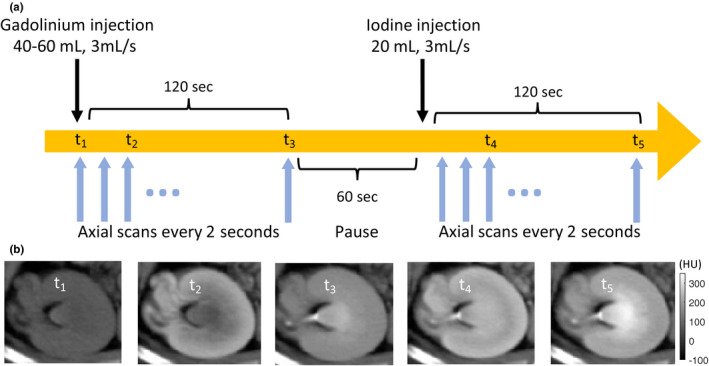
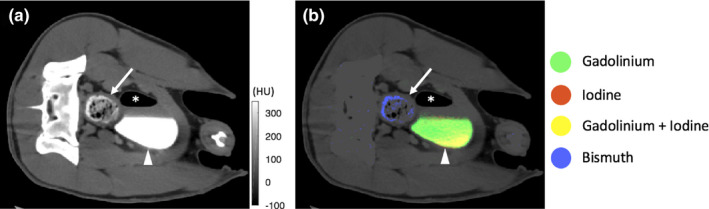
Methods: This Institutional Animal Care and Use Committee-approved study used a canine model. Bismuth subsalicylate was administered orally 24-72 h before imaging. PCD CT was performed during intravenous administration of 40-60 ml gadoterate meglumine; 3.5 min later, iopamidol 370 was injected intravenously. Renal PCD CT images were acquired every 2 s for 5-6 min to capture the wash-in and wash-out kinetics of the contrast agents. Least mean squares linear material decomposition was used to calculate the concentrations of contrast agents in the aorta, renal cortex, renal medulla and renal pelvis.
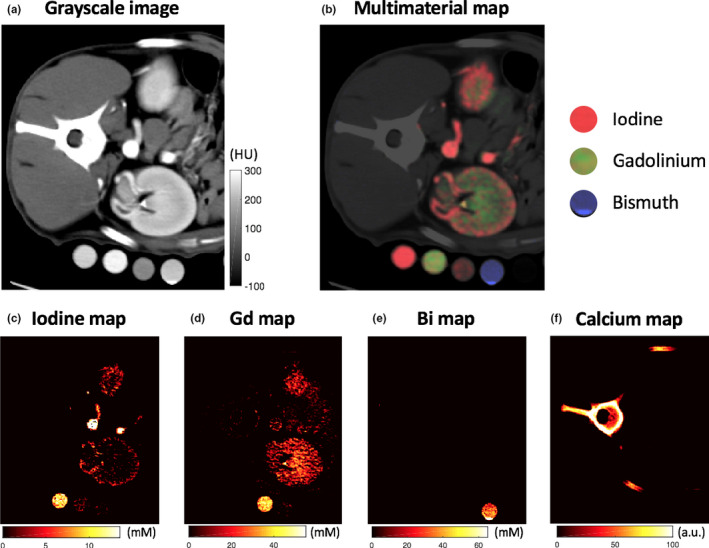
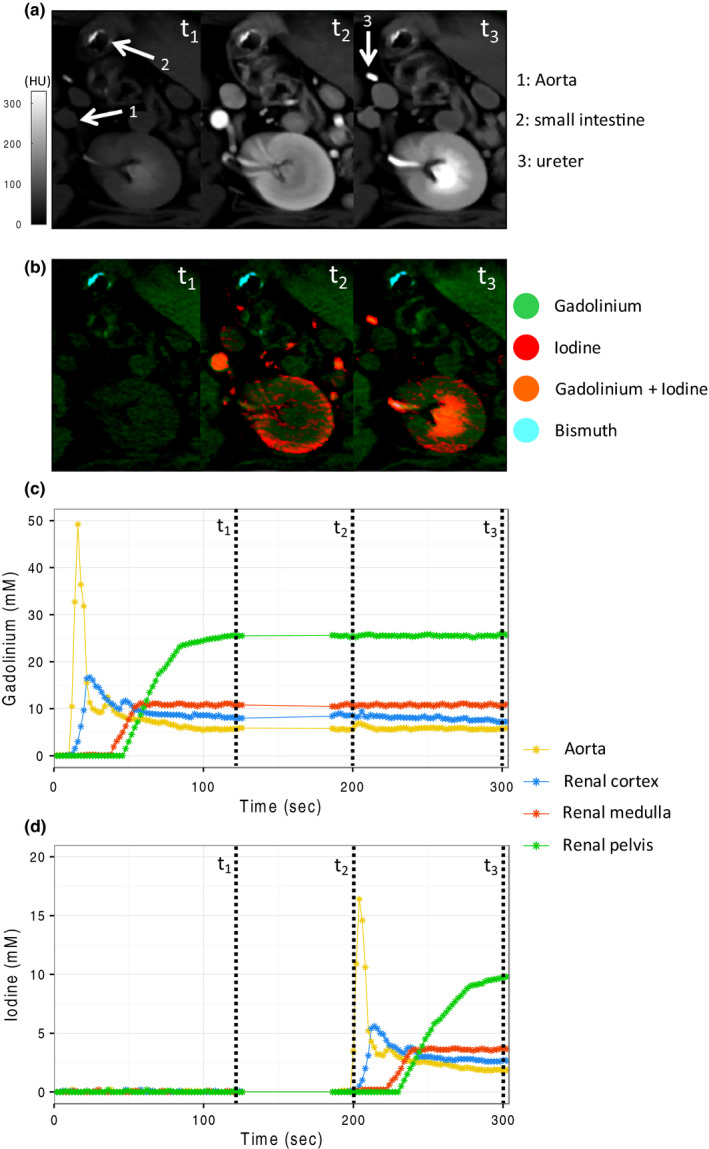
Results: Using reference vials with known concentrations of materials, we computed molar concentrations of the various contrast agents during each phase of CT scanning. Material concentration maps allowed simultaneous quantification of both arterial and delayed renal enhancement in a single CT acquisition. The accuracy of the material decomposition algorithm in a test phantom was -0.4 ± 2.2 mM, 0.3 ± 2.2 mM for iodine and gadolinium solutions, respectively. Peak contrast concentration of gadolinium and iodine in the aorta, renal cortex, and renal medulla were observed 16, 24, and 60 s after the start each injection, respectively.
Conclusion: Photon-counting spectral CT allowed simultaneous material decomposition of multiple contrast agents in vivo. Besides defining contrast agent concentrations, tissue enhancement at multiple phases was observed in a single CT acquisition, potentially obviating the need for multiphase CT scans and thus reducing radiation dose.
Keywords: contrast agents; k-edge imaging; material decomposition; multi-contrast; photon-counting CT; spectral CT.
© 2017 American Association of Physicists in Medicine.
Conflict of interest statement
This study was supported by a research agreement with Siemens Healthcare GmbH (Forchheim, Germany). Authors who are not employees of or consultants for Siemens had control of data inclusion and analysis that might present a conflict of interest for the authors who are employed by Siemens.
Figures
References
-
- Schlomka JP, Roessl E, Dorscheid R, et al. Experimental feasibility of multi‐energy photon‐counting K‐edge imaging in pre‐clinical computed tomography. Phys Med Biol. 2008;53:4031. - PubMed
-
- Kappler S, Henning A, Kreisler B, Schoeck F, Stierstorfer K, Flohr T. Photon counting CT at elevated X‐ray tube currents: contrast stability, image noise and multi‐energy performance; 2014, p. 90331C–90331C–8.
-
- Szolar DH, Kammerhuber F, Altziebler S, et al. Multiphasic helical CT of the kidney: increased conspicuity for detection and characterization of small (< 3‐cm) renal masses. Radiology. 1997;202:211–217. - PubMed
MeSH terms
Substances
Grants and funding
LinkOut - more resources
Full Text Sources
Other Literature Sources
Medical
