Increased risk of brain metastases in women with breast cancer and p16 expression in metastatic lymph-nodes
- PMID: 28445153
- PMCID: PMC5514912
- DOI: 10.18632/oncotarget.16953
Increased risk of brain metastases in women with breast cancer and p16 expression in metastatic lymph-nodes
Abstract
Purpose: Metastatic breast cancer is a leading cause of mortality in women, partly on account of brain metastases. However, the mechanisms by which cancer cells cross the blood-brain barrier remain undeciphered. Most molecular studies predicting metastatic risk have been performed on primary breast cancer samples. Here we studied metastatic lymph-nodes from patients with breast cancers to identify markers associated with the occurrence of brain metastases.
Results: Transcriptomic analyses identified CDKN2A/p16 as a gene potentially associated with brain metastases.
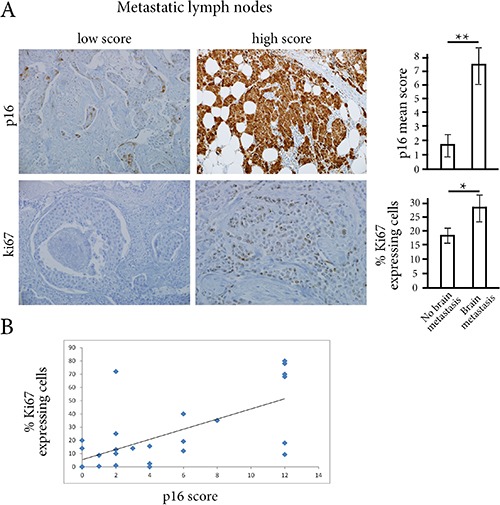
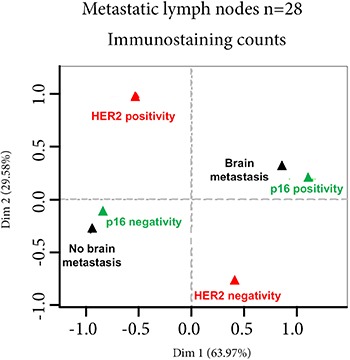
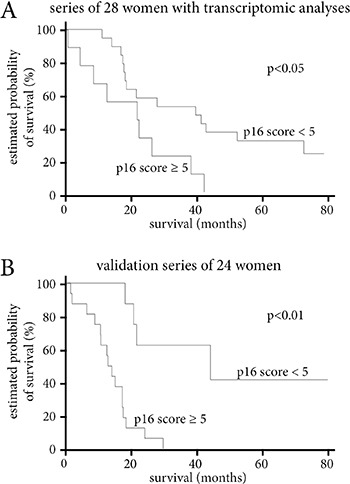
Materials and methods: Fifty-two patients with HER2-overexpressing or triple-negative breast carcinoma with lymph nodes and distant metastases were included in this study. Transcriptomic analyses were performed on laser-microdissected tumor cells from 28 metastatic lymph-nodes. Supervised analyses compared the transcriptomic profiles of women who developed brain metastases and those who did not. As a validation series, we studied metastatic lymph-nodes from 24 other patients.Immunohistochemistry investigations showed that p16 mean scores were significantly higher in patients with brain metastases than in patients without (7.4 vs. 1.7 respectively, p < 0.01). This result was confirmed on the validation series. Multivariate analyses showed that the p16 score was the only variable positively associated with the risk of brain metastases (p = 0.01).With the same threshold of 5 for p16 scores using a Cox model, overall survival was shorter in women with a p16 score over 5 in both series.
Conclusions: The risk of brain metastases in women with HER2-overexpressing or triple-negative breast cancer could be better assessed by studying p16 protein expression on surgically removed axillary lymph-nodes.
Keywords: brain metastases; breast cancer; p16.
Conflict of interest statement
Emilie Le Rhun has Research Fundings with MUNDIPHARMA and AMGEN Companies.
Jacques Bonneterre has honoraria to disclose with PHARMAMAR Company.
The other authors have declared no conflicts of interest.
Figures
References
-
- Lobbezoo DJ, van Kampen RJ, Voogd AC, Dercksen MW, van den Berkmortel F, Smilde TJ, van de Wouw AJ, Peters FP, van Riel JM, Peters NA, de Boer M, Borm GF, Tjan-Heijnen VC. Prognosis of metastatic breast cancer subtypes: the hormone receptor/HER2-positive subtype is associated with the most favorable outcome. Breast Cancer Res Treat. 2013;141:507–514. - PubMed
-
- Bria E, Cuppone F, Fornier M, Nistico C, Carlini P, Milella M, Sperduti I, Terzoli E, Cognetti F, Giannarelli D. Cardiotoxicity and incidence of brain metastases after adjuvant trastuzumab for early breast cancer: the dark side of the moon? A meta-analysis of the randomized trials. Breast Cancer Res Treat. 2008;109:231–239. - PubMed
-
- Leyland-Jones B. Human epidermal growth factor receptor 2-positive breast cancer and central nervous system metastases. J Clin Oncol. 2009;27:5278–5286. - PubMed
-
- Paik S, Shak S, Tang G, Kim C, Baker J, Cronin M, Baehner FL, Walker MG, Watson D, Park T, Hiller W, Fisher ER, Wickerham DL, et al. A multigene assay to predict recurrence of tamoxifen-treated, node-negative breast cancer. N Engl J Med. 2004;351:2817–2826. - PubMed
MeSH terms
Substances
LinkOut - more resources
Full Text Sources
Other Literature Sources
Medical
Research Materials
Miscellaneous