Review
doi: 10.1371/journal.pbio.2001846.
eCollection 2017 Apr.
The credibility crisis in research: Can economics tools help?
Affiliations
- PMID: 28445470
- PMCID: PMC5405914
- DOI: 10.1371/journal.pbio.2001846
Item in Clipboard
Review
The credibility crisis in research: Can economics tools help?
PLoS Biol.
.
Abstract
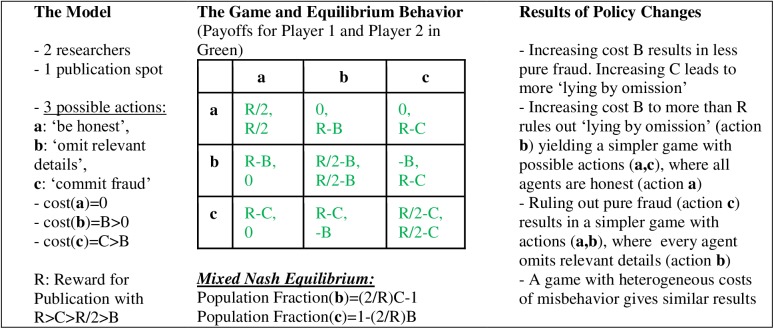
The issue of nonreplicable evidence has attracted considerable attention across biomedical and other sciences. This concern is accompanied by an increasing interest in reforming research incentives and practices. How to optimally perform these reforms is a scientific problem in itself, and economics has several scientific methods that can help evaluate research reforms. Here, we review these methods and show their potential. Prominent among them are mathematical modeling and laboratory experiments that constitute affordable ways to approximate the effects of policies with wide-ranging implications.
Conflict of interest statement
The authors have declared that no competing interests exist.
Figures
References
-
- Ioannidis JP. Why science is not necessarily self-correcting. Perspect Psychol Sci. 2012. November 1;7(6):645–54. doi: 10.1177/1745691612464056 - DOI - PubMed
-
- Open Science Collaboration. Estimating the reproducibility of psychological science. Science. 2015. August 28;349(6251):aac4716 doi: 10.1126/science.aac4716 - DOI - PubMed
-
- Bettis RA. The search for asterisks: Compromised statistical tests and flawed theories. Strategic Management Journal. 2012. January 1;33(1):108–13.
-
- Brodeur A, Lé M, Sangnier M, Zylberberg Y. Star wars: The empirics strike back. Am Econ J Appl Econ. 2016. January 1;8(1):1–32.
-
- Chang AC, Li P. Is economics research replicable? Sixty published papers from thirteen journals say ‘usually not’ Washington: Board of Governors of the Federal Reserve System Finance and Economics Discussion Series; 2015–083. https://papers.ssrn.com/sol3/papers.cfm?abstract_id=2669564. Cited 16 March 2017.
Publication types
MeSH terms
LinkOut - more resources
Full Text Sources
Other Literature Sources