


Web-Based Medical Appointment Systems: A Systematic Review
- PMID: 28446422
- PMCID: PMC5425771
- DOI: 10.2196/jmir.6747
Web-Based Medical Appointment Systems: A Systematic Review
Abstract
Background: Health care is changing with a new emphasis on patient-centeredness. Fundamental to this transformation is the increasing recognition of patients' role in health care delivery and design. Medical appointment scheduling, as the starting point of most non-urgent health care services, is undergoing major developments to support active involvement of patients. By using the Internet as a medium, patients are given more freedom in decision making about their preferences for the appointments and have improved access.
Objective: The purpose of this study was to identify the benefits and barriers to implement Web-based medical scheduling discussed in the literature as well as the unmet needs under the current health care environment.
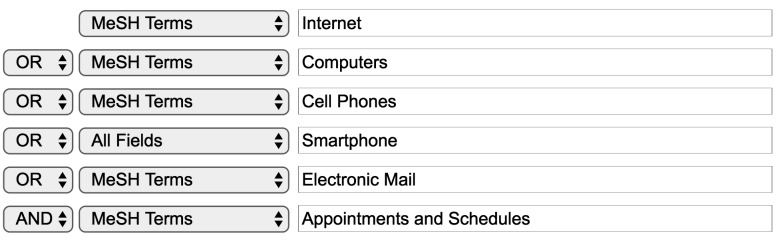
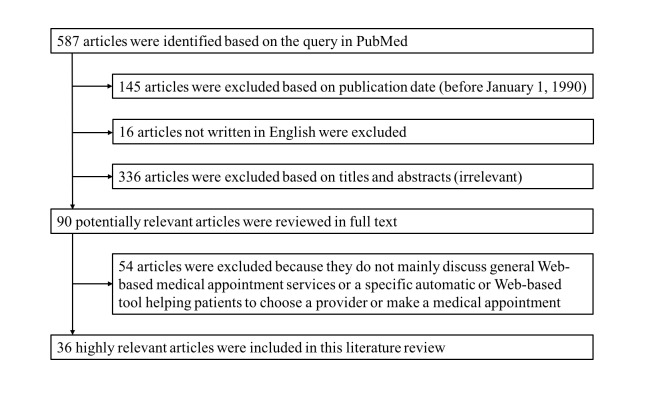
Methods: In February 2017, MEDLINE was searched through PubMed to identify articles relating to the impacts of Web-based appointment scheduling.
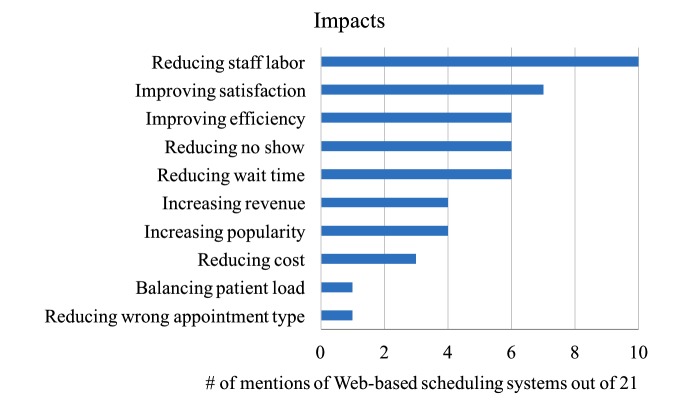
Results: A total of 36 articles discussing 21 Web-based appointment systems were selected for this review. Most of the practices have positive changes in some metrics after adopting Web-based scheduling, such as reduced no-show rate, decreased staff labor, decreased waiting time, and improved satisfaction, and so on. Cost, flexibility, safety, and integrity are major reasons discouraging providers from switching to Web-based scheduling. Patients' reluctance to adopt Web-based appointment scheduling is mainly influenced by their past experiences using computers and the Internet as well as their communication preferences.
Conclusions: Overall, the literature suggests a growing trend for the adoption of Web-based appointment systems. The findings of this review suggest that there are benefits to a variety of patient outcomes from Web-based scheduling interventions with the need for further studies.
Keywords: Internet; appointments and schedules; hospital information systems; no-show patients; patient-centered care; smartphone.
©Peng Zhao, Illhoi Yoo, Jaie Lavoie, Beau James Lavoie, Eduardo Simoes. Originally published in the Journal of Medical Internet Research (http://www.jmir.org), 26.04.2017.
Conflict of interest statement
Conflicts of Interest: None declared.
Figures
References
-
- Zhang X, Yu P, Yan J. Patients' adoption of the e-appointment scheduling service: a case study in primary healthcare. Stud Health Technol Inform. 2014;204:176–181. - PubMed
-
- - Online scheduling applications may improve customer satisfaction, but setup is not always easy. Internet Healthc Strateg. 2004;6(5):1–5. - PubMed
-
- Wang W, Gupta D. Adaptive appointment systems with patient preferences. Manuf Serv Oper Manag. 2011;13(3):373–389. doi: 10.1287/msom.1110.0332. - DOI
-
- Tang PC, Black W, Buchanan J, Young CY, Hooper D, Lane SR, Love B, Mitchell C, Smith N, Turnbull JR. PAMFOnline: integrating EHealth with an electronic medical record system. AMIA Annu Symp Proc; AMIA Annual Symposium; November 8, 2003; Washington, DC. 2003. pp. 644–648. http://europepmc.org/abstract/MED/14728253 - PMC - PubMed
Publication types
MeSH terms
Grants and funding
LinkOut - more resources
Full Text Sources
Other Literature Sources
Miscellaneous
