. 2017 Jul 1;77(13):3666-3671.
doi: 10.1158/0008-5472.CAN-16-3338. Epub 2017 Apr 26.

Landscape of Combination Immunotherapy and Targeted Therapy to Improve Cancer Management

Affiliations

Landscape of Combination Immunotherapy and Targeted Therapy to Improve Cancer Management

Leandro M Colli et al. Cancer Res. .

Abstract

Cancer treatments composed of immune checkpoint inhibitors and oncogene-targeted drugs might improve cancer management, but there has been little investigation of their combined potential as yet. To estimate the fraction of cancer cases that might benefit from such combination therapy, we conducted an exploratory study of cancer genomic datasets to determine the proportion with somatic mutation profiles amenable to either immunotherapy or targeted therapy. We surveyed 13,349 genomic profiles from public databases for cases with specific mutations targeted by current agents or a burden of exome-wide nonsynonymous mutations (NsM) that exceed a proposed threshold for response to checkpoint inhibitors. Overall, 8.9% of cases displayed profiles that could benefit from combination therapy, which corresponded to approximately 11.2% of U.S. annual incident cancer cases. Frequently targetable mutations were in PIK3CA, BRAF, NF1, NRAS, and PTEN We also noted a high burden of NsM in cases with targetable mutations in SMO, DDR2, FGFR1, PTCH1, FGFR2, and MET Our results indicate that a significant proportion of solid tumor patients are eligible for immuno-targeted combination therapy, and they suggest prioritizing specific cancers for trials of certain targeted and checkpoint inhibitor drugs. Cancer Res; 77(13); 3666-71. ©2017 AACR.


Conflict of interest statement

Conflicts of interest: The authors declare that they have no competing interests.

Figures

Figure 1
Figure 1
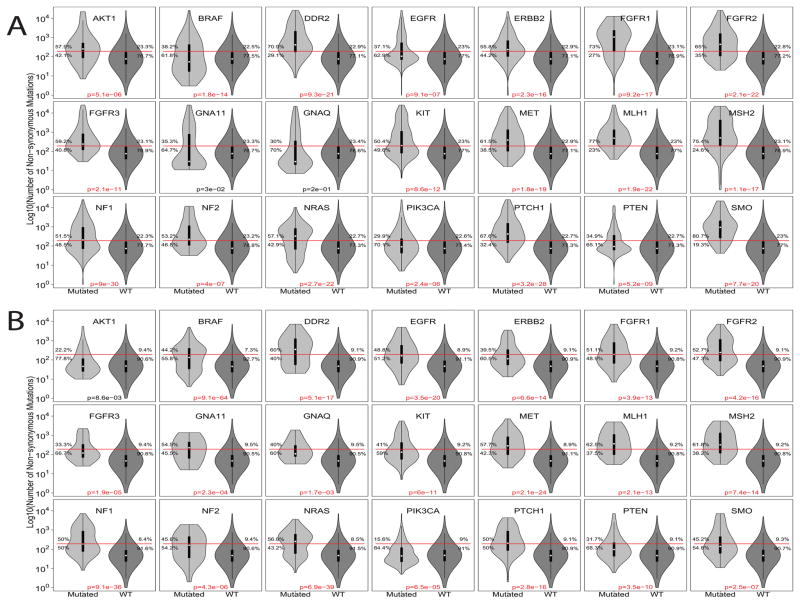
Violin plot for the number of non-synonymous mutations (log10) across 21 target genes combining all tumor types on (A) TCGA as discovery set and (B) ICGC plus TP as replication set. Red line: 192 non-synonymous mutations threshold. P-value refers to fisher’s test comparing proportion of samples regarding gene mutation and 192 NsM threshold.
Figure 2
Figure 2
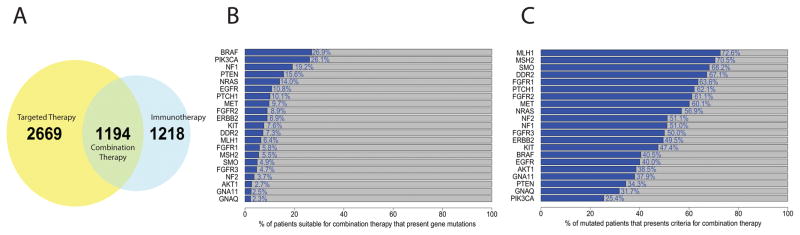
(A) Venn diagram for all 13,349 samples from discovery and replication set combined showing proportion that could respond to targeted, checkpoint inhibitor and combination therapy in our analysis. (B) Stacked plot shows the percent of patients suitable for combination therapy that presents each studied gene mutation in samples. Patients can be in more than one category since patients can have multiple genes mutated. (C) Stacked plot shows, for each studied gene, the proportion of mutated patients that presents criteria for combination therapy. Patients can be in more than one category since patients can have multiple genes mutated.
Figure 3
Figure 3
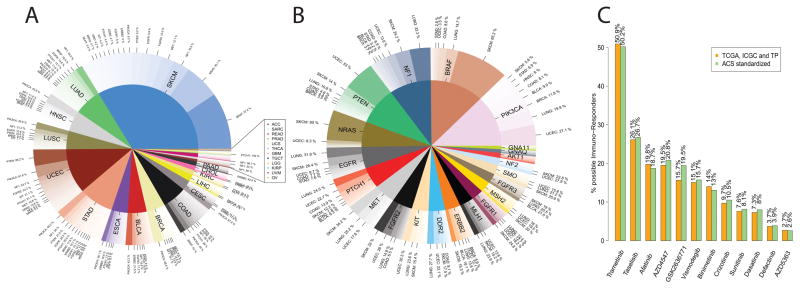
(A) Plot showing the most common mutations in each tumor type for the samples predicted to respond to combination therapy. These genes can be selected for tumor specific clinical trials for combination therapy. (B) Genes and tumor type standardize to 2016 Cancer Statistics. (C) Percent of samples predicted to benefit from combination therapy that could receive each targeted drug based on the mutation profile. Orange, data from combined databases (TCGA, ICGC and TP). Green, data from 2016 Cancer Statistics Standardized analysis.

References

    1. Pardoll DM. The blockade of immune checkpoints in cancer immunotherapy. Nat Rev Cancer. 2012;12:252–64. - PMC - PubMed
    1. Khalil DN, Smith EL, Brentjens RJ, Wolchok JD. The future of cancer treatment: immunomodulation, CARs and combination immunotherapy. Nat Rev Clin Oncol. 2016;13:273–90. - PMC - PubMed
    1. Sharma P, Allison JP. Immune checkpoint targeting in cancer therapy: toward combination strategies with curative potential. Cell. 2015;161:205–14. - PMC - PubMed
    1. Vanneman M, Dranoff G. Combining immunotherapy and targeted therapies in cancer treatment. Nat Rev Cancer. 2012;12:237–51. - PMC - PubMed
    1. Morgan S, Grootendorst P, Lexchin J, Cunningham C, Greyson D. The cost of drug development: a systematic review. Health Policy. 2011;100:4–17. - PubMed

Publication types