Post Hoc Analyses of Randomized Clinical Trial for the Effect of Clopidogrel Added to Aspirin on Kidney Function
- PMID: 28446537
- PMCID: PMC5498342
- DOI: 10.2215/CJN.00100117
Post Hoc Analyses of Randomized Clinical Trial for the Effect of Clopidogrel Added to Aspirin on Kidney Function
Abstract
Background and objectives: Despite the high burden of CKD, few specific therapies are available that can halt disease progression. In animal models, clopidogrel has emerged as a potential therapy to preserve kidney function. The effect of clopidogrel on kidney function in humans has not been established.
Design, setting, participants, & measurements: The Secondary Prevention of Small Subcortical Strokes Study randomized participants with prior lacunar stroke to treatment with aspirin or aspirin plus clopidogrel. We compared annual eGFR decline and incidence of rapid eGFR decline (≥30% from baseline) using generalized estimating equations and interval-censored proportional hazards regression, respectively. We also stratified our analyses by baseline eGFR, systolic BP target, and time after randomization.
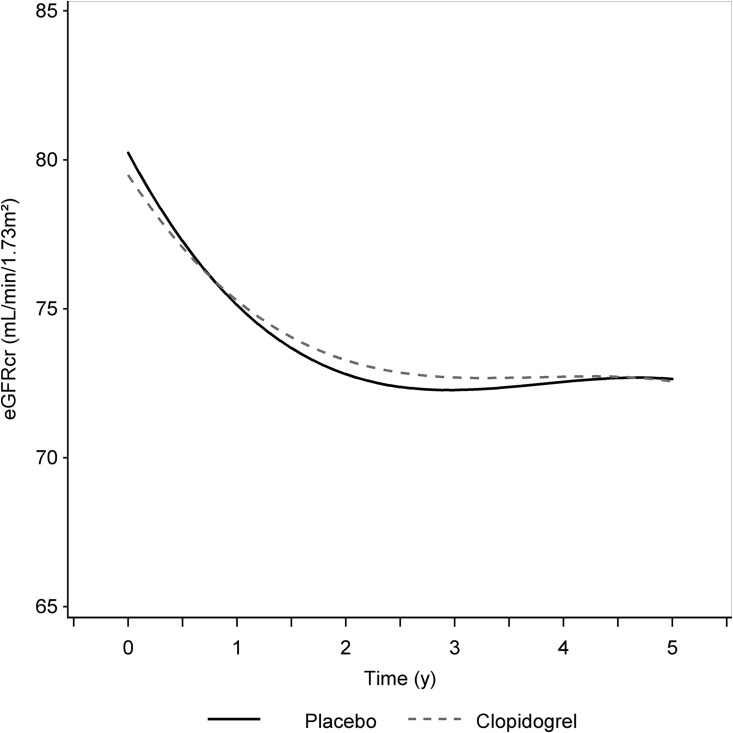
Results: At randomization, median age was 62 (interquartile range, 55-71) years old; 36% had a history of diabetes, 90% had hypertension, and the median eGFR was 81 (interquartile range, 65-94) ml/min per 1 m2. Persons receiving aspirin plus clopidogrel had an average annual change in kidney function of -1.39 (95% confidence interval, -1.15 to -1.62) ml/min per 1.73 m2 per year compared with -1.52 (95% confidence interval, -1.30 to -1.74) ml/min per 1.73 m2 per year among persons receiving aspirin only (P=0.42). Rapid kidney function decline occurred in 21% of participants receiving clopidogrel plus aspirin compared with 22% of participants receiving aspirin plus placebo (hazard ratio, 0.94; 95% confidence interval, 0.79 to 1.10; P=0.42). Findings did not vary by baseline eGFR, time after randomization, or systolic BP target (all P values for interaction were >0.3).
Conclusions: We found no effect of clopidogrel added to aspirin compared with aspirin alone on kidney function decline among persons with prior lacunar stroke.
Keywords: Animals; Aspirin; Confidence Intervals; Disease Progression; Humans; Incidence; Models, Animal; Random Allocation; Renal Insufficiency, Chronic; Secondary Prevention; Stroke; Stroke, Lacunar; Ticlopidine; antiplatelet; blood pressure; clopidogrel; creatinine; decline; diabetes mellitus; eGFR; glomerular filtration rate; hypertension.
Copyright © 2017 by the American Society of Nephrology.
Figures
References
-
- Centers for Disease Control and Prevention (CDC) : National Chronic Kidney Disease Fact Sheet: General Information and National Estimates on Chronic Kidney Disease in the United States, 2014. Available at https://www.cdc.gov/diabetes/pubs/pdf/kidney_factsheet.pdf. Accessed October 3, 2016
-
- Jha V, Garcia-Garcia G, Iseki K, Li Z, Naicker S, Plattner B, Saran R, Wang AY, Yang CW: Chronic kidney disease: Global dimension and perspectives. Lancet 382: 260–272, 2013 - PubMed
-
- Schrör K: Clinical pharmacology of the adenosine diphosphate (ADP) receptor antagonist, clopidogrel. Vasc Med 3: 247–251, 1998 - PubMed
-
- Högberg C, Svensson H, Gustafsson R, Eyjolfsson A, Erlinge D: The reversible oral P2Y12 antagonist AZD6140 inhibits ADP-induced contractions in murine and human vasculature. Int J Cardiol 142: 187–192, 2010 - PubMed
-
- Wihlborg AK, Wang L, Braun OO, Eyjolfsson A, Gustafsson R, Gudbjartsson T, Erlinge D: ADP receptor P2Y12 is expressed in vascular smooth muscle cells and stimulates contraction in human blood vessels. Arterioscler Thromb Vasc Biol 24: 1810–1815, 2004 - PubMed
Publication types
MeSH terms
Substances
Grants and funding
LinkOut - more resources
Full Text Sources
Other Literature Sources
Medical
Research Materials
Miscellaneous