Prevalence and Outcomes of Achromobacter Species Infections in Adults with Cystic Fibrosis: a North American Cohort Study
- PMID: 28446570
- PMCID: PMC5483909
- DOI: 10.1128/JCM.02556-16
Prevalence and Outcomes of Achromobacter Species Infections in Adults with Cystic Fibrosis: a North American Cohort Study
Abstract
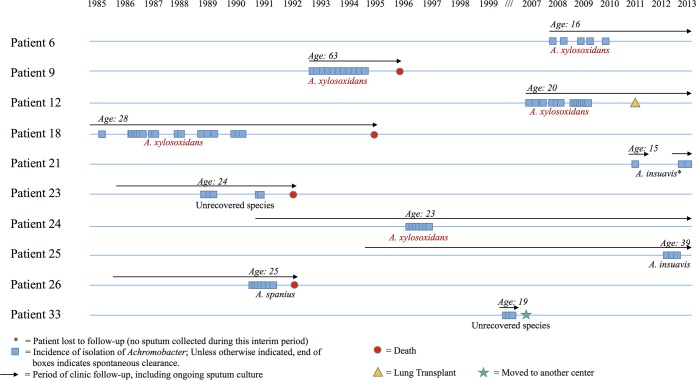
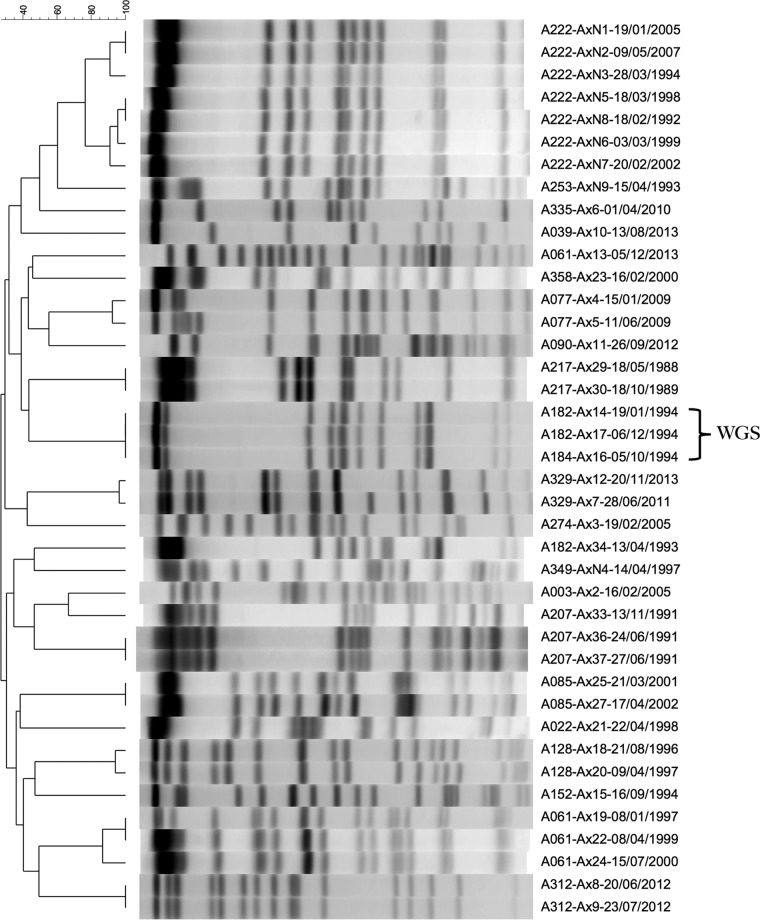
Achromobacter species are increasingly being detected in cystic fibrosis (CF) patients, with an unclear epidemiology and impact. We studied a cohort of patients attending a Canadian adult CF clinic who had positive sputum cultures for Achromobacter species in the period from 1984 to 2013. Infection was categorized as transient or persistent (≥50% positive cultures for 1 year). Those with persistent infection were matched 2:1 with age-, sex-, and time-matched controls without a history of Achromobacter infection, and mixed-effects models were used to assess pulmonary exacerbation (PEx) frequency and lung function decline. Isolates from a biobank were retrospectively assessed, identified to the species level by nrdA sequencing, and genotyped using pulsed-field gel electrophoresis (PFGE). Thirty-four patients (11% of those in our clinic), with a median age of 24 years (interquartile range [IQR], 20.3 to 29.8 years), developed Achromobacter infection. Ten patients (29%) developed persistent infection. Persistence did not denote permanence, as most patients ultimately cleared infection, often after years. Patients were more likely to experience PEx at incident isolation than at prior or subsequent visits (odds ratio [OR], 2.7 [95% confidence interval {CI}, 1.2 to 6.7]; P = 0.03). Following persistent infection, there was no difference in annual lung function decline (-1.08% [95% CI, -2.73 to 0.57%] versus -2.74% [95% CI, -4.02 to 1.46%]; P = 0.12) or the odds of PEx (OR, 1.21 [95% CI, 0.45 to 3.28]; P = 0.70). Differential virulence among Achromobacter species was not observed, and no cases of transmission occurred. We demonstrated that incident Achromobacter infection was associated with a greater risk of PEx; however, neither transient nor chronic infection was associated with a worsened long-term prognosis. Large, multicenter studies are needed to clarify the clinical impact, natural history, and transmissibility of Achromobacter.
Keywords: Achromobacter xylosoxidans; emerging infections; epidemiology; eradication; infection control; infection transmission; inhaled corticosteroids; multilocus sequence typing; pulsed-field gel electrophoresis; whole-genome sequencing.
Copyright © 2017 American Society for Microbiology.
Figures
References
-
- Vandamme P, Moore ERB, Cnockaert M, De Brandt E, Svensson-Stadler L, Houf K, Spilker T, LiPuma JJ. 2013. Achromobacter animicus sp. nov., Achromobacter mucicolens sp. nov., Achromobacter pulmonis sp. nov. and Achromobacter spiritinus sp. nov., from human clinical samples. Syst Appl Microbiol 36:1–10. doi: 10.1016/j.syapm.2012.10.003. - DOI - PubMed
-
- Amoureux L, Bador J, Zouak FB, Chapuis A, de Curraize C, Neuwirth C. 2016. Distribution of the species of Achromobacter in a French cystic fibrosis centre and multilocus sequence typing analysis reveal the predominance of A. xylosoxidans and clonal relationships between some clinical and environmental isolates. J Cyst Fibros 15:486–494. doi: 10.1016/j.jcf.2015.12.009. - DOI - PubMed
Publication types
MeSH terms
LinkOut - more resources
Full Text Sources
Other Literature Sources
Medical
Molecular Biology Databases