. 2017 Jul;55(7):2086-2097.
doi: 10.1128/JCM.00080-17. Epub 2017 Apr 26.

Core Genome Multilocus Sequence Typing Scheme for Stable, Comparative Analyses of Campylobacter jejuni and C. coli Human Disease Isolates

Affiliations

Core Genome Multilocus Sequence Typing Scheme for Stable, Comparative Analyses of Campylobacter jejuni and C. coli Human Disease Isolates

Alison J Cody et al. J Clin Microbiol. 2017 Jul.

Abstract

Human campylobacteriosis, caused by Campylobacter jejuni and C. coli, remains a leading cause of bacterial gastroenteritis in many countries, but the epidemiology of campylobacteriosis outbreaks remains poorly defined, largely due to limitations in the resolution and comparability of isolate characterization methods. Whole-genome sequencing (WGS) data enable the improvement of sequence-based typing approaches, such as multilocus sequence typing (MLST), by substantially increasing the number of loci examined. A core genome MLST (cgMLST) scheme defines a comprehensive set of those loci present in most members of a bacterial group, balancing very high resolution with comparability across the diversity of the group. Here we propose a set of 1,343 loci as a human campylobacteriosis cgMLST scheme (v1.0), the allelic profiles of which can be assigned to core genome sequence types. The 1,343 loci chosen were a subset of the 1,643 loci identified in the reannotation of the genome sequence of C. jejuni isolate NCTC 11168, chosen as being present in >95% of draft genomes of 2,472 representative United Kingdom campylobacteriosis isolates, comprising 2,207 (89.3%) C. jejuni isolates and 265 (10.7%) C. coli isolates. Validation of the cgMLST scheme was undertaken with 1,478 further high-quality draft genomes, containing 150 or fewer contiguous sequences, from disease isolate collections: 99.5% of these isolates contained ≥95% of the 1,343 cgMLST loci. In addition to the rapid and effective high-resolution analysis of large numbers of diverse isolates, the cgMLST scheme enabled the efficient identification of very closely related isolates from a well-defined single-source campylobacteriosis outbreak.

Keywords: Campylobacter; core genome; molecular epidemiology; whole-genome sequencing.


Figures

FIG 1
FIG 1
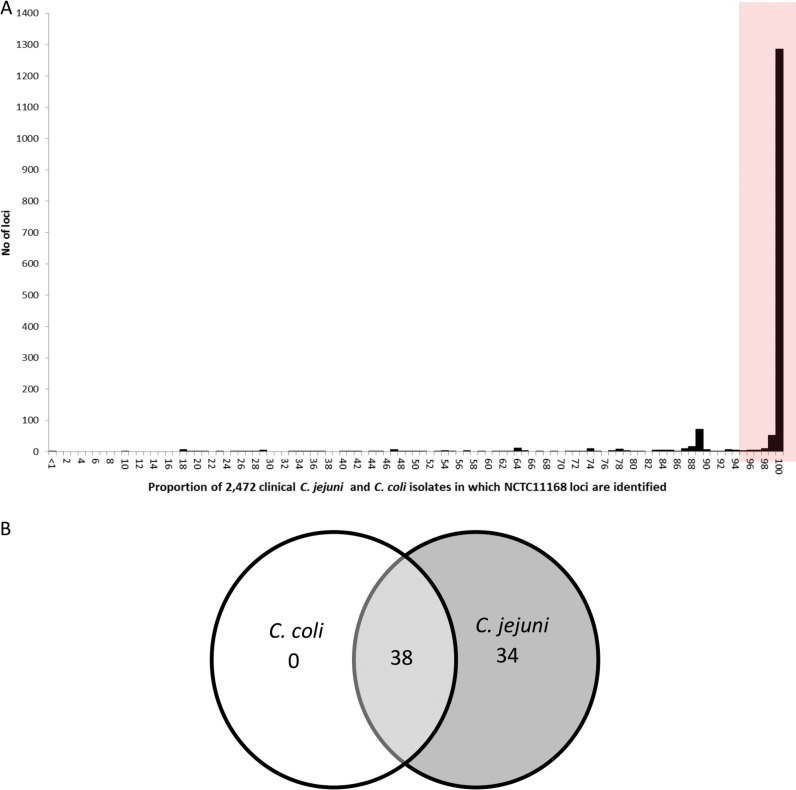
(A) Numbers of 1,643 loci defined in the reannotation of reference genome NCTC 11168, identified in 2,472 clinical C. jejuni (2,207) and C. coli (265) isolates, from Oxfordshire, UK. The area under the shaded box includes 1,365 loci identified in 95% or more of the isolates from both species. (B) Reanalysis of the 72 loci identified under the peak at 89% in panel A, indicating the number of loci identified in genomes from C. coli only or C. jejuni only or that are present in both species.
FIG 2
FIG 2
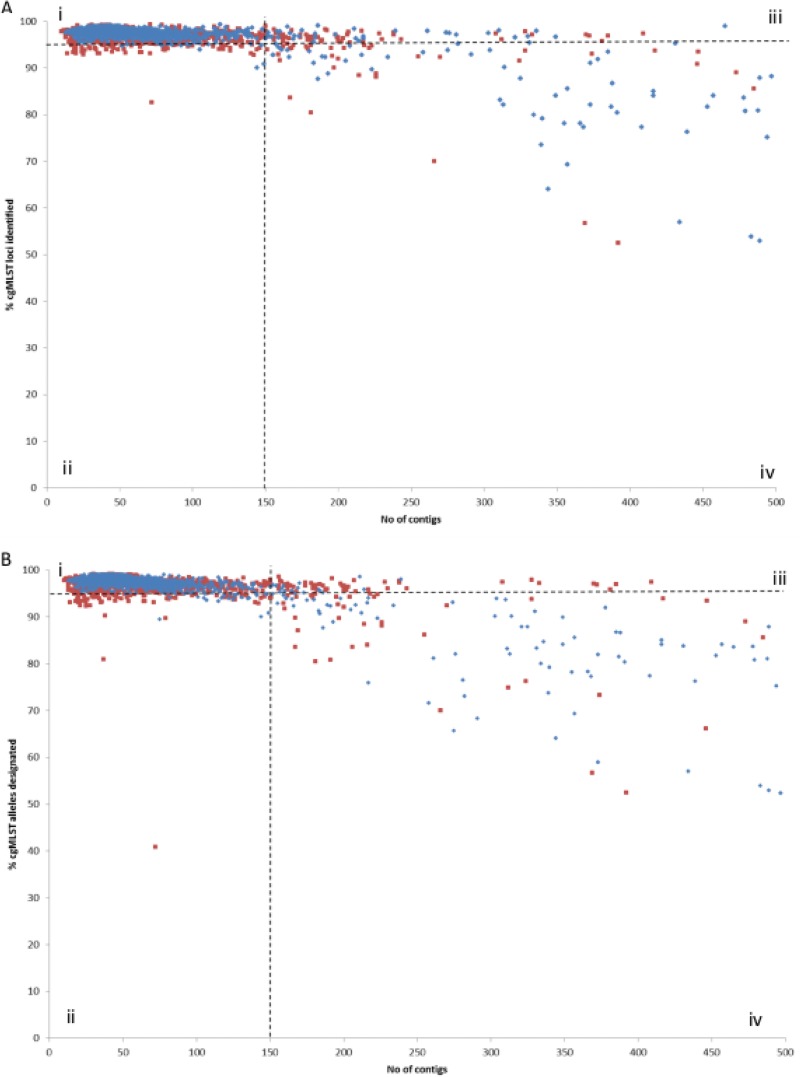
Validation of the cgMLST scheme by assessment of the proportion of clinical (blue) and nonclinical (red) isolates in which the core loci and defined allele sequences could be identified. (A) Percentage of 1,343 cgMLST loci identified; (B) proportion of these loci from panel A with an allele designated in 2,945 C. jejuni and C. coli isolates. Broken lines indicate the cutoff values for isolates in which 95% of loci were identified or alleles designated and the numbers of contigs from which these data could be reliably informed. Quadrants thus defined are labeled as i, ii, iii, and iv, respectively, with details of these for each isolate detailed in Table S5.
FIG 3
FIG 3
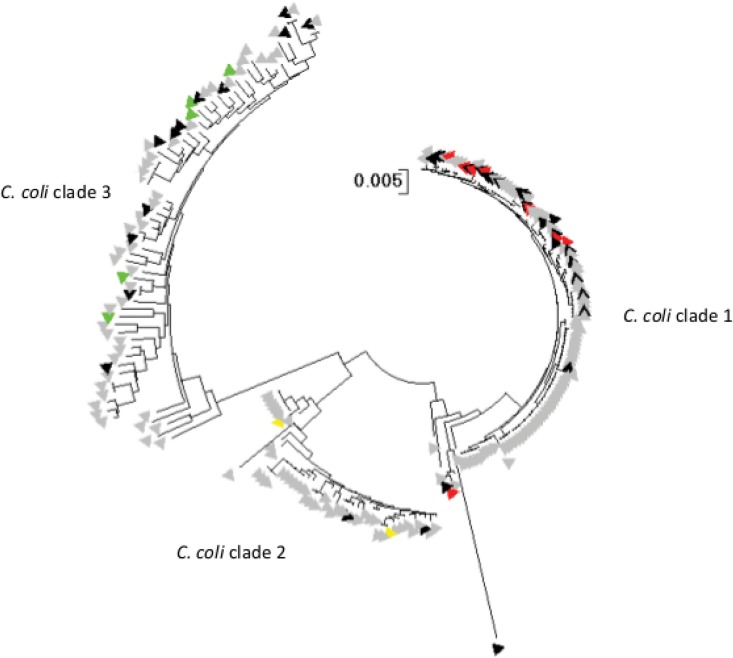
Identification of C. coli genomes unassigned to a clonal complex from clinical (n = 42) (black triangles) and nonclinical (n = 175) (gray triangles) isolates belonging to clades 1, 2, and 3. Concatenated sequences from seven-locus MLST alleles of isolates used to validate the human disease cgMLST scheme v1.0 were used to construct a neighbor-joining tree, which included reference isolates of known C. coli clades that are colored as follows: red, C. coli clade 1; yellow, C. coli clade 2; green, C. coli clade 3. Reference isolates are detailed in Table S2. The scale bar represents the p-distance between aligned sequences.
FIG 4
FIG 4
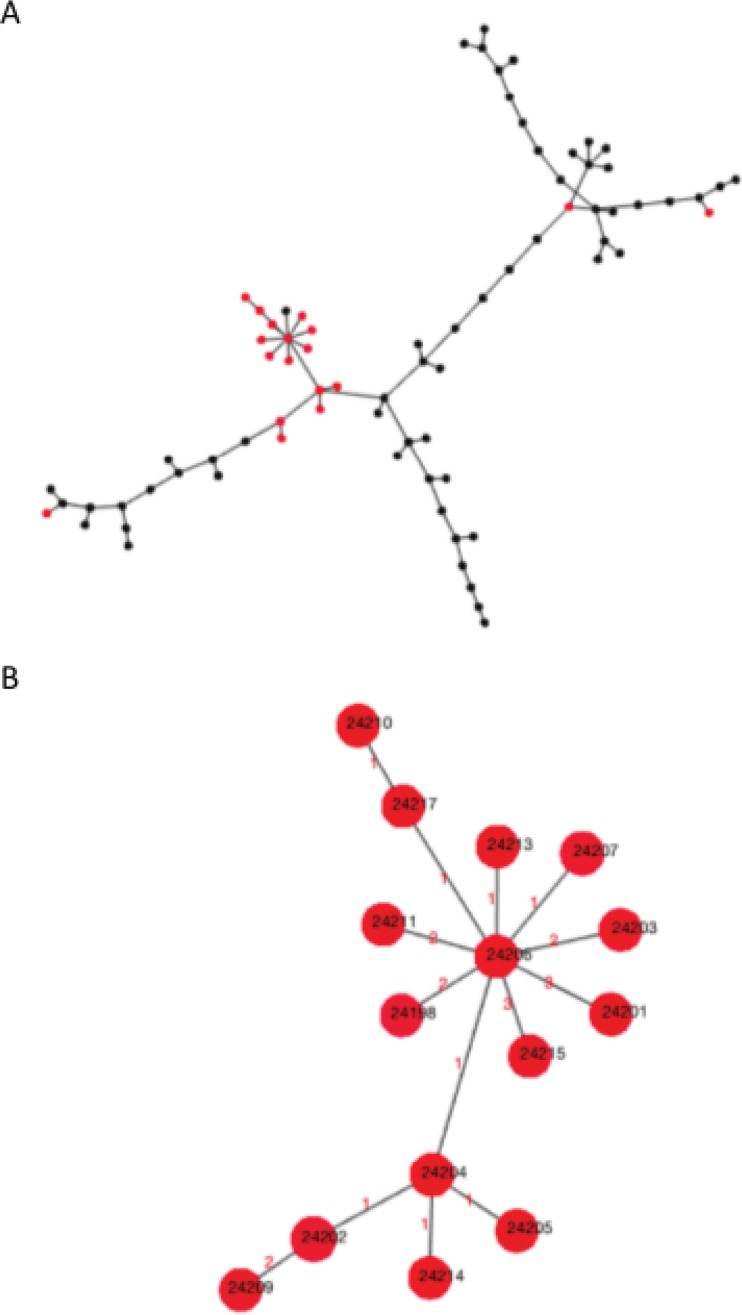
(A) Single-linkage cluster analysis of cgMLST allelic profiles visualized as a minimum spanning tree in PHYLOViZ, from 23 potential outbreak isolates (red) and 59 contemporaneous surveillance isolates from Oxfordshire, UK (black). (B) Twenty clustered outbreak isolates represented by 15 cgMLST profiles, as represented by a single isolate identifier, indicated in black type. The numbers of allelic differences between cgMLST profiles are indicated in red. Link lengths are not proportional to the number of allelic differences.
FIG 5
FIG 5
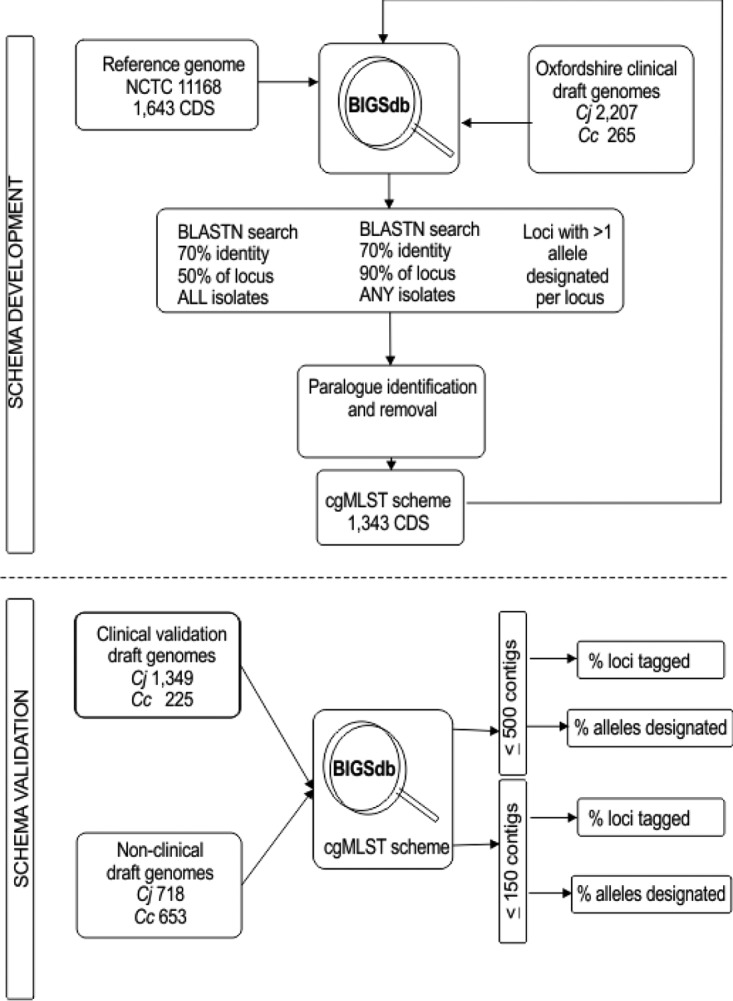
Diagrammatic representation of the basic methodology used for (i) identification of cgMLST genes from Oxfordshire clinical draft genomes and paralogous loci, for the development of the cgMLST scheme (top), and (ii) validation of the scheme using clinical and nonclinical draft genomes available in pubmlst.org/campylobacter (bottom).

References

    1. Kaakoush NO, Castano-Rodriguez N, Mitchell HM, Man SM. 2015. Global epidemiology of Campylobacter infection. Clin Microbiol Rev 28:687–720. doi:10.1128/CMR.00006-15. - DOI - PMC - PubMed
    1. Cody AJ, McCarthy NM, Wimalarathna HL, Colles FM, Clark L, Bowler IC, Maiden MC, Dingle KE. 2012. A longitudinal six-year study of the molecular epidemiology of clinical Campylobacter isolates in Oxfordshire, United Kingdom. J Clin Microbiol 50:3193–3201. doi:10.1128/JCM.01086-12. - DOI - PMC - PubMed
    1. Humphrey S, Chaloner G, Kemmett K, Davidson N, Williams N, Kipar A, Humphrey T, Wigley P. 2014. Campylobacter jejuni is not merely a commensal in commercial broiler chickens and affects bird welfare. mBio 5:e01364-14. doi:10.1128/mBio.01364-14. - DOI - PMC - PubMed
    1. Sheppard SK, Didelot X, Jolley KA, Darling AE, Pascoe B, Meric G, Kelly DJ, Cody A, Colles FM, Strachan NJ, Ogden ID, Forbes K, French NP, Carter P, Miller WG, McCarthy ND, Owen R, Litrup E, Egholm M, Affourtit JP, Bentley SD, Parkhill J, Maiden MC, Falush D. 2013. Progressive genome-wide introgression in agricultural Campylobacter coli. Mol Ecol 22:1051–1064. doi:10.1111/mec.12162. - DOI - PMC - PubMed
    1. Dingle KE, Colles FM, Wareing DRA, Ure R, Fox AJ, Bolton FJ, Bootsma HJ, Willems RJL, Urwin R, Maiden MCJ. 2001. Multilocus sequence typing system for Campylobacter jejuni. J Clin Microbiol 39:14–23. doi:10.1128/JCM.39.1.14-23.2001. - DOI - PMC - PubMed

Publication types

MeSH terms

LinkOut - more resources