


Evaluation of StrepB Select Chromogenic Medium and the Fast-Track Diagnostics Group B Streptococcus (GBS) Real-Time PCR Assay Compared to Routine Culture for Detection of GBS during Antepartum Screening
- PMID: 28446575
- PMCID: PMC5483915
- DOI: 10.1128/JCM.00043-17
Evaluation of StrepB Select Chromogenic Medium and the Fast-Track Diagnostics Group B Streptococcus (GBS) Real-Time PCR Assay Compared to Routine Culture for Detection of GBS during Antepartum Screening
Abstract
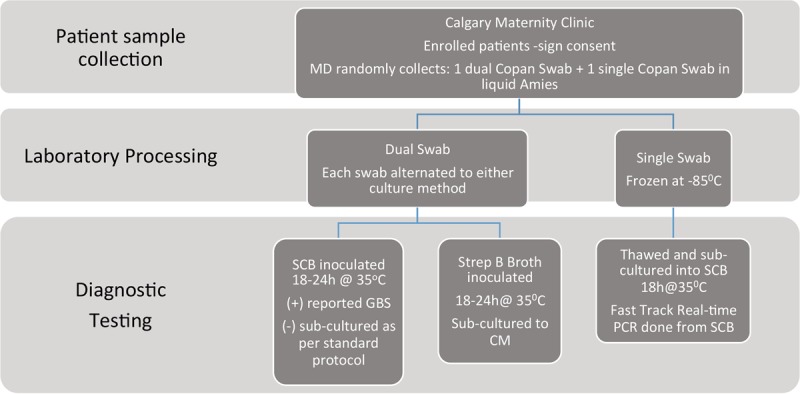
Life-threatening infection in neonates due to group B Streptococcus (GBS) is preventable by screening of near-term pregnant women and treatment at delivery. A total of 295 vaginal-rectal swabs were collected from women attending antepartum clinics in Calgary, Alberta, Canada. GBS colonization was detected by the standard culture method (Strep B Carrot Broth subcultured to blood agar with a neomycin disk) and compared to recovery with Strep Group B Broth (Dalynn Biologicals) subcultured to StrepBSelect chromogenic medium (CM; Bio-Rad Laboratories) and the Fast-Track Diagnostics GBS real-time PCR (quantitative PCR [qPCR]) assay (Phoenix Airmid Biomedical Corp.) performed with broth-enriched samples and the Abbott m2000sp/m2000rt system. A total of 62/295 (21%) women were colonized with GBS; 58 (19.7%) cases were detected by standard culture, while CM and qPCR each found 61 (20.7%) cases. The qPCR and CM were similar in performance, with sensitivities, specificities, and positive and negative predictive values of 98.4 and 98.4%, 99.6 and 99.6%, 98.4 and 98.4%, and 99.6 and 99.6%, respectively, compared to routine culture. Both qPCR and CM would allow more rapid reporting of routine GBS screening results than standard culture. Although the cost per test was similar for standard culture and CM, the routine use of qPCR would cost approximately four times as much as culture-based detection. Laboratories worldwide should consider implementing one of the newer methods for primary GBS testing, depending on the cost limitations of different health care jurisdictions.
Keywords: chromogenic medium; detection; group B streptococcus; real-time PCR; screening.
Copyright © 2017 American Society for Microbiology.
References
-
- Stoll BJ, Hansen NI, Sanchez PJ, Faix RG, Poindexter BB, Van Meurs KP, Bizzarro MJ, Goldberg RN, Frantz ID III, Hale EC, Shankaran S, Kennedy K, Carlo WA, Watterberg KL, Bell EF, Walsh MC, Schibler K, Laptook AR, Shane AL, Schrag SJ, Das A, Higgins RD, Eunice Kennedy Shriver National Institute of Child H, Human Development Neonatal Research N. 2011. Early onset neonatal sepsis: the burden of group B streptococcal and E. coli disease continues. Pediatrics 127:817–826. doi: 10.1542/peds.2010-2217. - DOI - PMC - PubMed
-
- Weston EJ, Pondo T, Lewis MM, Martell-Cleary P, Morin C, Jewell B, Daily P, Apostol M, Petit S, Farley M, Lynfield R, Reingold A, Hansen NI, Stoll BJ, Shane AL, Zell E, Schrag SJ. 2011. The burden of invasive early-onset neonatal sepsis in the United States, 2005–2008. Pediatr Infect Dis J 30:937–941. doi: 10.1097/INF.0b013e318223bad2. - DOI - PMC - PubMed
-
- Davis RL, Hasselquist MB, Cardenas V, Zerr DM, Kramer J, Zavitkovsky A, Schuchat A. 2001. Introduction of the new Centers for Disease Control and Prevention group B streptococcal prevention guideline at a large west coast health maintenance organization. Am J Obstet Gynecol 184:603–610. doi: 10.1067/mob.2001.110308. - DOI - PubMed
Publication types
MeSH terms
Substances
LinkOut - more resources
Full Text Sources
Other Literature Sources
Medical
