


Collateral Damage during Dengue Virus Infection: Making Sense of DNA by cGAS
- PMID: 28446670
- PMCID: PMC5487551
- DOI: 10.1128/JVI.01081-16
Collateral Damage during Dengue Virus Infection: Making Sense of DNA by cGAS
Abstract
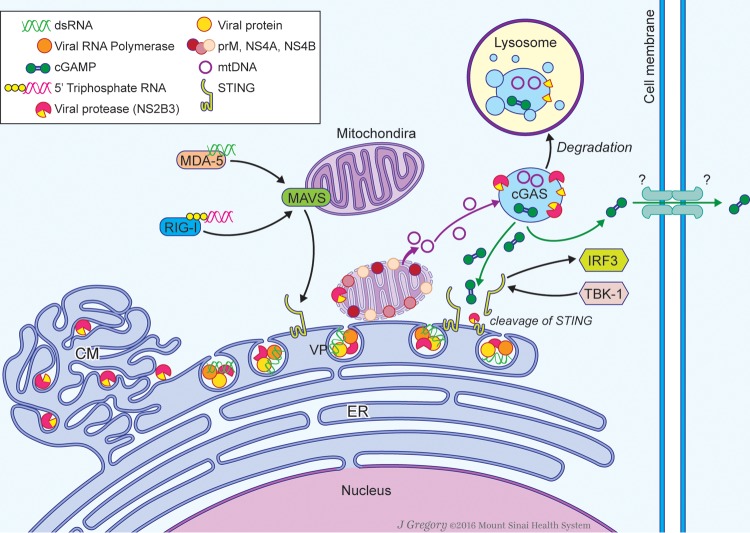
Early sensing of viral components or infection-induced tissue damage is a prerequisite for the successful control of pathogenic viruses by the host innate immune system. Recent results from our laboratory show how immune cells use the DNA-sensing machinery to detect intracellular damage generated early during infection by an RNA virus, namely, dengue virus (DENV). Conversely, we found that DENV can efficiently dismantle this sensing mechanism by targeting the cyclic GMP-AMP synthase (cGAS) and the stimulator of interferon (IFN) genes (STING), two crucial host factors involved in DNA detection and type I IFN production. These findings highlight the relevance of the DNA-sensing mechanism in the detection and control of infections by RNA viruses. In this review, we discuss how DENV modulates the innate immune DNA-sensing pathway, activated in the context of cellular damage during infection.
Keywords: DNA sensing; STING; cGAS; damage; dengue virus; innate immunity; interferon; mitochondria; mtDNA.
Copyright © 2017 American Society for Microbiology.
Figures
References
-
- Aguirre S, Luthra P, Sanchez-Aparicio MT, Maestre AM, Patel J, Lamothe F, Fredericks AC, Tripathi S, Zhu T, Pintado-Silva J, Webb LG, Bernal-Rubio D, Solovyov A, Greenbaum B, Simon V, Basler CF, Mulder LC, Garcia-Sastre A, Fernandez-Sesma A. 2017. Dengue virus NS2B protein targets cGAS for degradation and prevents mitochondrial DNA sensing during infection. Nat Microbiol 2:17037. doi: 10.1038/nmicrobiol.2017.37. - DOI - PMC - PubMed
-
- Schoggins JW, MacDuff DA, Imanaka N, Gainey MD, Shrestha B, Eitson JL, Mar KB, Richardson RB, Ratushny AV, Litvak V, Dabelic R, Manicassamy B, Aitchison JD, Aderem A, Elliott RM, García-Sastre A, Racaniello V, Snijder EJ, Yokoyama WM, Diamond MS, Virgin HW, Rice CM. 2014. Pan-viral specificity of IFN-induced genes reveals new roles for cGAS in innate immunity. Nature 505:691–695. doi: 10.1038/nature12862. - DOI - PMC - PubMed
Publication types
MeSH terms
Substances
Grants and funding
LinkOut - more resources
Full Text Sources
Other Literature Sources
Medical
Research Materials
