. 2017 Apr 26;7(1):1172.
doi: 10.1038/s41598-017-01178-5.

Peripheral blood AKAP7 expression as an early marker for lymphocyte-mediated post-stroke blood brain barrier disruption

Affiliations

Peripheral blood AKAP7 expression as an early marker for lymphocyte-mediated post-stroke blood brain barrier disruption

Grant C O'Connell et al. Sci Rep. .

Abstract

Our group recently identified 16 genes whose peripheral blood expression levels are differentially regulated in acute ischemic stroke. The purpose of this study was to determine whether the early expression levels of any of these 16 genes are predictive for post-stroke blood brain barrier (BBB) disruption. Transcriptional expression levels of candidate genes were measured in peripheral blood sampled from ischemic stroke patients at emergency department admission, and BBB permeability was assessed at 24 hour follow up via perfusion-weighted imaging. Early heightened expression levels of AKAP7, a gene encoding a protein kinase A-binding scaffolding molecule, were significantly associated with BBB disruption 24 hours post-hospital admission. We then determined that AKAP7 is predominantly expressed by lymphocytes in peripheral blood, and strongly co-expressed with ITGA3, a gene encoding the adhesion molecule integrin alpha 3. Subsequent in vitro experiments revealed that heightened expression of AKAP7 and ITGA3 in primary human lymphocytes is associated with a highly adherent phenotype. Collectively, our results suggest that AKAP7 expression levels may have clinical utility as a prognostic biomarker for post-stroke BBB complications, and are likely elevated early in patients who later develop post-stroke BBB disruption due to the presence of an invasive lymphocyte population in the peripheral blood.


Conflict of interest statement

G.C.O. and T.L.B. have a patent pending re: genomic patterns of expression for stroke diagnosis. T.L.B. serves as chief scientific officer for Valtari Bio Incorporated. Work by G.C.O. is included in a licensing agreement with Valtari Bio Incorporated. The remaining authors report no potential conflicts of interest.

Figures

Figure 1
Figure 1
Assessment of post-stroke BBB disruption via HARM on perfusion-weighted imaging. (A) Pre-contrast and (B) post-contrast FLAIR images from a patient presenting with HARM at 24 hour follow up. HARM was positively identified when the CSF space in the sulci or ventricles appeared hyperintense post-contrast. Level of HARM was systematically categorized as none, mild, moderate, or severe based on the number of serial slices exhibiting evidence of HARM.
Figure 2
Figure 2
Relationships between the early expression levels of candidate genes and post-stroke BBB disruption. (A) Relationships between peripheral blood total transcriptional expression levels of each of the 16 candidate genes at hospital admission and level of HARM on perfusion-weighted imaging at 24 hour follow up. Expression levels are presented as standardized values generated from mean normalized microarray florescence intensities. Significance of relationships between gene expression levels and severe HARM was assessed via bias-reduced logistic regression. (B) Relationship between peripheral blood total transcriptional expression levels of AKAP7 at hospital admission and level of HARM on perfusion weighted imaging at 24 hour follow up. Expression levels are presented as mean normalized microarray florescence intensity and were compared between HARM categories using one-way ANOVA. (C) Receiver operator curve depicting the sensitivity and specificity of admission peripheral blood total AKAP7 levels as an identifier of patients who later developed severe HARM.
Figure 3
Figure 3
Results of genome-wide correlational analysis. (A) Volcano plot depicting the direction, strength, and statistical significance of all 18,000 correlations examined in the analysis. Correlations were assed via Spearman’s rho and p-values were corrected via the Bonferroni method to account for multiple comparisons. (B) Relationship between total transcriptional expression levels of AKAP7 and total transcriptional expression levels of ITGA3 in the peripheral blood of AIS patients at emergency department admission. Expression levels are presented as mean normalized microarray florescence.
Figure 4
Figure 4
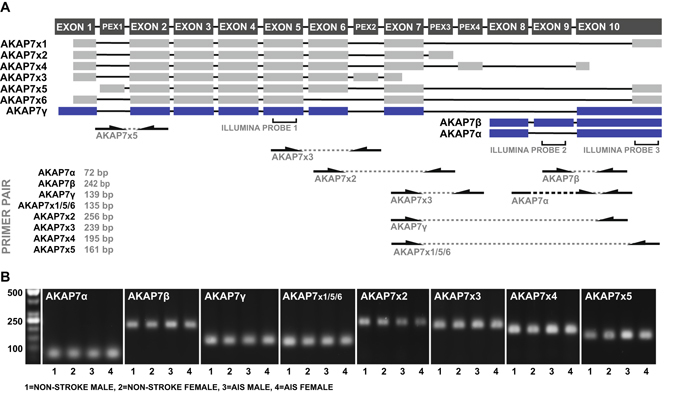
Detection of AKAP7 splice variants in peripheral blood. (A) Exon maps of previously validated (blue) and bioinformatically predicted (grey) AKAP7 splice variants with the location of microarray probes and variant-specific priming sites. PEX denotes a bioinformatically predicted exon. (B) AKAP7 splice variant-specific RT-PCR products amplified from peripheral blood-derived cDNA obtained from two non-stroke donors and two stroke patients.
Figure 5
Figure 5
Relationship between peripheral blood expression levels of AKAP7 splice variants and ITGA3. (AH) Relationship between transcriptional expression levels of AKAP7 splice variants and total transcriptional expression levels of ITGA3 in the peripheral whole blood of validation cohort AIS patients at emergency department admission as measured using qRT-PCR. Splice variants which are translated to produce PKA-binding AKAP7 isoforms are highlighted. Expression levels are presented as log2 fold differences relative to the sample of lowest expression.
Figure 6
Figure 6
Expression of AKAP7 splice variants in primary leukocyte populations isolated from peripheral blood. (AH) Transcriptional expression levels of AKAP7 splice variants in primary leukocyte populations isolated from the peripheral blood of two male and one female heathy donors as measured by qRT-PCR. Splice variants which are translated to produce PKA-binding AKAP7 isoforms are highlighted. Expression levels are presented as fold difference relative to the population of lowest expression and were statistically compared using one-way ANOVA.
Figure 7
Figure 7
Expression of AKAP7 splice variants and ITGA3 on differentially adherent lymphocyte populations. (A) Actively proliferating primary human lymphocytes following 72 hours of in vitro stimulation with PHA. (B) Adherent fraction of lymphocytes bound to extracellular matrix rich in ITGA3 ligands following 20 minutes of serum starvation. (C) Non-adherent fraction of lymphocytes collected following 20 minutes of serum starvation. (D) Transcriptional expression levels of total ITGA3 and AKAP7 splice variants in adherent and non-adherent lymphocyte fractions as measured by qRT-PCR. Splice variants which are translated to produce PKA-binding AKAP7 isoforms are highlighted. Expression levels are presented as fold difference relative to the adherent fraction and were statistically compared using two-sample two-way paired t-test.

References

    1. Montaner J, et al. Matrix metalloproteinase expression after human cardioembolic stroke: temporal profile and relation to neurological impairment. Stroke. 2001;32:1759–66. doi: 10.1161/01.STR.32.8.1759. - DOI - PubMed
    1. Rosell A, et al. MMP-9-positive neutrophil infiltration is associated to blood-brain barrier breakdown and basal lamina type IV collagen degradation during hemorrhagic transformation after human ischemic stroke. Stroke. 2008;39:1121–1126. doi: 10.1161/STROKEAHA.107.500868. - DOI - PubMed
    1. The National Institute of Neurological Disorders and Stroke rt-PA Stroke Study Group (NINDS) Tissue plasminogen activator for acute ischemic stroke. The National Institute of Neurological Disorders and Stroke rt-PA Stroke Study Group. N. Engl. J. Med. 1995;333:1581–7. doi: 10.1056/NEJM199512143332401. - DOI - PubMed
    1. Mohr JP. Thrombolytic therapy for ischemic stroke: from clinical trials to clinical practice. JAMA. 2000;283:1189–91. doi: 10.1001/jama.283.9.1189. - DOI - PubMed
    1. Hacke W, et al. Intravenous thrombolysis with recombinant tissue plasminogen activator for acute hemispheric stroke. The European Cooperative Acute Stroke Study (ECASS) JAMA. 1995;274:1017–25. doi: 10.1001/jama.1995.03530130023023. - DOI - PubMed

Publication types