. 2017 Jun 7;139(22):7632-7639.
doi: 10.1021/jacs.7b02988. Epub 2017 May 22.

Total Chemical Synthesis and Folding of All-l and All-d Variants of Oncogenic KRas(G12V)

Affiliations

Total Chemical Synthesis and Folding of All-l and All-d Variants of Oncogenic KRas(G12V)

Adam M Levinson et al. J Am Chem Soc. .

Abstract

The Ras proteins are essential GTPases involved in the regulation of cell proliferation and survival. Mutated oncogenic forms of Ras alter effector binding and innate GTPase activity, leading to deregulation of downstream signal transduction. Mutated forms of Ras are involved in approximately 30% of human cancers. Despite decades of effort to develop direct Ras inhibitors, Ras has long been considered "undruggable" due to its high affinity for GTP and its lack of hydrophobic binding pockets. Herein, we report a total chemical synthesis of all-l- and all-d-amino acid biotinylated variants of oncogenic mutant KRas(G12V). The protein is synthesized using Fmoc-based solid-phase peptide synthesis and assembled using combined native chemical ligation and isonitrile-mediated activation strategies. We demonstrate that both KRas(G12V) enantiomers can successfully fold and bind nucleotide substrates and binding partners with observable enantiodiscrimination. By demonstrating the functional competency of a mirror-image form of KRas bound to its corresponding enantiomeric nucleotide triphosphate, this study sets the stage for further biochemical studies with this material. In particular, this protein will enable mirror-image yeast surface display experiments to identify all-d peptide ligands for oncogenic KRas, providing a useful tool in the search for new therapeutics against this challenging disease target.


Figures
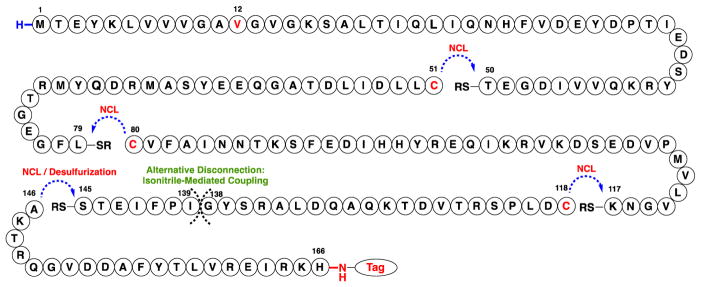
Figure 1
Figure 1
Retrosynthetic disconnection sites for KRas(G12V)[1–166]
Figure 2
Figure 2
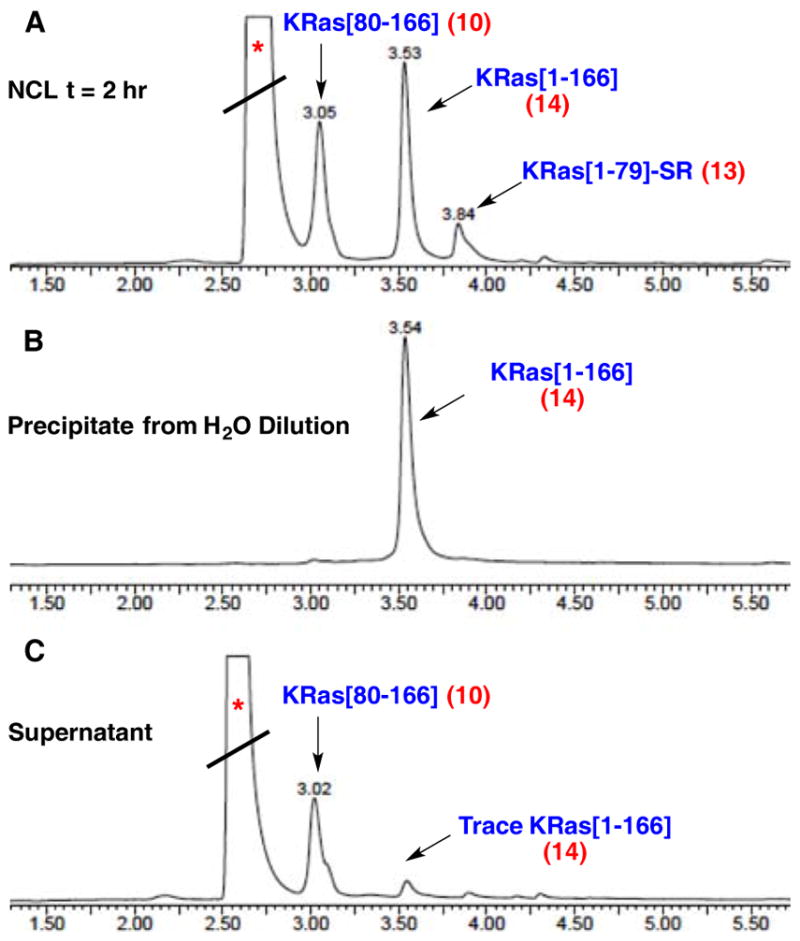
UPLC traces of the NCL between 10 and 13 and isolation of 14. (A) NCL after 2 h. (B) Only 14 is obtained in the precipitate from H2O dilution after the NCL is complete (t = 6.5 h). (C) Only trace 14 remained in the supernatant after dilution of the NCL with H2O, while excess 10 remains entirely dissolved. *denotes absorption peak derived from MPAA.
Figure 3
Figure 3
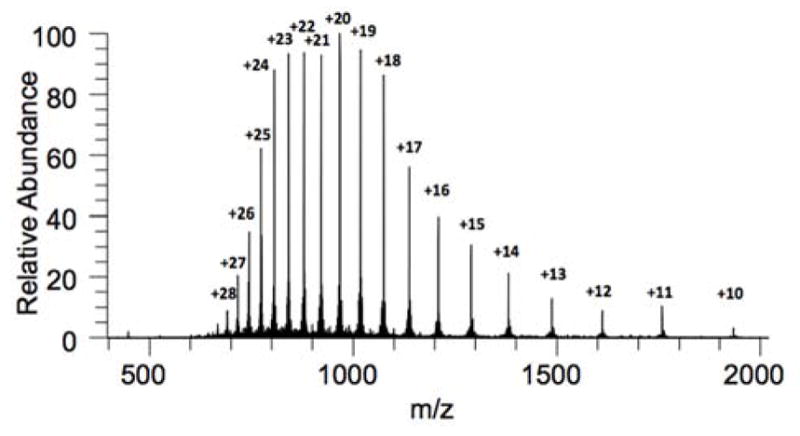
High-resolution mass spectrum of biotinylated, all D-residue KRas(G12V) (1).
Figure 4
Figure 4
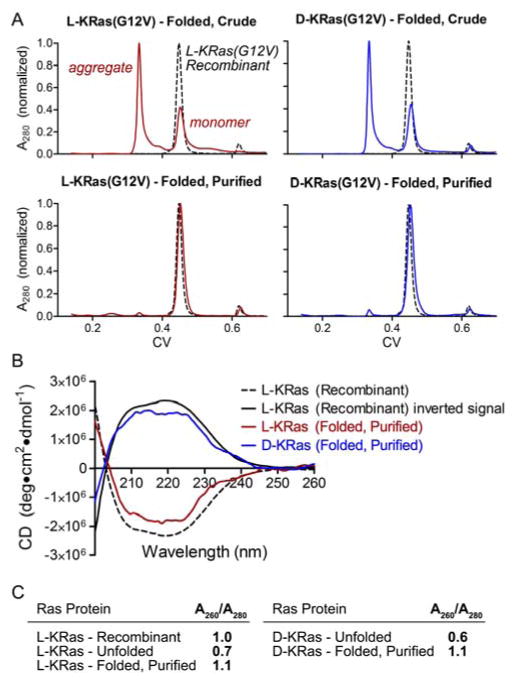
Folding analysis of synthetic proteins. A) Crude gel filtration traces and purified synthetic all L- and all D-KRas(G12V) after folding with GppNHp; B) Circular dichroism analysis of folded and purified synthetic proteins and recombinant KRas(G12V); C) Comparison of A260/A280 values for synthetic proteins and recombinant KRas(G12V).
Figure 5
Figure 5
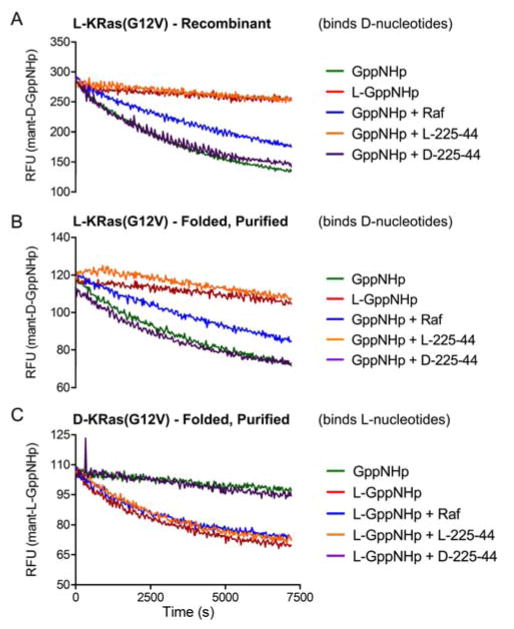
Unlabeled nucleotide displacement of mant-GppNHp-loaded KRas(G12V) in the presence of Ras-binding miniproteins. A) Recombinant L-KRas(G12V); B) Synthetic L-KRas(G12V); C) Synthetic D-KRas(G12V).
Figure 6
Figure 6
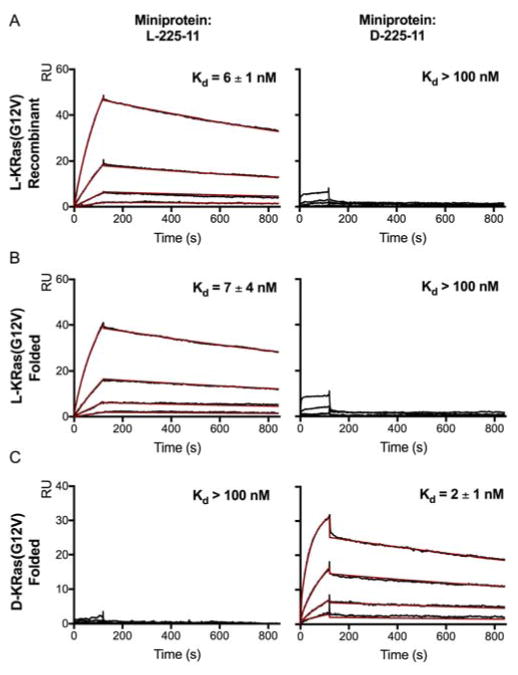
SPR binding analysis of Ras proteins with Ras-binding miniproteins. A) Binding of miniproteins with recombinant KRas; B) Binding of miniproteins with synthetic all-L KRas; C) Binding of miniproteins with synthetic all-D KRas. Kd values are mean ± SEM for triplicate runs.
Scheme 1
Scheme 1
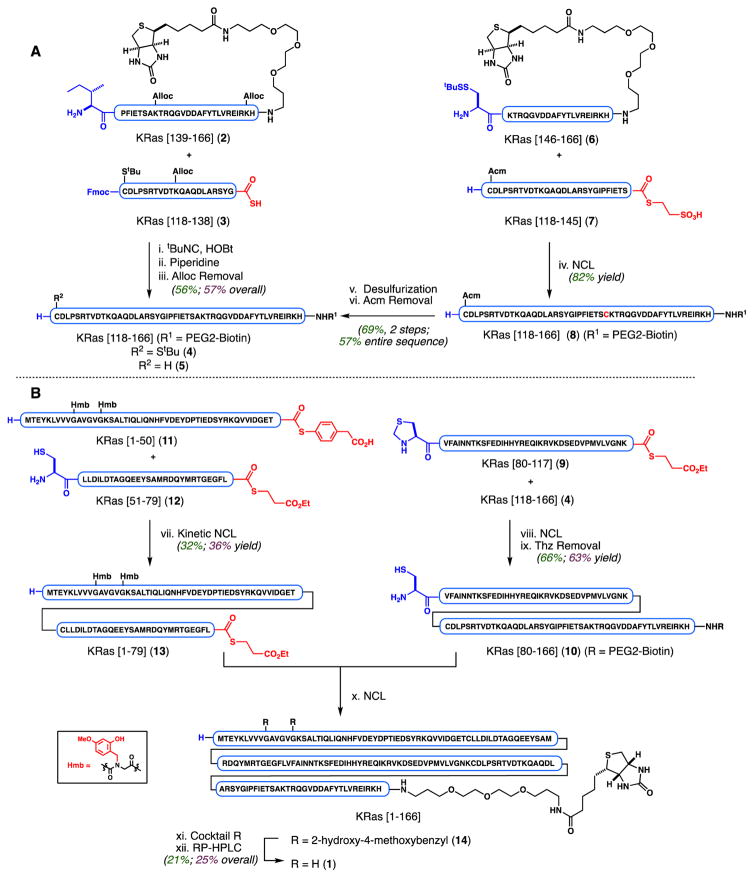
aReagents and conditions: (i) tBuNC (3.2 equiv), HOBt (10.2 equiv), DMA, room temperature (r.t.), 48 h. (ii) Piperidine (20 vol%), 30 min r.t.. (iii) PdCl2(dppf) (50 mol%), PhSiH3 (50 equiv), DMF, r.t. (iv) 6 M Gnd HCl, 0.2 M Na2HPO4, 0.2 M MPAA, 40 mM TCEP HCl, pH = 7.0, 6 h, r.t. (v) VA-044, tBuSH, TCEP, Gnd HCl buffer, 4 h, r.t. (vi) AgOAc (100 equiv), 70% aqueous AcOH, 2.5 h, r.t. (vii) 6 M Gnd HCl, 0.2 M Na2HPO4, pH = 7.0, 6 h, r.t. bReagents and conditions: (viii) 6 M Gnd HCl, 0.2 M Na2HPO4, 0.2 M MPAA, 40 mM TCEP HCl, pH = 7.0, 4 h, r.t. (ix) NH2OMe HCl added, pH = 4.55.0, 4.5 h, r.t. (x) 6 M Gnd HCl, 0.2 M Na2HPO4, 0.2 M MPAA, 20 mM TCEP HCl, pH = 7.0, 6.5 h, r.t. (xi) TFA/thioanisole/ethanedithiol/anisole (90:5:3:2), 2 h, r.t. (xii) Solubilization in 1:1 MeCN/H2O (0.1% TFA) with sonication, then TCEP, pH = 8.0, and RP-HPLC purification; HOBt = 1-Hydroxybenzotriazole, DMA = N,N-dimethylacetamide, Gnd = guanidine, MPAA = 4-mercaptophenylacetic acid, TCEP = Tris(2-carboxyethyl)phosphine, VA-044 = 2,2′-Azobis[2-(2-imidazolin-2-yl)propane] dihydrochloride, TFA = trifluoroacetic acid. Yields are reported in the following manner: green = all-L-residue peptides; purple = all-D-residue peptides.

References

    1. For useful recent reviews and perspectives on the structure, function and targeting of Ras: Lu S, Jan H, Muratcioglu S, Gursoy A, Keskin O, Nussinov R, Zhang J. Chem Rev. 2016;116:6607–6665.Samatar AA, Poulikakos PI. Nature Rev Drug Disc. 2014;13:928–942.Spiegel J, Cromm PM, Zimmermann G, Grossmann TN, Waldmann H. Nature Chem Biol. 2014;10:613–622.Wang Y, Kaiser CE, Frett B, Li H-Y. J Med Chem. 2013;56:5219–5230.Stephen AG, Esposito D, Bagni RK, McCormick F. Cancer Cell. 2014;25:272–281.

    1. Konstantinopoulos PA, Karamouzis MV, Papavassilou AG. Nat Rev Drug Disc. 2007;6:541–555.(and references therein) Vetter IR, Wittinghofer A. Science. 2001;294:1299–1304.

    1. Kamata T, Feramisco JR. Nature. 1984;310:147–150.McCormick F. Nature. 1993;363:15–16.(and references therein). Adari H, Lowy DR, Willumsen BM, Der CJ, McCormick F. Science. 1988;240:518–521.Scheffzek K, Ahmadian MR, Kabsch W, Wismüller L, Lautwein A, Schmitz F, Winttinghofer A. Science. 1997;277:333–338.

    1. Gibbs JB, Sigal IS, Poe M, Scolnick EM. Proc Natl Acad Sci USA. 1984;81:5704–5708. - PMC - PubMed
    2. Sweet RW, Yokoyama S, Kamata T, Feramisco JR, Rosenberg M, Gross M. Nature. 1984;311:273–275. - PubMed
    3. McGrath JP, Capon DJ, Goeddel DV, Levinson AD. Nature. 1984;310:644–649. - PubMed
    1. Cox AD, Fesik SW, Kimmelman AC, Luo J, Der CJ. Nature Rev Drug Disc. 2014;13:828–851. - PMC - PubMed

Publication types

MeSH terms

Substances