


Water temperature-dependent degradation of environmental DNA and its relation to bacterial abundance
- PMID: 28448613
- PMCID: PMC5407774
- DOI: 10.1371/journal.pone.0176608
Water temperature-dependent degradation of environmental DNA and its relation to bacterial abundance
Abstract
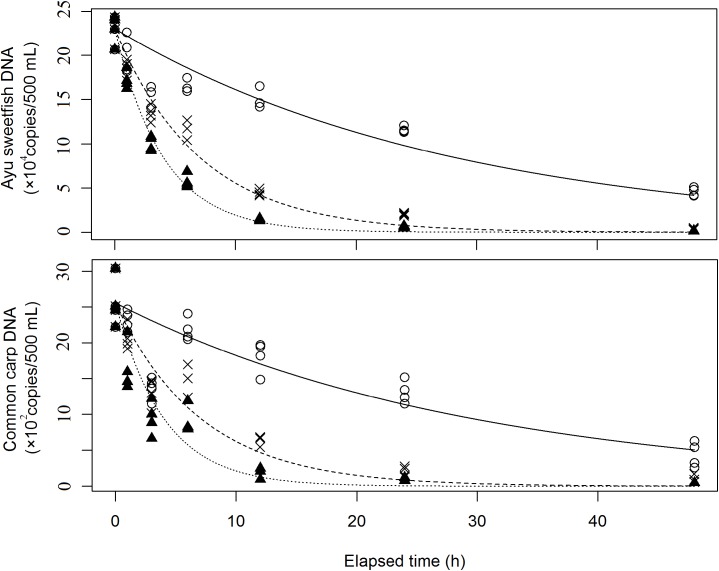
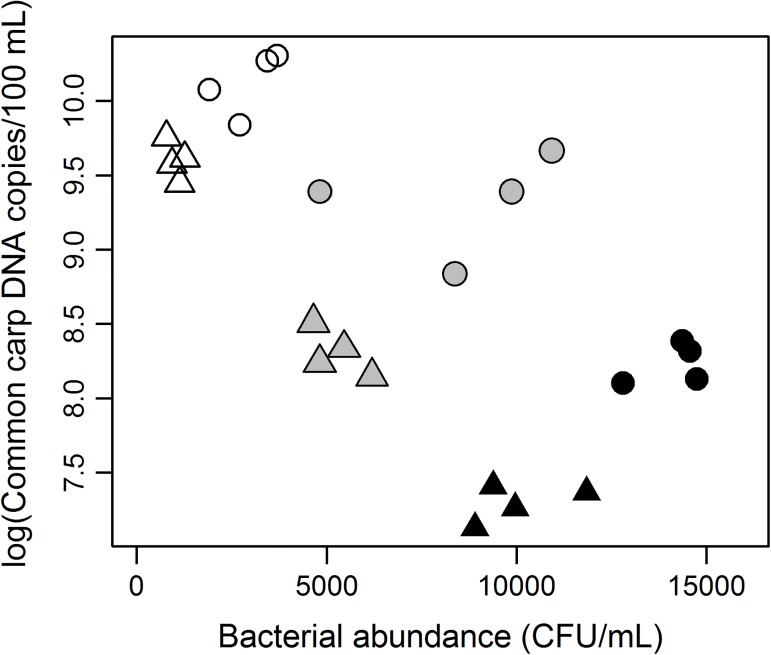
Environmental DNA (eDNA) is DNA shed by organisms into surrounding environments such as soil and water. The new methods using eDNA as a marker for species detection are being rapidly developed. Here we explore basic knowledge regarding the dependence of the eDNA degradation rate on time and water temperature, and the relationship between eDNA degradation and bacterial abundance. This subject has not been well clarified, even though it is essential for improving the reliability of eDNA analysis. To determine the time- and water temperature-dependent degradation of eDNA, river water was sampled and eDNA concentrations were determined for ayu sweetfish (Plecoglossus altivelis altivelis) and common carp (Cyprinus carpio) at seven time points, over a 48-h period, and at three different water temperatures. The degradation of eDNA was modeled for each species using an existing exponential decay model with an extension to include water temperature effects. The degradation models were constructed for ayu sweetfish as Nt = 229,901.2 × exp [- (0.01062 × k - 0.07081) × t] and for common carp as Nt = 2,558.0 × exp [- (0.01075 × k - 0.07372) × t]. Nt is the DNA concentration at time t (elapsed time in hours) and k is the water temperature (°C). We also measured the concentration of eDNA derived from purified genomic DNA of the common carp, which was spiked into aquarium water without the target species, and we measured the bacterial abundance in the sample water after 12 and 24 h of incubation. Environmental DNA degradation was accelerated at higher water temperatures (generalized linear model, GLM; p < 0.001), but bacterial abundance did not have a significant effect on eDNA degradation (GLM, p = 0.097). These results suggest that the proper treatment of this temperature effect in data interpretations and adjustments would increase the reliability of eDNA analysis in future studies.
Conflict of interest statement
Figures
References
-
- Ficetola GF, Miaud C, Pompanon F, Taberlet P. Species detection using environmental DNA from water samples. Biol Lett. 2008;4: 423–425. doi: 10.1098/rsbl.2008.0118 - DOI - PMC - PubMed
-
- Jerde CL, Mahon AR, Chadderton WL, Lodge DM. “Sight-unseen” detection of rare aquatic species using environmental DNA. Conserv Lett. 2011;4: 150–157.
-
- Lodge DM, Turner CR, Jerde CL, Barnes MA, Chadderton L, Egan SP, et al. Conservation in a cup of water: estimating biodiversity and population abundance from environmental DNA. Mol Ecol. 2012;21: 2555–2558. doi: 10.1111/j.1365-294X.2012.05600.x - DOI - PMC - PubMed
-
- Minamoto T, Yamanaka H, Takahara T, Honjo MN, Kawabata Z. Surveillance of fish species composition using environmental DNA. Limnol. 2012;13: 193–197.
-
- Kelly RP, Port JA, Yamahara KM, Crowder LB. Using environmental DNA to census marine fishes in a large mesocosm. PLOS ONE. 2014;9: e86175 doi: 10.1371/journal.pone.0086175 - DOI - PMC - PubMed
MeSH terms
Substances
LinkOut - more resources
Full Text Sources
Other Literature Sources
Research Materials
