Estimating Survival After Salvage Surgery for Recurrent Oral Cavity Cancer
- PMID: 28448645
- PMCID: PMC5824200
- DOI: 10.1001/jamaoto.2017.0001
Estimating Survival After Salvage Surgery for Recurrent Oral Cavity Cancer
Abstract
Importance: Locoregional recurrence of oral cavity squamous cell carcinoma (OCSCC) continues to be a life-threatening and difficult clinical situation. Salvage surgery can result in significant morbidities, and survival following recurrence is poor.
Objective: To outline prognostic factors influencing overall survival (OS) following salvage surgery for OCSCC to guide management of treatment for patients with locoregionally recurrent disease.
Design, setting, and participants: The medical records of 293 patients presenting to the London Health Sciences Center with locoregionally recurrent OCSCC between October 5, 1999, and May 2, 2011, were retrospectively reviewed. The primary outcome was OS from salvage treatment to last follow-up or death. Univariate analyses were carried out using the Cox proportional hazards regression model. A recursive partitioning analysis was used to create risk groups based on prognosis. Analysis was conducted from December 8, 2015, to February 26, 2016.
Results: Of the 293 patients evaluated, 59 (20%) had recurrence identified after their initial OCSCC treatment; 39 (66%) were men, and the mean (SD) age at diagnosis was 62.2 (11.8) years. Thirty-nine (66%) of these patients underwent salvage surgery for locoregional recurrence with curative intent. Five-year OS from the time of salvage surgery was 43%. Recursive partitioning analysis identified 3 risk groups: (1) high risk (patients who received adjuvant chemoradiotherapy or radiotherapy after initial surgery) with 5-year OS rate of 10% (hazard ratio [HR], 9.41; 95% CI, 2.68-33.04), (2) intermediate risk (previous surgery alone, age ≥62 years) with a 5-year OS rate of 39% (HR, 2.95; 95% CI, 0.86-10.09), and (3) low risk (previous surgery alone, age <62 years) with 5-year OS rate of 74%.
Conclusions and relevance: This recursive partitioning analysis identified 3 prognostic groups in patients undergoing salvage surgery for recurrent OCSCC. The marked differences in survival between these groups should be taken into consideration when counselling and managing treatment for patients with locoregionally recurrent disease.
Conflict of interest statement
Figures
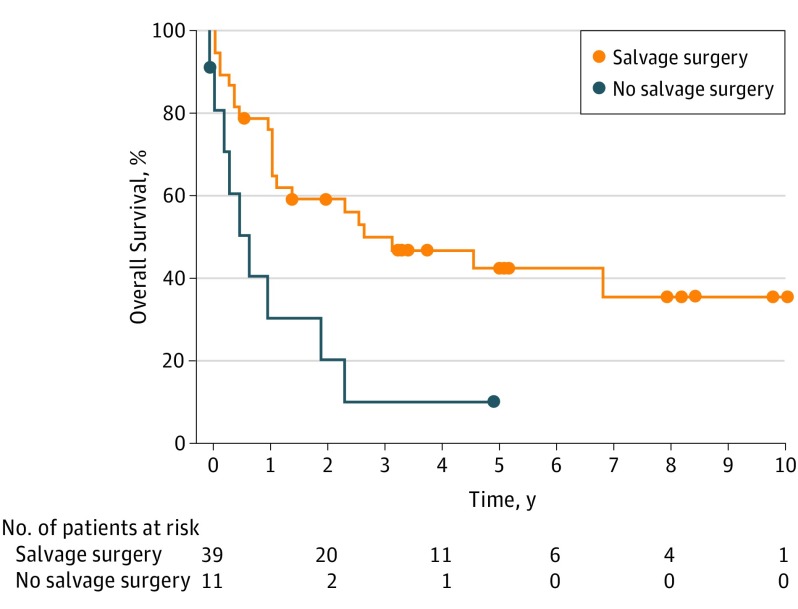
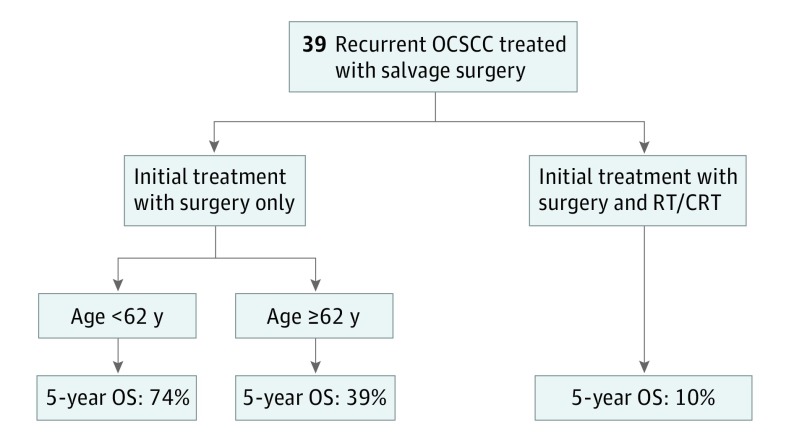
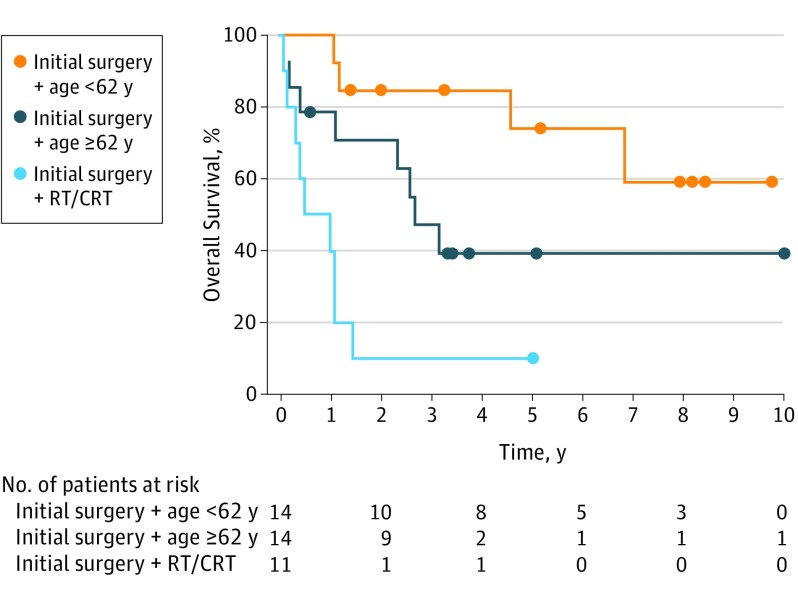
Comment in
-
Salvage-Chirurgie bei Tumorrezidiven der Mundhöhle – Einfluss der vorherigen Behandlung und des Patientenalters.Laryngorhinootologie. 2018 Jan;97(1):8-10. doi: 10.1055/s-0043-121838. Epub 2018 Jan 4. Laryngorhinootologie. 2018. PMID: 29301156 German.
References
-
- Torre LA, Bray F, Siegel RL, Ferlay J, Lortet-Tieulent J, Jemal A. Global cancer statistics, 2012. CA Cancer J Clin. 2015;65(2):87-108. - PubMed
-
- Koo BS, Lim YC, Lee JS, Choi EC. Recurrence and salvage treatment of squamous cell carcinoma of the oral cavity. Oral Oncol. 2006;42(8):789-794. - PubMed
-
- Goto M, Hanai N, Ozawa T, et al. . Prognostic factors and outcomes for salvage surgery in patients with recurrent squamous cell carcinoma of the tongue. Asia Pac J Clin Oncol. 2016;12(1):e141-e148. - PubMed
-
- Lin Y-C, Hsiao J-R, Tsai S-T. Salvage surgery as the primary treatment for recurrent oral squamous cell carcinoma. Oral Oncol. 2004;40(2):183-189. - PubMed
-
- Ord RA, Kolokythas A, Reynolds MA. Surgical salvage for local and regional recurrence in oral cancer. J Oral Maxillofac Surg. 2006;64(9):1409-1414. - PubMed
Publication types
MeSH terms
Grants and funding
LinkOut - more resources
Full Text Sources
Other Literature Sources
Medical