


Support for marijuana legalization in the US state of Washington has continued to increase through 2016
- PMID: 28448904
- PMCID: PMC5509359
- DOI: 10.1016/j.drugalcdep.2017.02.015
Support for marijuana legalization in the US state of Washington has continued to increase through 2016
Abstract
Background: Support for the legalization of recreational marijuana continues to increase across the United States and globally. In 2016, recreational marijuana was legalized in the most populous US state of California, as well as three other states. The primary aim of this study was to examine trends in support for recreational marijuana legalization in Washington, a state which has had legal recreational marijuana for almost four years, using data collected over the four years post-legalization. A secondary aim was to examine trends in support for the cultivation of marijuana for personal use.
Methods: Data come from geographically representative general population samples of adult (aged 18 and over) Washington residents collected over five timepoints (every six months) between January 2014 and April 2016 (N=4101). Random Digit Dial was used for recruitment. Statistical analyses involved bivariate comparisons of proportions across timepoints and subgroups (defined by age, gender, and marijuana user status), and multivariable logistic regression controlling for timepoint (time) to formally test for trend while controlling for demographic and substance use covariates. All analyses adjusted for probability of selection.
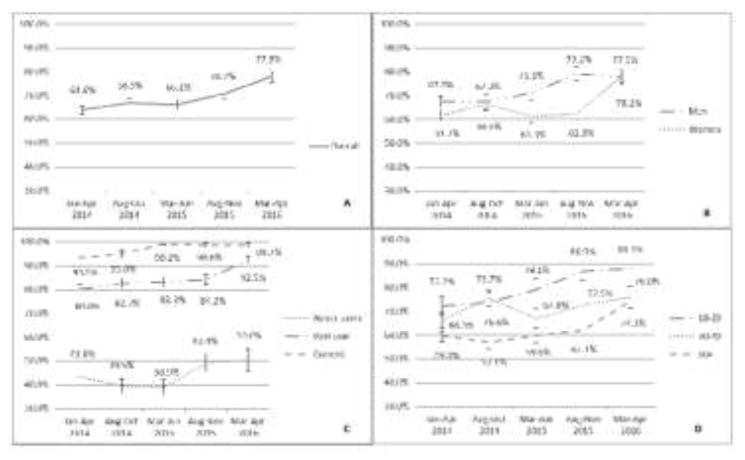
Results: Support for legalization in Washington has significantly increased: support was 64.0% (95% CI: 61.2%-67.8%) at timepoint 1 and 77.9% (95% CI: 73.2%-81.9%) at timepoint 5. With each six months' passing, support increased 19% on average. We found no statistically significant change in support for home-growing.
Conclusions: Support for marijuana legalization has continued to significantly increase in a state that has experienced the policy change for almost four years.
Keywords: Cannabis; Legalization; Marijuana; Policy; Public opinion.
Copyright © 2017. Published by Elsevier B.V.
Conflict of interest statement
No conflict declared by either author.
Figures
References
-
- ABC News. Roper Center for Public Opinion Research, iPOLL. Cornell University; Ithaca, NY: 1988. [accessed Jan-4-2017]. ABC News Poll [All drugs should be illegal?] USABC.091388.R19.
-
- CBS News. Roper Center for Public Opinion Research, iPOLL. Cornell University; Ithaca, NY: 1994. [accessed Jan-4-2017]. CBS News Poll [Some people feel that current drug laws haven’t worked, and that drugs like marijuana, cocaine, and heroin should be legalized and subject to government regulation and taxation like alcohol and tobacco. Do you think drug legalization is a good idea or a bad idea?] USCBS.080394.R02.
-
- Cruz JM, Queirolo R, Boidi MF. Determinants of public support for marijuana legalization in Uruguay, the United States, and El Salvador. J Drug Issues. 2016;46:308–325.
-
- Gallup Organization. Roper Center for Public Opinion Research, iPOLL. Cornell University; Ithaca, NY: 1939. [accessed Jan-4-2017]. Gallup Poll [If the question of national prohibition should come up again, would you vote to make the country dry?] USGALLUP.180A.QA01.
MeSH terms
Substances
Grants and funding
LinkOut - more resources
Full Text Sources
Other Literature Sources
Medical
Miscellaneous
