


Utility of the Fitbit Flex to evaluate sleep in major depressive disorder: A comparison against polysomnography and wrist-worn actigraphy
- PMID: 28448949
- PMCID: PMC5509938
- DOI: 10.1016/j.jad.2017.04.030
Utility of the Fitbit Flex to evaluate sleep in major depressive disorder: A comparison against polysomnography and wrist-worn actigraphy
Abstract
Background: Sleep disturbance is a common and important component of affective illness. Fitness activity trackers are emerging as alternative means to estimate sleep in psychiatric patients; however, their ability to quantify sleep in mood disorders has not been empirically evaluated. Thus, this study sought to evaluate the utility of the Fitbit Flex (FBF) to estimate sleep in patients with major depressive disorder (MDD) relative to gold standard polysomnography (PSG) and a widely-used actigraph (Actiwatch-2; AW-2).
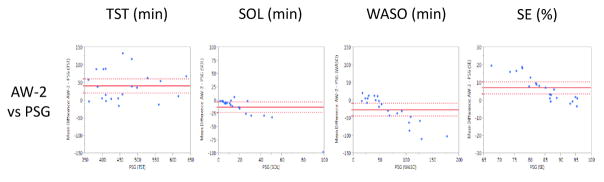
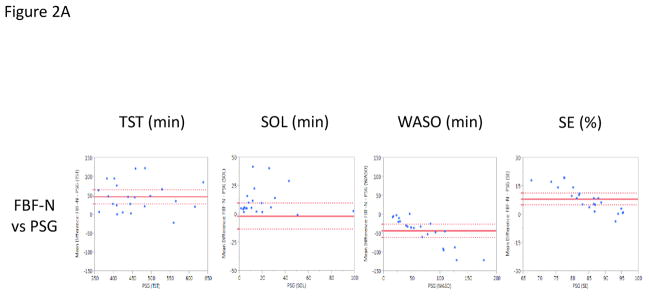
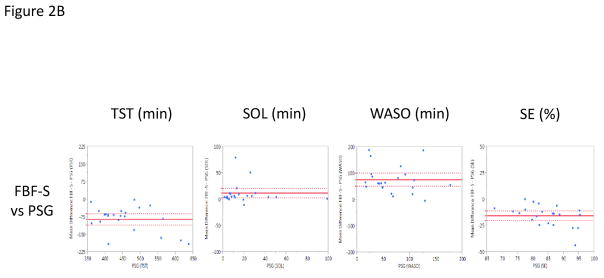
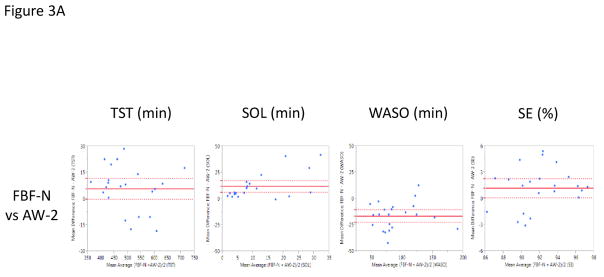
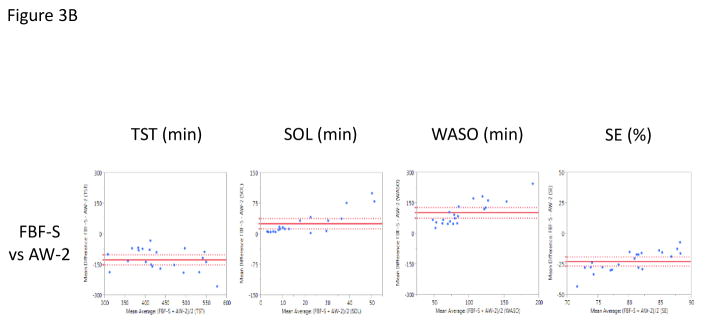
Methods: Twenty-one patients with unipolar MDD wore the FBF and AW-2 during in-laboratory PSG. Bland-Altman analysis compared sleep variables among devices. Epoch-by-epoch analysis further evaluated sensitivity, specificity, and accuracy for the FBF and AW-2 relative to PSG.
Results: The FBF demonstrated significant limitations in quantifying sleep and wake, relative to PSG. In the normal setting, the FBF significantly overestimated sleep time and efficiency, and displayed poor ability to correctly identify wake epochs (i.e. low specificity). In the sensitive setting, the FBF significantly underestimated sleep time and efficiency relative to PSG. Performance characteristics of the FBF were more similar to the AW-2 in the normal compared to sensitive setting.
Limitations: Participants were young to middle aged and predominantly female, which may limit generalizability of findings. Study design also precluded ability to assess longitudinal performance of FBF.
Conclusions: The FBF is not an adequate substitute for PSG when quantifying sleep in MDD, and the settings of the device sizably impact its performance relative to PSG and other standard actigraphs. The limitations and capabilities of the FBF should be carefully considered prior to clinical and research implementation.
Keywords: Actigraphy; Depression; Fitbit; Polysomnography; Sleep.
Copyright © 2017 Elsevier B.V. All rights reserved.
Figures
References
-
- Altman DG, Bland JM. Measurement in Medicine: the Analysis of Method Comparison Studies. The Statistician. 1983;32:307–317.
-
- Baglioni C, Battagliese G, Feige B, Spiegelhalder K, Nissen C, Voderholzer U, Lombardo C, Riemann D. Insomnia as a predictor of depression: a meta-analytic evaluation of longitudinal epidemiological studies. J Affect Disord. 2011;135:10–19. - PubMed
-
- Baroni A, Bruzzese JM, Di Bartolo CA, Shatkin JP. Fitbit Flex: an unreliable device for longitudinal sleep measures in a non-clinical population. Sleep Breath. 2016;20:853–854. - PubMed
-
- Bastien CH, Vallières A, Morin CM. Validation of the Insomnia Severity Index as an outcome measure for insomnia research. Sleep Med. 2001;2:297–307. - PubMed
-
- Beck AT, Steer RA, Brown GK. Manual for the Beck Depression Inventory-II. 2. San Antonio, TX: 1996.
Publication types
MeSH terms
Grants and funding
LinkOut - more resources
Full Text Sources
Other Literature Sources
Medical
