


Professional burnout in European young oncologists: results of the European Society for Medical Oncology (ESMO) Young Oncologists Committee Burnout Survey
- PMID: 28449049
- PMCID: PMC5834057
- DOI: 10.1093/annonc/mdx196
Professional burnout in European young oncologists: results of the European Society for Medical Oncology (ESMO) Young Oncologists Committee Burnout Survey
Abstract
Background: Burnout in health care professionals could have serious negative consequences on quality of patient care, professional satisfaction and personal life. Our aim was to investigate the burnout prevalence, work and lifestyle factors potentially affecting burnout amongst European oncologists ≤40 (YOs).
Methods: A survey was conducted using the validated Maslach Burnout Inventory (MBI) and additional questions exploring work/lifestyle factors. Statistical analyses were carried out to identify factors associated with burnout.
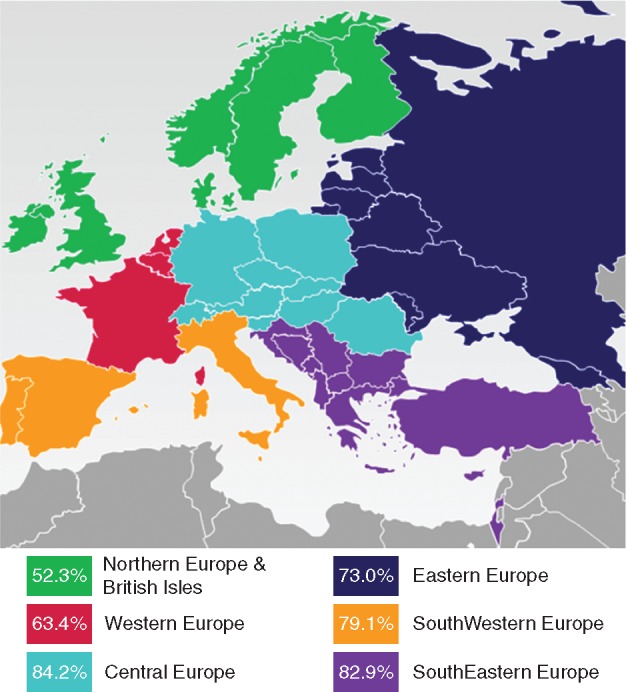
Results: Total of 737 surveys (all ages) were collected from 41 European countries. Countries were divided into six regions. Results from 595 (81%) YOs were included (81% medical oncologists; 52% trainees, 62% women). Seventy-one percent of YOs showed evidence of burnout (burnout subdomains: depersonalization 50%; emotional exhaustion 45; low accomplishment 35%). Twenty-two percent requested support for burnout during training and 74% reported no hospital access to support services. Burnout rates were significantly different across Europe (P < 0.0001). Burnout was highest in central European (84%) and lowest in Northern Europe (52%). Depersonalization scores were higher in men compared with women (60% versus 45% P = 0.0001) and low accomplishment was highest in the 26-30 age group (P < 0.01). In multivariable linear regression analyses, European region, work/life balance, access to support services, living alone and inadequate vacation time remained independent burnout factors (P < 0.05).
Conclusions: This is the largest burnout survey in European Young Oncologists. Burnout is common amongst YOs and rates vary across Europe. Achieving a good work/life balance, access to support services and adequate vacation time may reduce burnout levels. Raising awareness, support and interventional research are needed.
Keywords: European; burnout; work-life balance; young oncologists.
© The Author 2017. Published by Oxford University Press on behalf of the European Society for Medical Oncology. All rights reserved. For Permissions, please email: journals.permissions@oup.com.
Figures
Comment in
-
Can we trust burnout research?Ann Oncol. 2017 Sep 1;28(9):2320-2321. doi: 10.1093/annonc/mdx267. Ann Oncol. 2017. PMID: 28520921 No abstract available.
-
Burnout among young European oncologists: a call for action.Ann Oncol. 2017 Jul 1;28(7):1414-1415. doi: 10.1093/annonc/mdx256. Ann Oncol. 2017. PMID: 28863448 No abstract available.
-
Reply to the letter to the editor 'Can we trust burnout research?' by Bianchi et al.Ann Oncol. 2017 Oct 1;28(10):2625-2626. doi: 10.1093/annonc/mdx329. Ann Oncol. 2017. PMID: 28961831 No abstract available.
References
-
- Whippen DA, Canellos GP.. Burnout syndrome in the practice of oncology: results of a random survey of 1,000 oncologists. J Clin Oncol 1991; 9(10): 1916–1920. - PubMed
-
- Campbell DA, Sonnad SS, Eckhauser FE. et al. Burnout among American surgeons. Surgery 2001; 130(4): 696–702–5. - PubMed
-
- Golin M. Physician burnout: when the healer is wounded. Am Med News 1981; 24(29): suppl 1–suppl 2. http://www.ncbi.nlm.nih.gov/pubmed/10252614. Accessed December 13, 2016. - PubMed
-
- Shanafelt TD, Boone S, Tan L. et al. Burnout and satisfaction with work-life balance among US physicians relative to the general US population. Arch Intern Med 2012; 172(18): 1377–1385. - PubMed
-
- Medscape 2015 Physician Lifestyle Report. www.medscape.com/sites/public/lifestyle/2015 (14 February 2017, date last accessed).
Publication types
MeSH terms
LinkOut - more resources
Full Text Sources
Other Literature Sources
Medical
