Performance in the shuttle walk test is associated with cardiopulmonary complications after lung resections
- PMID: 28449487
- PMCID: PMC5394008
- DOI: 10.21037/jtd.2017.03.22
Performance in the shuttle walk test is associated with cardiopulmonary complications after lung resections
Abstract
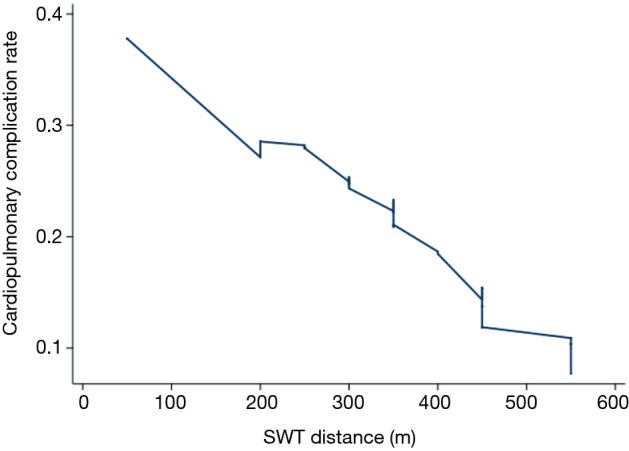
Background: The current functional guidelines recommend the shuttle walk test (SWT) as an initial screening tool to identify candidates for lung resection without requiring cardiopulmonary exercise testing. This study aims to: (I) assess the use of the SWT in predicting postoperative cardiopulmonary complications; and (II) determine whether the recommended 400 m cut-off is an appropriate distance.
Methods: We retrospectively analysed 101 patients that had performed a SWT prior to surgery. Univariate and multivariate regression analyses were used to test associations between patient variables [demographics, pre-existing conditions, pulmonary function, oxygen desaturation during the SWT, shuttle walk distance (SWD)] and post-operative cardiopulmonary complications.
Results: Patients without cardiopulmonary complications walked longer distance compared to those with complication (417.3 vs. 348.6 m, P=0.01. Fifty two patients walked less than 400 m and 16 less than 250 m. Only 10% of patients who walked at least 400 m had cardiopulmonary complications compared to 33% of those who did not reach this distance (P=0.008). Half of the patients who walked less than 400 m and desaturated during the exercise developed cardiopulmonary complications. A SWD shorter than 400 m remained the only factor significantly associated with cardiopulmonary complications (P=0.009, OR: 4.3) after logistic regression analysis.
Conclusions: Our results support the use of the SWT as an initial screening tool in all patients prior to lung resection. Patients walking longer than 400 m experienced very low incidence of complications and would not need further testing prior to proceed to lung resection.
Keywords: Shuttle walk test (SWT); complications; exercise test; lung cancer; lung surgery.
Conflict of interest statement
Conflicts of Interest: The authors have no conflicts of interest to declare.
Figures
References
-
- Brunelli A, Kim AW, Berger KI, et al. Physiologic evaluation of the patient with lung cancer being considered for resectional surgery: Diagnosis and management of lung cancer, 3rd ed: American College of Chest Physicians evidence-based clinical practice guidelines. Chest 2013;143:e166S-90S. - PubMed
-
- Brunelli A, Pompili C, Salati M. Low-technology exercise test in the preoperative evaluation of lung resection candidates. Monaldi Arch Chest Dis 2010;73:72-8. - PubMed
LinkOut - more resources
Full Text Sources
Other Literature Sources