. 2017 Apr 28;18(1):18.
doi: 10.1186/s40360-017-0128-7.

Large-scale detection of drug off-targets: hypotheses for drug repurposing and understanding side-effects

Affiliations

Large-scale detection of drug off-targets: hypotheses for drug repurposing and understanding side-effects

Matthieu Chartier et al. BMC Pharmacol Toxicol. .

Abstract

Background: Promiscuity in molecular interactions between small-molecules, including drugs, and proteins is widespread. Such unintended interactions can be exploited to suggest drug repurposing possibilities as well as to identify potential molecular mechanisms responsible for observed side-effects.

Methods: We perform a large-scale analysis to detect binding-site molecular interaction field similarities between the binding-sites of the primary target of 400 drugs against a dataset of 14082 cavities within 7895 different proteins representing a non-redundant dataset of all proteins with known structure. Statistically-significant cases with high levels of similarities represent potential cases where the drugs that bind the original target may in principle bind the suggested off-target. Such cases are further analysed with docking simulations to verify if indeed the drug could, in principle, bind the off-target. Diverse sources of data are integrated to associated potential cross-reactivity targets with side-effects.

Results: We observe that promiscuous binding-sites tend to display higher levels of hydrophobic and aromatic similarities. Focusing on the most statistically significant similarities (Z-score ≥ 3.0) and corroborating docking results (RMSD < 2.0 Å), we find 2923 cases involving 140 unique drugs and 1216 unique potential cross-reactivity protein targets. We highlight a few cases with a potential for drug repurposing (acetazolamide as a chorismate pyruvate lyase inhibitor, raloxifene as a bacterial quorum sensing inhibitor) as well as to explain the side-effects of zanamivir and captopril. A web-interface permits to explore the detected similarities for each of the 400 binding-sites of the primary drug targets and visualise them for the most statistically significant cases.

Conclusions: The detection of molecular interaction field similarities provide the opportunity to suggest drug repurposing opportunities as well as to identify potential molecular mechanisms responsible for side-effects. All methods utilized are freely available and can be readily applied to new query binding-sites. All data is freely available and represents an invaluable source to identify further candidates for repurposing and suggest potential mechanisms responsible for side-effects.

Keywords: Binding-site similarities; Cross-reactivity; Drug repurposing; Large-scale analysis; Molecularinteraction field similarities; Promiscuity; Side-effects.


Figures
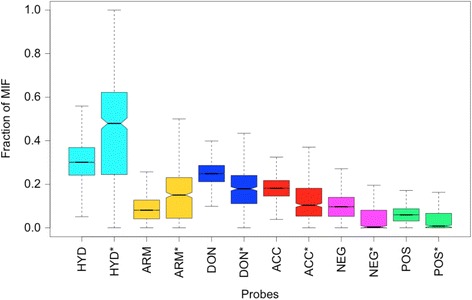
Fig. 1
Fig. 1
Fraction of MIFs for the common Pisces entries. Boxplots showing the fraction of the MIFs represented by the 6 probe types in the 14082 Pisces binding-sites compared to the ones measured using only the 554 most commonly predicted similar target binding-sites for each probe type (marked by *). HYD: Hydrophobic, ARM: Aromatic, DON: Hydrogen bond donor, ACC: Hydrogen bond acceptor, NEG: Negatively charged, and POS: Positively charged
Fig. 2
Fig. 2
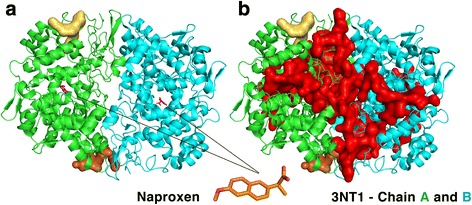
Cavities of Prostaglandin-endoperoxide synthase 2 (PDB 3NT1). a The two cavities 3NT1_2 (pale yellow) and 3NT1_3 (orange) define the two binding-sites of this protein in the Pisces dataset. The bound naproxen is also shown. b Cavity 3NT1_1, in red, covers the naproxen binding-site, but was excluded because of its size
Fig. 3
Fig. 3
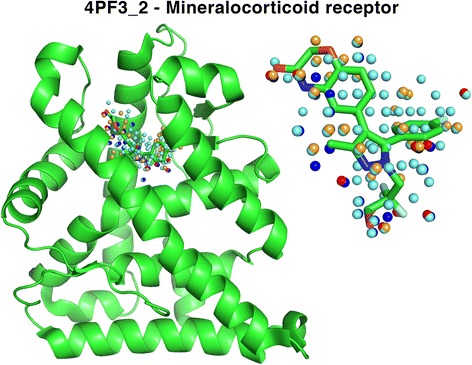
MIF of the mineralocorticoid receptor in the 4PF3_2 binding-site. The MIF is defined in the substrate binding-site and is composed of hydrophobic (cyan), aromatic (orange), hydrogen bond donor (blue) and acceptor (red)
Fig. 4
Fig. 4
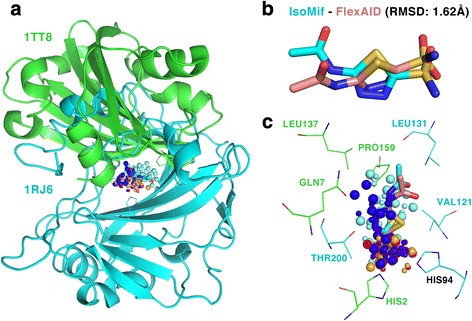
Similarities between carbonic anhydrase and chorismate pyruvate lyase (a) Both structures have different folds and are superimposed using the MIF similarities. b The IsoMif pose (cyan) and the FlexAID pose (salmon), RMSD of 1.62 Å. c Similarities for hydrophobic (cyan), aromatic (orange), donor (blue), acceptor (red) and negative charge (magenta). Large spheres represent probes of 1RJ6 and small ones of 1TT8
Fig. 5
Fig. 5
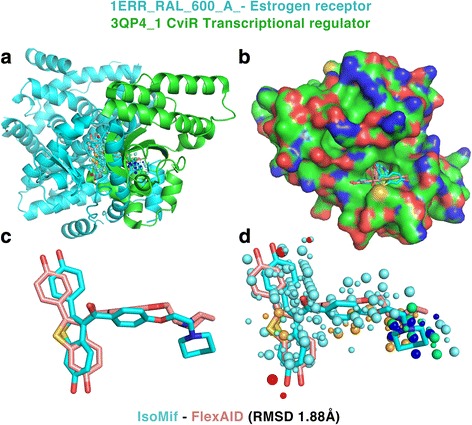
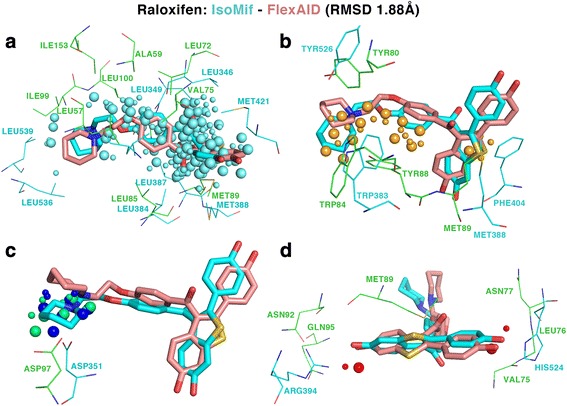
Superimposition of the estrogen receptor and CviR receptor. a The two structures of different folds are superimposed using the MIF similarities. b A surface representation of 3QP4 shows the deep pocket where raloxifen would bind in CviR. c The pose predicted by IsoMIF (cyan) and FlexAID (salmon) and d the similarities identified by IsoMIF are shown
Fig. 6
Fig. 6
Similarities between the estrogen receptor and the CviR receptor. a Hydrophobic similarities are shown in cyan, b aromatic in orange, c hydrogen bond donor in blue and positive charge in green and d hydrogen bond acceptor in red
Fig. 7
Fig. 7
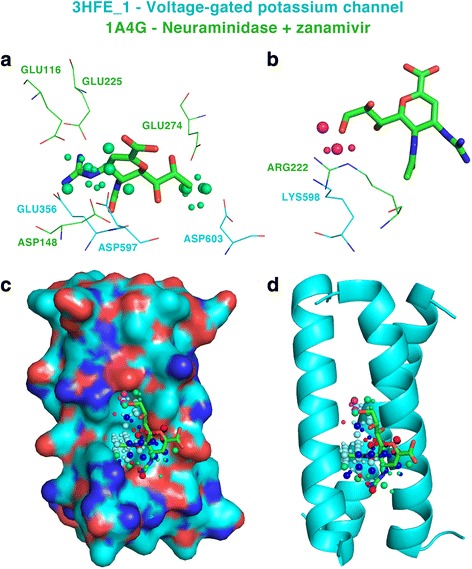
Similarities between the neuraminidase query binding-site and potassium voltage-gated channel 3HFE_1, the potential target. a Positively and b negatively charged probe similarities. c Surface and d cartoon representation of a subunit of the channel showing the binding-site of zanamivir and the identified similarities
Fig. 8
Fig. 8
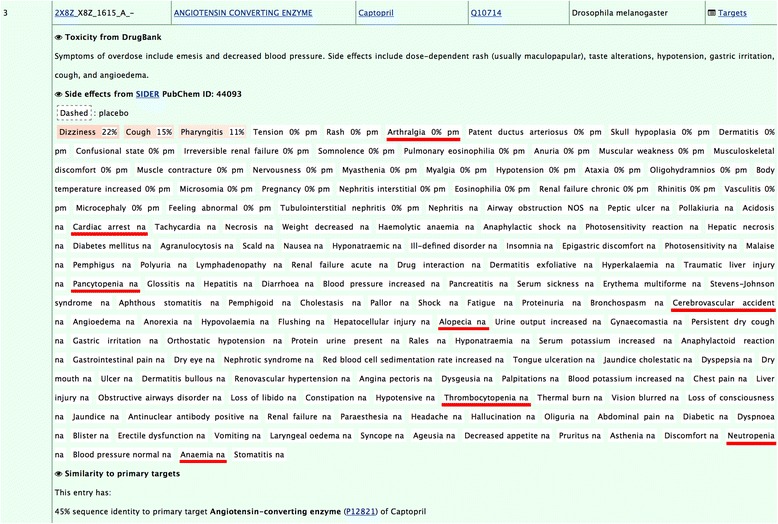
Entry 2X8Z_X8Z_1615_A_- in the online interface showing side effects retrieved from Sider. Hyperlinks bring to external resources: the page of the PDB structure on the RCSB website, Pubmed showing articles where the name of the protein appears in their title, Drugbank page of the drug, Uniprot page, and the side effect resource in Sider. The ‘Targets’ link on the top right leads to the sorted list of predicted targets
Fig. 9
Fig. 9
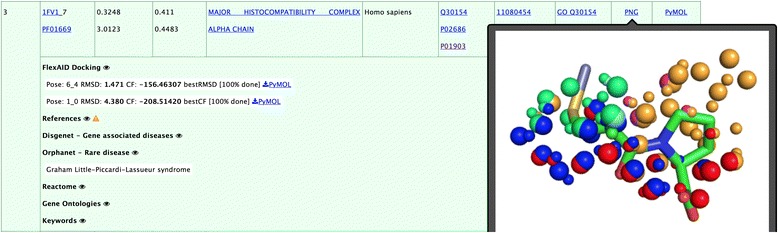
Cross-reactivity target 1FV1_7 identified with Drugs dataset entry 2X8Z_X8Z_1615_A_-. For each off-target, the Tanimoto coefficient and MPCq are given with their Z-score. When available, cross-referenced information can be clicked to expand (Pubmed references, Disgenet, Orphanet, Reactome and Keyowrds in this example). Hovering the mouse on the PNG hyperlink shows a glimpse of the similarities identified by IsoMif and the PyMOL session can be downloaded for the similarities alone and next to the docking results (that contain, in addition to similarities, the docking pose predicted). The information for this off-target is available at the http://bcb.med.usherbrooke.ca/drugs.php?id=2X8Z_X8Z1615A-#1FV1_7
Fig. 10
Fig. 10
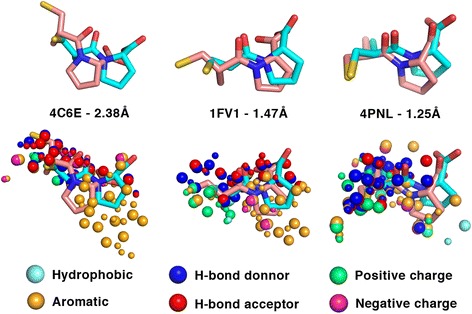
Comparison of captopril docking and ACE MIF similarity based ligand superimposition for the top three captopril cross-reactivity targets. The RMSD is that between ligand poses predicted by FlexAID (salmon) compared to those obtained upon the superimposition of the target and potential cross-reactivity target using the MIF similarities obtained with IsoMIF (cyan). The color-coded similarities identified by IsoMIF for specific probe types are shown as spheres. Pairs of large and small spheres represent corresponding (similar) probes in the query and target binding-sites respectively

References

    1. Davis MI, Hunt JP, Herrgard S, Ciceri P, Wodicka LM, Pallares G, et al. Comprehensive analysis of kinase inhibitor selectivity. Nat Biotechnol. 2011;29:1046–51. doi: 10.1038/nbt.1990. - DOI - PubMed
    1. Paolini GV, Shapland RHB, van Hoorn WP, Mason JS, Hopkins AL. Global mapping of pharmacological space. Nat Biotechnol. 2006;24:805–15. doi: 10.1038/nbt1228. - DOI - PubMed
    1. Whitebread S, Hamon J, Bojanic D, Urban L. Keynote review: in vitro safety pharmacology profiling: an essential tool for successful drug development. Drug Discov Today. 2005;10:1421–33. doi: 10.1016/S1359-6446(05)03632-9. - DOI - PubMed
    1. Peters J-U. Polypharmacology – Foe or Friend? J Med Chem. Am Chem Soc. 2013;56:8955–71. - PubMed
    1. Barabási A-L, Oltvai ZN. Network biology: understanding the cell’s functional organization. Nat Rev Genet. 2004;5:101–13. doi: 10.1038/nrg1272. - DOI - PubMed

Publication types