. 2017 Apr 27;14(1):28.
doi: 10.1186/s12977-017-0352-7.

Interference of retroviral envelope with vaccine-induced CD8+ T cell responses is relieved by co-administration of cytokine-encoding vectors

Affiliations

Interference of retroviral envelope with vaccine-induced CD8+ T cell responses is relieved by co-administration of cytokine-encoding vectors

Nadine Bongard et al. Retrovirology. .

Abstract

Background: Retroviral envelope (Env) proteins are known to exhibit immunosuppressive properties, which become apparent not only in retroviral infections, but also in gene-based immunizations using retroviral immunogens, where envelope interferes with the induction of CD8+ T cell responses towards another, simultaneously or subsequently delivered, immunogen.

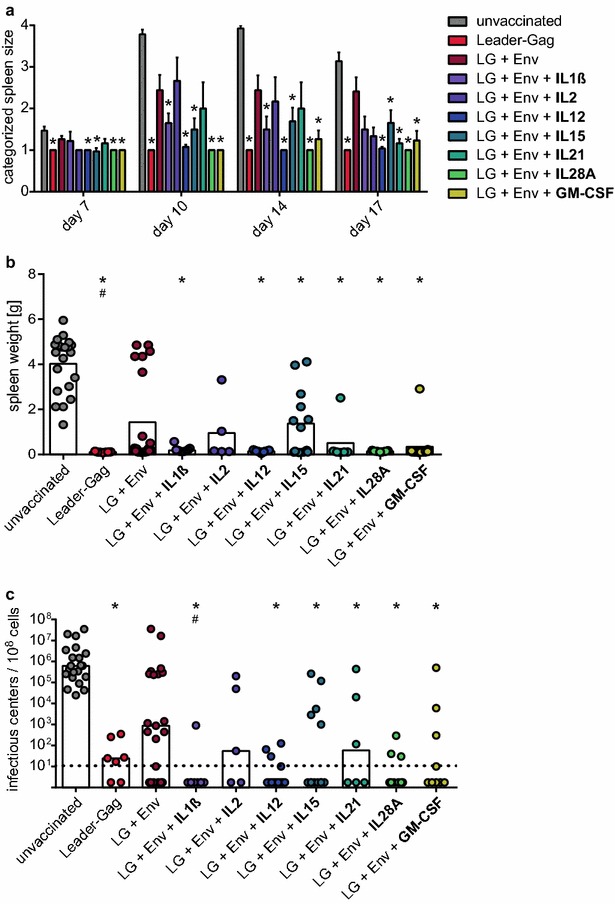
Results: In the Friend retrovirus mouse model, immunization with a plasmid encoding the Friend murine leukemia virus (F-MuLV) Leader-Gag protein resulted in induction of a strong GagL85-93-specific CD8+ T cell response, while the response was completely abrogated by co-immunization with an F-MuLV Env-encoding plasmid. In order to overcome this interference of retroviral envelope, we employed plasmids encoding the cytokines interleukin (IL) 1β, IL2, IL12, IL15, IL21, IL28A or granulocyte-macrophage colony-stimulating factor (GM-CSF) as genetic adjuvants. Co-application of plasmids encoding IL2, IL12, IL21, IL28A and especially GM-CSF rescued the induction of GagL85-93-specific CD8+ T cells in mice vaccinated with FV Leader-Gag and Env. Mice that were immunized with plasmids encoding Leader-Gag and Env and the cytokines IL1β, IL12, IL15, IL28A or GM-CSF, but not Leader-Gag and Env without any cytokine, showed significantly reduced viral loads upon a high-dose Friend virus challenge infection.

Conclusions: Our data demonstrate the potency of cytokine-encoding vectors as adjuvants and immune modulators in composite vaccines for anti-retroviral immunization.

Keywords: Adjuvant; Envelope; Friend retrovirus; Friend virus; Immune modulation; Immunosuppression; Retrovirus; Vaccine.


Figures

Fig. 1
Fig. 1
Induction of GagL85–93-specific CD8+ T cells by co-immunization with cytokine-encoding plasmids. CB6F1 mice were immunized once with a DNA plasmid encoding Leader-Gag, a mix of plasmids encoding Leader-Gag and Env (LG + Env), or a mix of plasmids encoding Leader-Gag, Env and cytokines as indicated; 25 µg of each plasmid were injected intramuscularly followed by in vivo electroporation. Two weeks after immunization, the frequency of GagL85–93-specific CD8+ T cells in blood cells was analysed by MHC I tetramer staining (a), the production of IFNγ by GagL85–93-specific CD8+ T cells was analysed by intracellular cytokine staining after peptide restimulation (b). Data were acquired in two to four independent experiments with three to four mice per group per experiment. Each dot indicates an individual mouse, the bars indicate the mean values. Data were analysed by Kruskall–Wallis One Way Analysis of Variance on Ranks and Dunn’s multiple comparison procedure, statistically significant differences (P < 0.05) compared to unvaccinated mice are indicated by *, significant differences compared to mice immunized with the combination of Leader-Gag and Env plasmids (LG + Env) are indicated by #
Fig. 2
Fig. 2
Binding antibody responses to plasmid combination vaccines. CB6F1 mice were immunized once with a DNA plasmid encoding Leader-Gag, a mix of plasmids encoding Leader-Gag and Env (LG + Env), or a mix of plasmids encoding Leader-Gag, Env and cytokines as indicated; 25 µg of each plasmid were injected intramuscularly followed by in vivo electroporation. Two weeks after immunization, blood samples were collected and F-MuLV-binding antibodies were analysed. The figure shows absorption values for plasma samples diluted 1:50 in PBS. Data were acquired in two to four independent experiments with three to four mice per group per experiment. Each dot indicates an individual mouse, bars indicate median values. Data were analysed by Kruskall–Wallis One Way Analysis of Variance on Ranks and Dunn’s multiple comparison procedure for statistical significance; statistically significant differences (P < 0.05) compared to unvaccinated mice are indicated by *, significant differences compared to mice immunized with the combination of Leader-Gag and Env plasmids (LG + Env) are indicated by #
Fig. 3
Fig. 3
Protection from FV challenge infection by co-immunization with cytokine-encoding plasmids. CB6F1 mice were immunized once with a DNA plasmid encoding Leader-Gag, a mix of plasmids encoding Leader-Gag and Env (LG + Env), or a mix of plasmids encoding Leader-Gag, Env and cytokines as indicated; 25 µg of each plasmid were injected intramuscularly followed by in vivo electroporation. Three weeks after immunization, mice were infected with 5000 spleen focus forming units FV. The development of splenomegaly was monitored by palpation of the spleen twice a week (a). Three weeks after FV challenge, mice were sacrificed and spleen weight (b) and viral loads in spleen cells were determined (c). Data were acquired in two to four independent experiments with three to four mice per group per experiment. The bars in (a) indicate the mean values, whiskers indicate the standard error of the means. Each dot (b, c) indicates an individual mouse, bars indicate mean (b) or median (c) values. Data were analysed by Kruskall–Wallis One Way Analysis of Variance on Ranks and Dunn’s multiple comparison procedure, statistically significant differences (P < 0.05) compared to unvaccinated mice are indicated by *, significant differences compared to mice immunized with the combination of Leader-Gag and Env plasmids (LG + Env) are indicated by #

References

    1. Korber B, Gaschen B, Yusim K, Thakallapally R, Kesmir C, Detours V. Evolutionary and immunological implications of contemporary HIV-1 variation. Br Med Bull. 2001;58:19–42. doi: 10.1093/bmb/58.1.19. - DOI - PubMed
    1. Heeney JL, Plotkin SA. Immunological correlates of protection from HIV infection and disease. Nat Immunol. 2006;7:1281–1284. doi: 10.1038/ni1206-1281. - DOI - PubMed
    1. Pantaleo G, Koup RA. Correlates of immune protection in HIV-1 infection: what we know, what we don’t know, what we should know. Nat Med. 2004;10:806–810. doi: 10.1038/nm0804-806. - DOI - PubMed
    1. Schlecht-Louf G, Mangeney M, El-Garch H, Lacombe V, Poulet H, Heidmann T. A targeted mutation within the feline leukemia virus (FeLV) envelope protein immunosuppressive domain to improve a canarypox virus-vectored FeLV vaccine. J Virol. 2014;88:992–1001. doi: 10.1128/JVI.02234-13. - DOI - PMC - PubMed
    1. Denner J. The transmembrane proteins contribute to immunodeficiencies induced by HIV-1 and other retroviruses. AIDS. 2014;28:1081–1090. doi: 10.1097/QAD.0000000000000195. - DOI - PubMed

Publication types

MeSH terms