


Impact of Transcatheter Technology on Surgical Aortic Valve Replacement Volume, Outcomes, and Cost
- PMID: 28450137
- PMCID: PMC5596915
- DOI: 10.1016/j.athoracsur.2017.02.039
Impact of Transcatheter Technology on Surgical Aortic Valve Replacement Volume, Outcomes, and Cost
Abstract
Background: Transcatheter aortic valve replacement (TAVR) represents a disruptive technology that is rapidly expanding in use. We evaluated the effect on surgical aortic valve replacement (SAVR) patient selection, outcomes, volume, and cost.
Methods: A total of 11,565 patients who underwent SAVR, with or without coronary artery bypass grafting (2002 to 2015), were evaluated from the Virginia Cardiac Services Quality Initiative database. Patients were stratified by surgical era: pre-TAVR era (2002 to 2008, n = 5,113), early-TAVR era (2009 to 2011, n = 2,709), and commercial-TAVR era (2012 to 2015, n = 3,743). Patient characteristics, outcomes, and resource utilization were analyzed by univariate analyses.
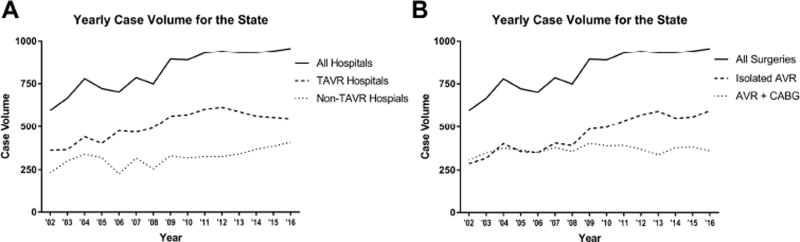
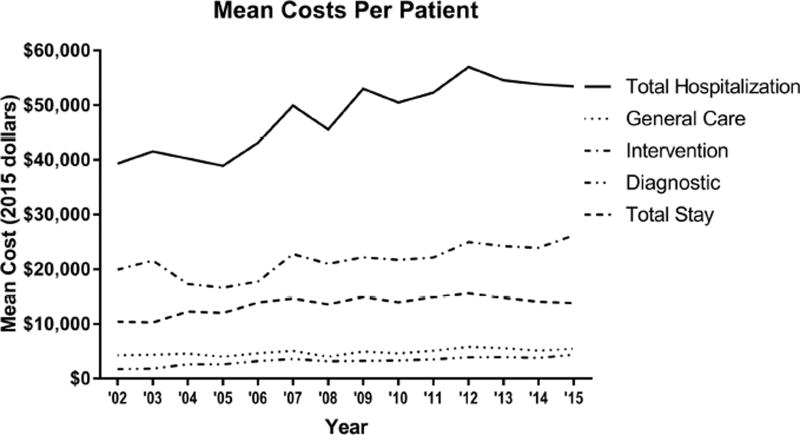
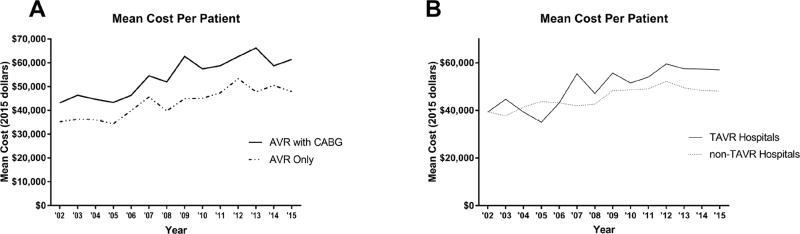
Results: Throughout the study period, statewide SAVR volumes increased with median volumes of pre-TAVR: 722 cases/year, early-TAVR: 892 cases/year, and commercial-TAVR: 940 cases/year (p = 0.005). Implementation of TAVR was associated with declining Society of Thoracic Surgeons predicted risk of mortality among SAVR patients (3.7%, 2.6%, and 2.4%; p < 0.0001), despite increasing rates of comorbid disease. The mortality rate was lowest in the current commercial-TAVR era (3.9%, 4.3%, and 3.2%; p = 0.05), and major morbidity decreased throughout the time period (21.2%, 20.5%, and 15.2%; p < 0.0001). The lowest observed-to-expected ratios for both occurred in the commercial-TAVR era (0.9 and 0.9, respectively). Resource utilization increased generally, including total cost increases from $42,835 to $51,923 to $54,710 (p < 0.0001).
Conclusions: At present, SAVR volumes have not been affected by the introduction of TAVR. The outcomes for SAVR continue to improve, potentially due to availability of transcatheter options for high-risk patients. Despite rising costs for SAVR, open approaches still provide a significant cost advantage over TAVR.
Copyright © 2017 The Society of Thoracic Surgeons. Published by Elsevier Inc. All rights reserved.
Figures
References
-
- 2016 Aging statistics. [Accessed 2016 May 23, 2016]; Available at http://www.aoa.acl.gov/aging_statistics/index.aspx.
-
- Eveborn GW, Schirmer H, Heggelund G, Lunde P, Rasmussen K. The evolving epidemiology of valvular aortic stenosis. The tromso study. Heart. 2013;99(6):396–400. - PubMed
-
- Iung B, Cachier A, Baron G, et al. Decision-making in elderly patients with severe aortic stenosis: Why are so many denied surgery? Eur Heart J. 2005;26(24):2714–2720. - PubMed
-
- Taniguchi T, Morimoto T, Shiomi H, et al. Initial surgical versus conservative strategies in patients with asymptomatic severe aortic stenosis. J Am Coll Cardiol. 2015;66(25):2827–2838. - PubMed
-
- Leon MB, Smith CR, Mack MJ, et al. Transcatheter or surgical aortic-valve replacement in intermediate-risk patients. N Engl J Med. 2016;374(17):1609–1620. - PubMed
MeSH terms
Grants and funding
LinkOut - more resources
Full Text Sources
Other Literature Sources
