. 2017 Jun 15;28(12):1688-1700.
doi: 10.1091/mbc.E17-02-0128. Epub 2017 Apr 27.

A novel Munc13-4/S100A10/annexin A2 complex promotes Weibel-Palade body exocytosis in endothelial cells

Affiliations

A novel Munc13-4/S100A10/annexin A2 complex promotes Weibel-Palade body exocytosis in endothelial cells

Tarek Chehab et al. Mol Biol Cell. .

Abstract

Endothelial cells respond to blood vessel injury by the acute release of the procoagulant von Willebrand factor, which is stored in unique secretory granules called Weibel-Palade bodies (WPBs). Stimulated WPB exocytosis critically depends on their proper recruitment to the plasma membrane, but factors involved in WPB-plasma membrane tethering are not known. Here we identify Munc13-4, a protein mutated in familial hemophagocytic lymphohistiocytosis 3, as a WPB-tethering factor. Munc13-4 promotes histamine-evoked WPB exocytosis and is present on WPBs, and secretagogue stimulation triggers an increased recruitment of Munc13-4 to WPBs and a clustering of Munc13-4 at sites of WPB-plasma membrane contact. We also identify the S100A10 subunit of the annexin A2 (AnxA2)-S100A10 protein complex as a novel Munc13-4 interactor and show that AnxA2-S100A10 participates in recruiting Munc13-4 to WPB fusion sites. These findings indicate that Munc13-4 supports acute WPB exocytosis by tethering WPBs to the plasma membrane via AnxA2-S100A10.


Figures

FIGURE 1:
FIGURE 1:
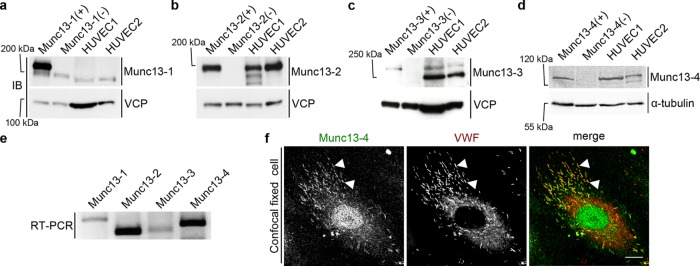
Expression and localization of Munc13 proteins in human endothelial cells. (a–d) Western blot (IB) detection of Munc13-1 to -4 in two different HUVEC lysates. Included are positive (+) and negative controls (–), that is, mouse brain lysates (Munc13-1 to -3) or mouse lung lysate (Munc13-4) from wild-type or the respective knockout mouse. Calculated molecular masses are as follows: Munc13-1, 193 kDa; Munc13-2, 180 kDa; Munc13-3, 250 kDa (migrates at ∼280 kDa in SDS–PAGE (Varoqueaux et al., 2005); and Munc13-4, 123 kDa. Valosin-containing protein (VCP; 97 kDa) and α-tubulin (55 kDa) served as loading control. In a, the weaker band below Munc13-1 most likely corresponds to Munc13-2, which shows some cross-reactivity with the anti–Munc13-1 antibody (Cooper et al., 2012). The lower band in the HUVEC lysates in c likely stems from an unspecific antibody reaction, as it is not seen in the mouse lysates. (e) RT-PCR of HUVEC cDNA with primers amplifying specific sequences of all human Munc13 proteins (Munc13-1, 243 base pairs; Munc13-2, 159 base pairs; Munc13-3, 168 base pairs; Munc13-4, 201 base pairs). (f) Confocal section of fixed HUVECs labeled with anti–Munc13-4 and anti-VWF antibodies and Alexa Fluor 488– and Alexa Fluor 647–conjugated secondary antibodies. Arrowheads mark examples of colocalizations of Munc13-4 and VWF on WPBs. Scale bar, 10 µm.
FIGURE 2:
FIGURE 2:
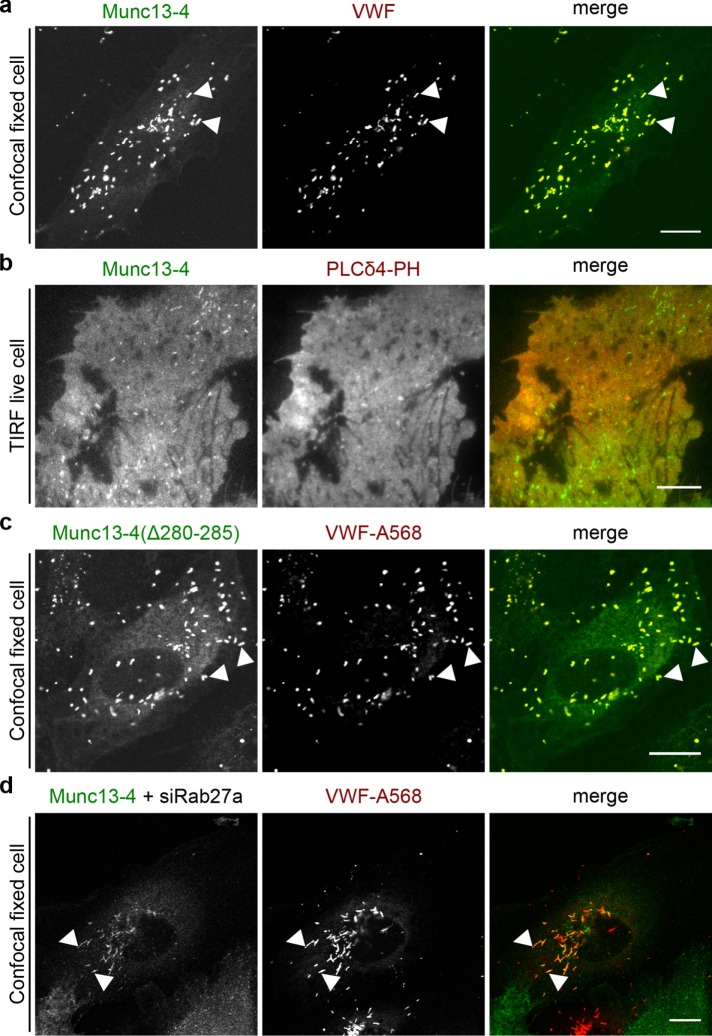
Munc13-4 localizes to WPBs and the plasma membrane independently of Rab27a. (a) Confocal section of fixed HUVECs expressing YFP–Munc13-4 for 48 h and labeled with anti-VWF and Alexa Fluor 568–conjugated secondary antibodies. (b) TIRF section of live HUVECs expressing YFP–Munc13-4 and the PI(4,5)P2-binding domain PLCδ4-PH-mKate as membrane marker. (c) Confocal section of fixed HUVECs expressing GFP–Munc13-4(Δ280-285), a mutant incapable of binding Rab27a, and labeled with anti-VWF and Alexa Fluor 568–conjugated secondary antibodies. (d) Confocal section of fixed HUVECs expressing YFP–Munc13-4 and transfected with siRNA against Rab27a (siRab27a) for 48 h. Cells were labeled with anti-VWF and Alexa Fluor 568–conjugated secondary antibodies. Arrowheads mark examples of colocalizations of Munc13-4 and VWF on WPBs. Scale bars, 10 µm.
FIGURE 3:
FIGURE 3:
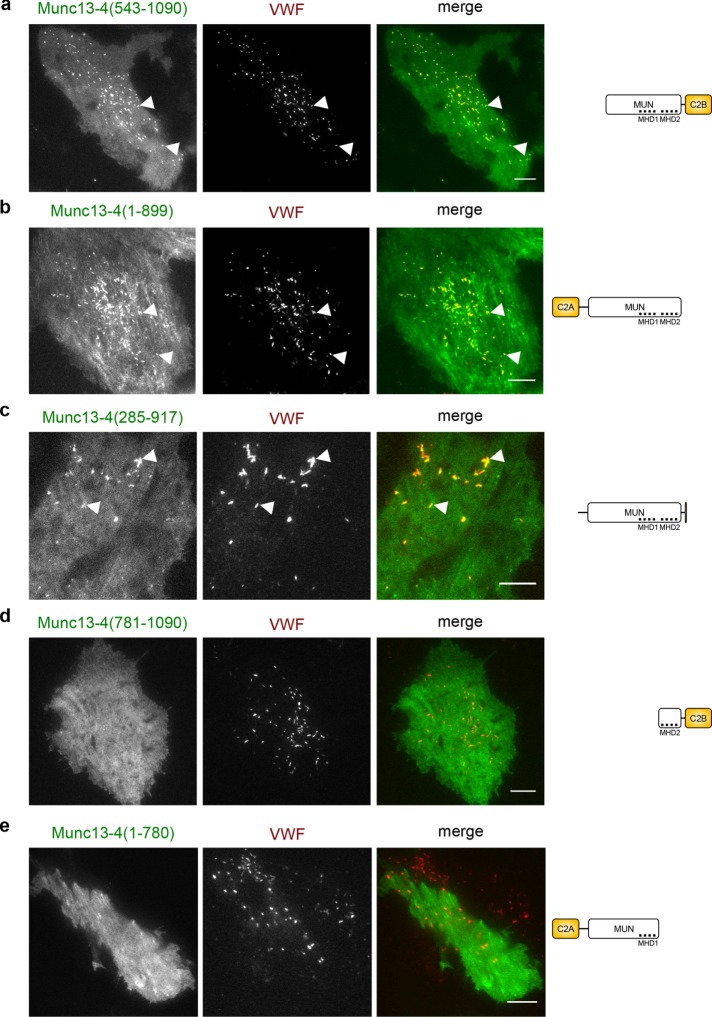
Munc13-4 localizes to WPBs via its MHD1/MHD2 region. TIRF images of live HUVECs expressing different truncated versions of YFP–Munc13-4 and VWF-RFP as WPB marker for 48 h. Right, domain structures of the respective Munc13-4 mutants lacking the C2A (aa 109–284), C2B (aa 904–1047), or parts of the MUN domain (aa 319–901). The first ∼100 aa of Munc13-4 of unknown structure were omitted for simplicity. MHD1 (aa 577–677) and MHD2 (aa 788–894) are two regions within the MUN domain with conserved sequences in all Munc13 proteins. (a) Munc13-4(543-1090), which lacks the C2A and parts of MUN domain but contains the entire region around MHD1/2. (b) Munc13-4(1-899), which lacks the C2B but contains the entire MHD1/2 region. (c) Munc13-4(285-917), which lacks C2A and C2B. (d) Munc13-4(1-780), which is truncated after MHD1 and therefore lacks MHD2-C2B. (e) Munc13-4(781-1090), which lacks the entire N-terminal part including MHD1. Arrowheads mark examples of colocalizations of Munc13-4 and VWF on WPBs. Note that mutants containing the MHD1 and MHD2 regions localize to WPBs, whereas those lacking these sequences do not. Scale bars, 10 µm.
FIGURE 4:
FIGURE 4:
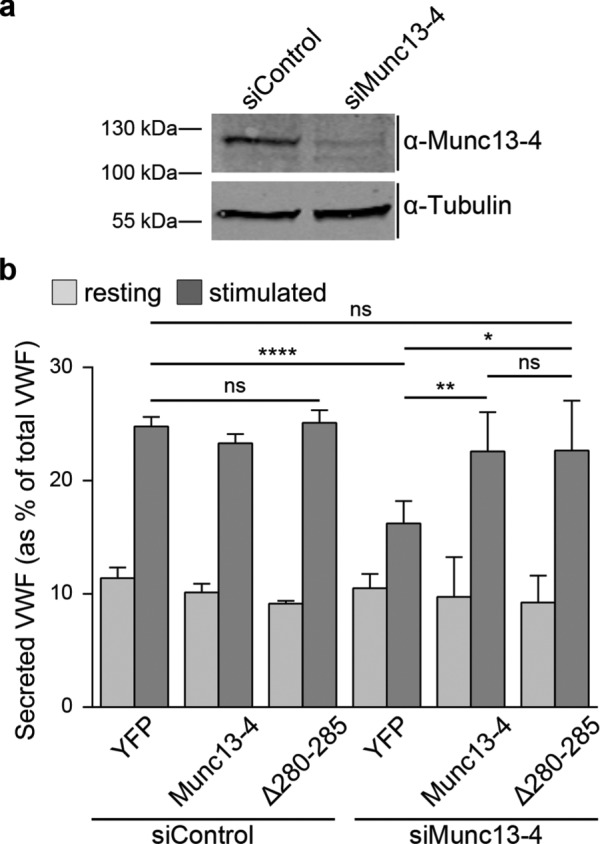
Munc13-4 is required for histamine-induced secretion of VWF. (a) HUVECs were treated with unspecific siRNA as control (siControl) or siRNA targeting Munc13-4 (siMunc13-4), and lysates of the respective cells were subjected to Western blot analysis with anti–Munc13-4 antibodies. Probing with anti–α-tubulin (55 kDa) antibodies served as loading control. Note that endogenous Munc13-4 was successfully depleted. (b) ELISA-based VWF secretion assay. HUVECs were transfected with siControl or Munc13-4 targeting siRNA (siMunc13-4) plus expression vectors encoding YFP (control), YFP-Munc13-4, or GFP-Munc13-4(Δ280-285), which were both rendered insensitive to the specific Munc13-4 siRNA (see Materials and Methods). In each case, the amount of VWF secreted into the cell culture supernatant was measured by ELISA. Means of at least five independent experiments that were tested for statistical significance by one-way ANOVA with Tukey’s test (ns, not statistically significant, *p ≤ 0.05, **p ≤ 0.01, ****p ≤ 0.0001). Bars represent mean ± SEM. Numbers of independent experiments: siControl plus YFP or Munc13-4, eight; siControl plus Δ280-285, seven; siMunc13-4 plus YFP or Munc13-4, six; siMunc13-4 plus Δ280-285, five.
FIGURE 5:
FIGURE 5:
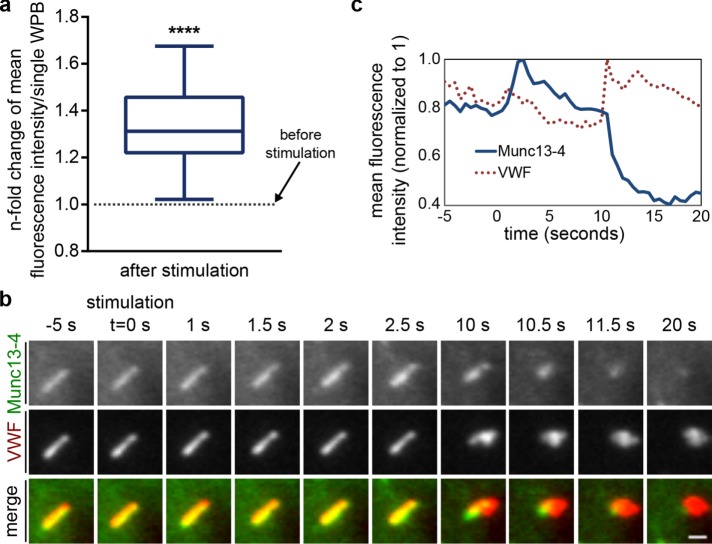
Histamine stimulation induces an additional recruitment of Munc13-4 to WPBs. (a) Munc13-4 fluorescence signals increase on WPBs after histamine stimulation. Cells expressing YFP–Munc13-4 or Munc13-4–mKate together with VWF-RFP or VWF-GFP were stimulated with histamine and imaged by live-cell confocal microscopy. Image stills were thresholded in ImageJ to create ROIs for Munc13-4–positive WPBs in a cell and compare mean fluorescence intensities of all ROIs soon before and soon after stimulation. Mean fluorescence intensity before stimulation was set to 1, and the increase after stimulation was measured as the n-fold change in mean fluorescence intensity for every individual ROIs. Mean n-fold changes from all individual ROIs (a total of 323 WPBs from at least three independent experiments) were tested for statistical significance by one-sample t test (****p ≤ 0.0001). (b) Munc13-4 increases and then disappears at a WPB during exocytosis. HUVECs expressing YFP–Munc13-4 and VWF-RFP were stimulated with 100 µM histamine, and the fusion of individual WPBs with the plasma membrane was recorded by TIRF microscopy. TIRF sections of a single WPB positive for YFP–Munc13-4 and VWF-RFP. The cell was stimulated at t = 0 s, and fusion of this WPB occurred at t = 10 s. See also Supplemental Video Fig5video01. Scale bar, 1 µm. (c) Corresponding mean fluorescence intensities (YFP, RFP) of the WPB shown in b vs. time. The YFP–Munc13-4 signature shows a fluorescence increase on stimulation (t = 0 to 2.5 s) and subsequently a rapid decrease in fluorescence that coincides with the formation of a characteristic VWF fusion spot (t = 10 to 11.5 s).
FIGURE 6:
FIGURE 6:
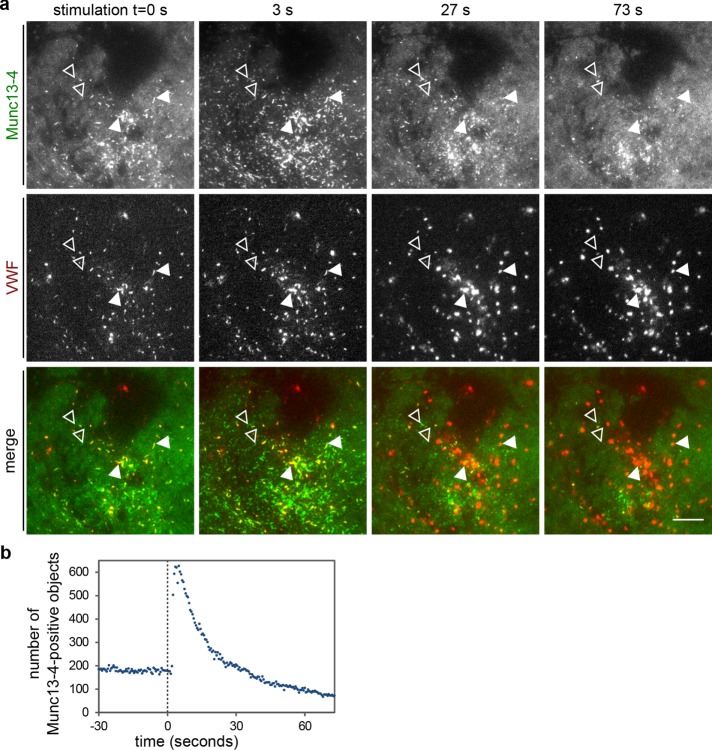
Histamine stimulation induces a clustering of Munc13-4 at or close to the plasma membrane. (a) TIRF sections of live HUVECs expressing YFP–Munc13-4 and VWF-RFP as WPB marker and stimulated with 100 µM histamine at t = 0 s. Before stimulation, YFP-Munc13-4 shows a general plasma membrane localization and is present on VWF-RFP–positive WPBs that reside in the TIRF field (examples marked by filled arrowheads). Some YFP-Munc13-4–positive objects that are shaped like WPBs but do not contain VWF-RFP can also be weakly seen against the general background (examples marked by open arrowheads). Stimulation triggers an additional clustering of Munc13-4 (t = 3 s), that is, the Munc13-4–positive objects become brighter as more Munc13-4 is recruited to them (see also Figure 5 for WPB-associated Munc13-4). WPB exocytosis, which is accompanied by the formation of a characteristic VWF-RFP fusion spot, leads to a disappearance of the Munc13-4–positive clusters. Arrowheads mark examples of Munc13-4–positive objects that colocalize with VWF-RFP and disappear after WPB fusion (fusion here occurred mainly between t = 3 and 27 s). Scale bar, 10 µm. See also Supplemental Video Fig 6video02. (b) Number of Munc13-4–positive objects in the TIRF field vs. time for the cell shown in a.
FIGURE 7:
FIGURE 7:
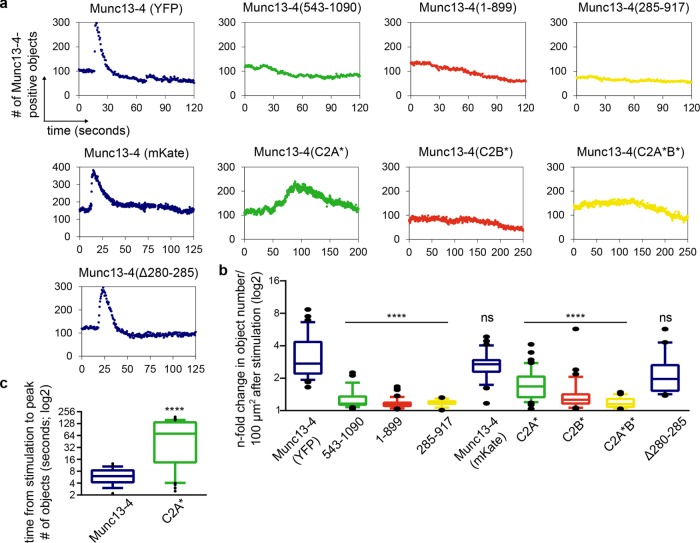
Deletion of C2A or C2B abolishes the stimulation-induced clustering of Munc13-4 at the plasma membrane. TIRF time-lapse movies of live HUVECs expressing YFP–Munc13-4, Munc13-4–mKate or the indicated mutant constructs and VWF-RFP as WPB marker were recorded, and the obtained images were analyzed by the object detection algorithm MorphoQuant. (a) Representative graphs showing the number of Munc13-4–positive objects detected in the TIRF field of HUVECs stimulated with 100 µM histamine at t = 15 s. Cells were transfected with YFP- or mKate-tagged full-length Munc13-4, Munc13-4 variants with truncated C2 domains, Munc13-4 variants with mutations in the Ca2+-binding sites of the C2 domains, or Munc13-4(Δ280-285). Munc13-4(543-1090) lacks the C2A domain, Munc13-4(1-899) lacks the C2B domain, and Munc13-4(285-917) lacks both C2A and C2B (Elstak et al., 2011). Munc13-4(C2A*) carries two point mutations in the Ca2+-binding site of the C2A domain, Munc13-4(C2B*) carries two analogous point mutations in the Ca2+-binding site of the C2B domain, and Munc13-4(C2A*B*) carries these mutations in both C2 domains (Boswell et al., 2012). (b) Change in the number of Munc13-4–positive objects/100 µm2 after histamine stimulation. Cells were transfected and stimulated as in a. Means of n-fold changes over all cells from at least five independent experiments were tested for statistical significance by one-way ANOVA with Tukey’s test (ns, statistically not significant, ****p ≤ 0.0001, as compared with the wild-type samples). Numbers of cells analyzed: Munc13-4, 33; Munc13-4(543-1090), 27; Munc13-4(1-899), 42; Munc13-4(285-917), 14; Munc13-4 (mKate), 32; Munc13-4(C2A*), 52; Munc13-4(C2B*), 35; Munc13-4(C2A*B*), 35; Munc13-4(D280-285), 35. Means ± SEM: 3.5 ± 0.3, 1.3 ± 0.03, 1.2 ± 0.02, 1.2 ± 0.02, 2.8 ± 0.1, 1.8 ± 0.1, 1.5 ± 0.1, 1.2 ± 0.02, and 2.3 ± 0.2. (c) Munc13-4(C2A*) is recruited more slowly to WPBs. HUVECs expressing VWF-RFP and YFP-Munc13-4 or YFP-Munc13-4(C2A*) were stimulated as in a. Given is the time from stimulation to the peak of Munc13-4–positive objects in the TIRF field. Means over all cells analyzed were tested for statistical significance by unpaired t test (****p ≤ 0.0001). Means ± SEM: 6.3 ± 0.1 (Munc13-4), 79 ± 8.6 (Munc13-4(C2A*)).
FIGURE 8:
FIGURE 8:
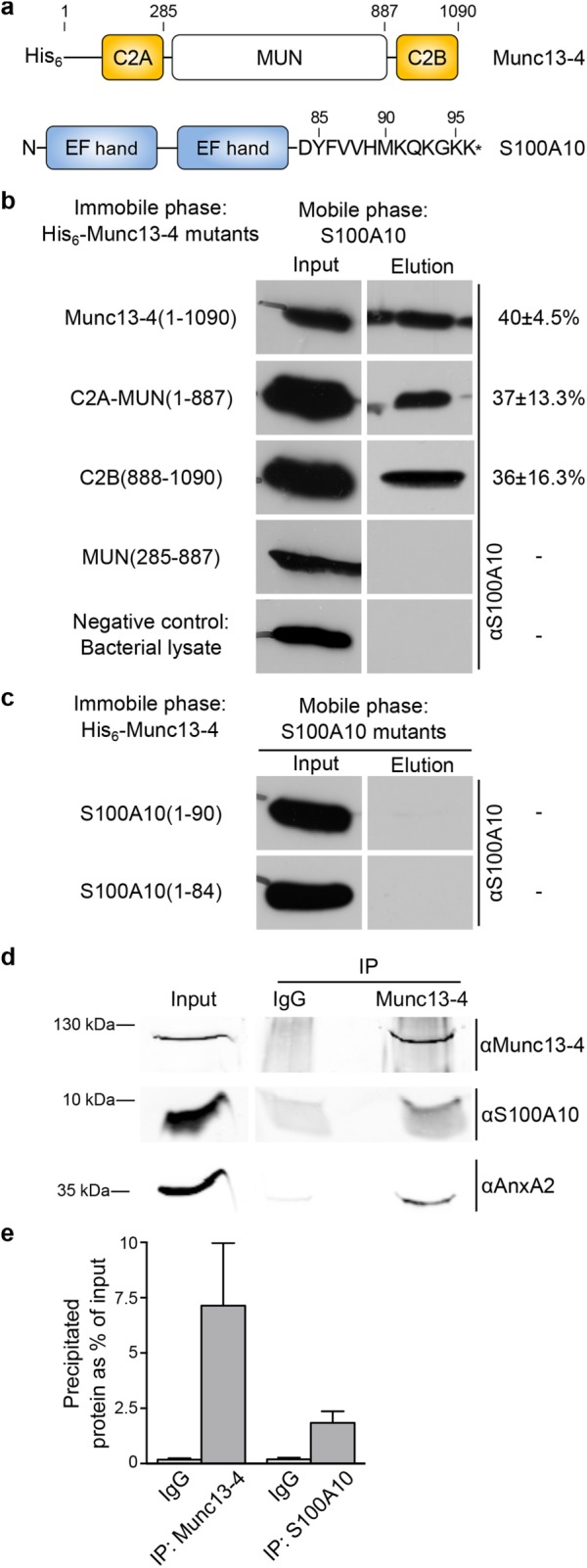
Munc13-4 interacts with the S100A10 subunit of the AnxA2-S100A10 complex. (a) Domain structures of Munc13-4 and S100A10. MUN, Munc13-homology domain. (b) S100A10 binds to both C2 domains of Munc13-4. In vitro binding assay with full-length or truncated mutants of Munc13-4 and wild-type S100A10. Bacterially expressed His6–Munc13-4 derivatives were immobilized on Ni-NTA and incubated with purified S100A10 (Input). After several washing steps, bound S100A10 was eluted as described in Materials and Methods (Elution). Lysates of untransformed E. coli served as negative control. The amount of eluted S100A10 as percentage of S100A10 input was quantified from at least three different experiments and is given next to the respective mutant panel on the right. Values are means ± SEM. (c) Two C-terminally truncated mutants of S100A10, S100A10(1-90) and S100A10(1-84), do not bind Munc13-4. In vitro binding assay as described in b with immobilized full-length His6–Munc13-4 and the two S100A10 truncation mutants. Note that S100A10(1-90). which can still bind AnxA2 (Kube et al., 1992), fails to interact with Munc13-4. (d) CoIP of Munc13-4 and AnxA2-S100A10. Postnuclear HUVEC supernatants were incubated with Dynabeads-coupled antibodies against either Munc13-4 (IP Munc13-4) or rabbit IgGs as negative control (IP IgG). The starting material (Input) and the precipitated proteins were analyzed by SDS–PAGE (15% gel in top and 10% gel in bottom images) and immunoblotting with antibodies against Munc13-4, S100A10 or AnxA2. (e) Relative amount of precipitated Munc13-4 and S100A10 in the immunoprecipitation experiments using either specific anti-Munc13-4 (IP) or control rabbit IgGs (IgG). Band intensities were calculated as percentage of the input material from five independent experiments (one example is shown in d). Bars represent mean ± SEM.
FIGURE 9:
FIGURE 9:
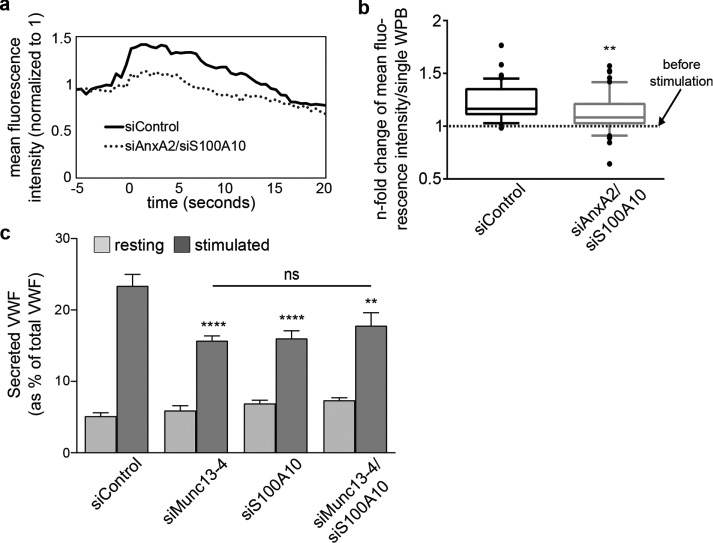
Munc13-4 and S100A10 function together in histamine-induced secretion of VWF. (a, b) Histamine-induced recruitment of Munc13-4 to WPB fusion sites is decreased on AnxA2-S100A10 depletion. HUVECs were transfected for 48 h with VWF-GFP as WPB marker, Munc13-4–mKate, and unspecific siControl RNAs or siRNAs targeting AnxA2-S100A10. Cells were stimulated with histamine at t = 0 s and imaged by live-cell TIRF microscopy, and individual WPB fusion sites were identified by a collapse of the VWF-GFP signal. Image stills were thresholded in ImageJ to create ROIs for Munc13-4–positive WPBs at WPB fusion sites and compare mean fluorescence intensities of all ROIs soon before and soon after stimulation. Mean fluorescence intensity before stimulation was set to 1, and the increase after stimulation was measured as the n-fold change in mean fluorescence intensity. (a) Examples of Munc13-4–mKate mean fluorescence intensity recordings of individual WPBs from cells treated with siControl or siRNAs targeting AnxA2-S100A10, respectively. (b) Comparison of histamine-induced Munc13-4–mKate fluorescence intensity changes of individual WPBs in siControl– and siAnxA2/siS100A10–treated cells at 2.5 s after stimulation. Mean n-fold changes from individual ROIs for Munc13-4-mKate–positive WPBs (a total of at least 57 WPBs/condition from at least three independent experiments) were tested for statistical significance by Mann–Whitney U test (**p ≤ 0.01). (c) ELISA-based VWF secretion assay. HUVECs were transfected for 48 h with unspecific siControl or siRNA targeting Munc13-4 (siMunc13-4) or S100A10 (siS100A10), or siRNAs targeting both proteins in a double knockdown (siMunc13-4/siS100A10). In each case, the amount of VWF secreted into the cell culture supernatant was measured by ELISA. Means of four independent experiments tested for statistical significance by one-way ANOVA with Tukey’s test (**p ≤ 0.01, ****p ≤ 0.0001, as related to the control sample). Differences between samples treated with specific siRNA were statistically not significant (ns). Bars represent mean ± SEM.

References

    1. Ayala-Sanmartin J, Gouache P, Henry J-P. N-terminal domain of annexin 2 regulates Ca2+-dependent membrane aggregation by the core domain: a site directed mutagenesis study. Biochemistry. 2000;39:15190–15198. - PubMed
    1. Betz A, Okamoto M, Benseler F, Brose N. Direct interaction of the rat unc-13 homologue Munc13-1 with the N terminus of syntaxin. J Biol Chem. 1997;272:2520–2526. - PubMed
    1. Bierings R, Hellen N, Kiskin N, Knipe L, Fonseca A-V, Patel B, Meli A, Rose M, Hannah MJ, Carter T. The interplay between the Rab27A effectors Slp4-a and MyRIP controls hormone-evoked Weibel-Palade body exocytosis. Blood. 2012;120:2757–2767. - PMC - PubMed
    1. Boswell KL, James DJ, Esquibel JM, Bruinsma S, Shirakawa R, Horiuchi H, Martin TFJ. Munc13-4 reconstitutes calcium-dependent SNARE-mediated membrane fusion. J Cell Biol. 2012;197:301–312. - PMC - PubMed
    1. Brandherm I, Disse J, Zeuschner D, Gerke V. cAMP-induced secretion of endothelial von Willebrand factor is regulated by a phosphorylation/dephosphorylation switch in annexin A2. Blood. 2013;122:1042–1051. - PubMed