. 2017 Apr 13:8:551.
doi: 10.3389/fpls.2017.00551. eCollection 2017.

Bioactivity in Rhododendron: A Systemic Analysis of Antimicrobial and Cytotoxic Activities and Their Phylogenetic and Phytochemical Origins

Affiliations

Bioactivity in Rhododendron: A Systemic Analysis of Antimicrobial and Cytotoxic Activities and Their Phylogenetic and Phytochemical Origins

Anne Grimbs et al. Front Plant Sci. .

Abstract

The exceptional diversity of the genus Rhododendron has a strong potential for identification, characterization, and production of bioactive lead compounds for health purposes. A particularly relevant field of application is the search for new antibiotics. Here, we present a comparative analysis of nearly 90 Rhododendron species targeted toward the search for such candidate substances. Through a combination of phytochemical profiles with antimicrobial susceptibility and cytotoxicity, complemented by phylogenetic analyses, we identify seven potentially antimicrobial active but non-cytotoxic compounds in terms of mass-to-charge ratios and retention times. Exemplary bioactivity-guided fractionation for a promising Rhododendron species experimentally supports in fact one of these candidate lead compounds. By combining categorical correlation analysis with Boolean operations, we have been able to investigate the origin of bioactive effects in further detail. Intriguingly, we discovered clear indications of systems effects (synergistic interactions and functional redundancies of compounds) in the manifestation of antimicrobial activities in this plant genus.

Keywords: Rhododendron; antimicrobial activity; bioactive compounds; categorical correlation analysis; cytotoxicity; phylogeny; phytochemical profiling.


Figures
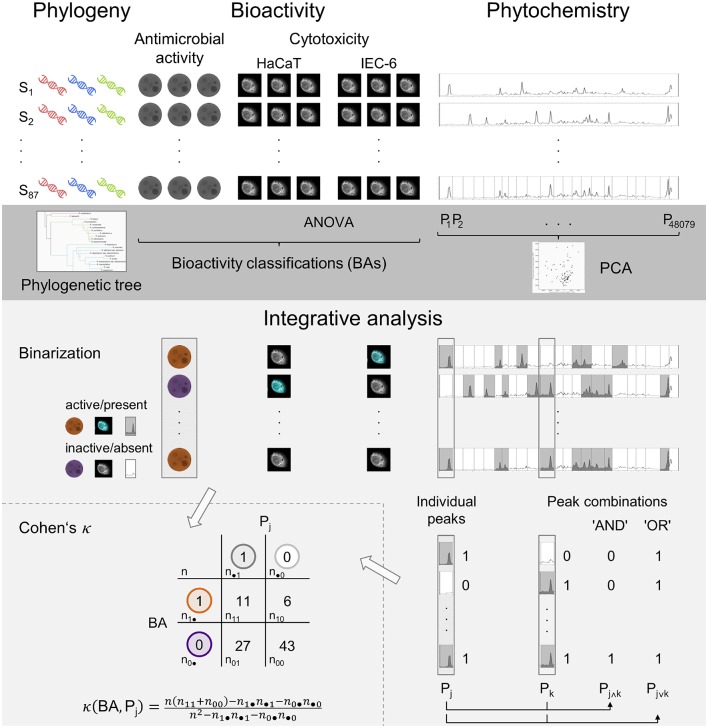
Figure 1
Figure 1
Schematic overview of the experimental approaches (white background) and statistical analyses (gray backgrounds) in the presented study. The dark gray region depicts the individual analyses while the brighter gray part illustrates the integrative analysis. Incorporating the individual results and based on the binarization of the processed data, bioactivity and phytochemistry are aligned in the correlation analysis, Cohen's κ.
Figure 2
Figure 2
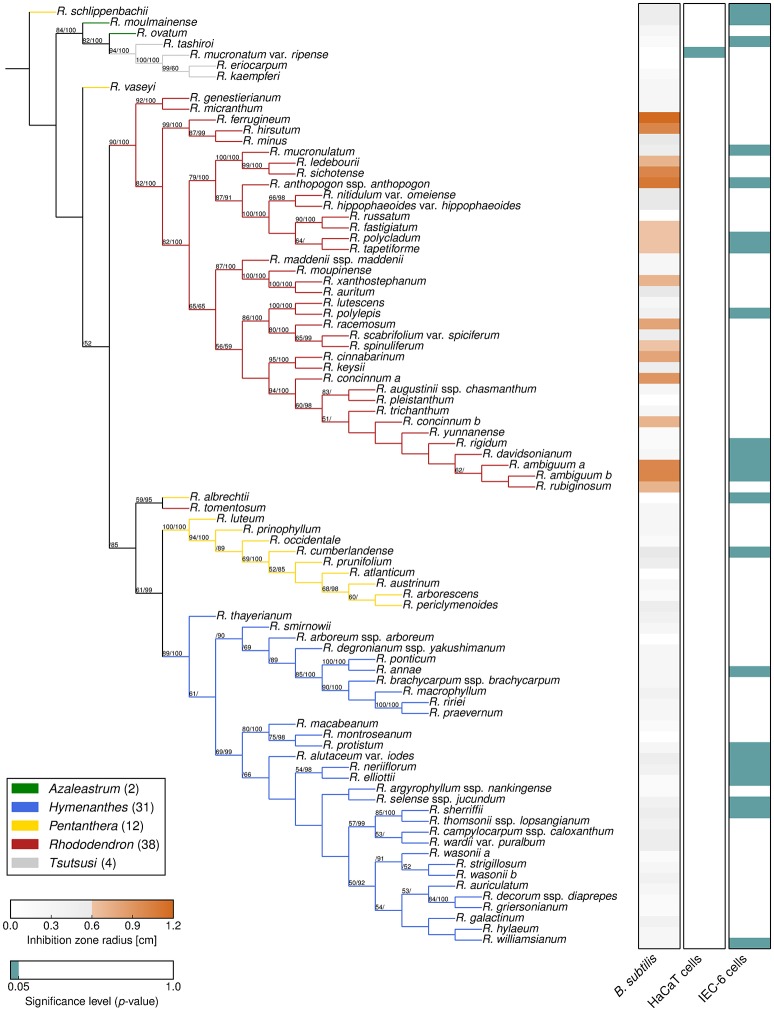
Phylogeny and bioactivities of Rhododendron. The phylogenetic tree of the 87 Rhododendron species is based on three genetic markers, trnK, trnL-F, and ITS. The support values from likelihood bootstrap analysis (before slash) and Bayesian inference (after slash) are denoted at the respective branches. The three panels show the antimicrobial activity against B. subtilis (left), and the cytotoxicity toward HaCaT cells (middle), and IEC-6 cells (right) with respect to the given threshold and significance level, respectively.
Figure 3
Figure 3
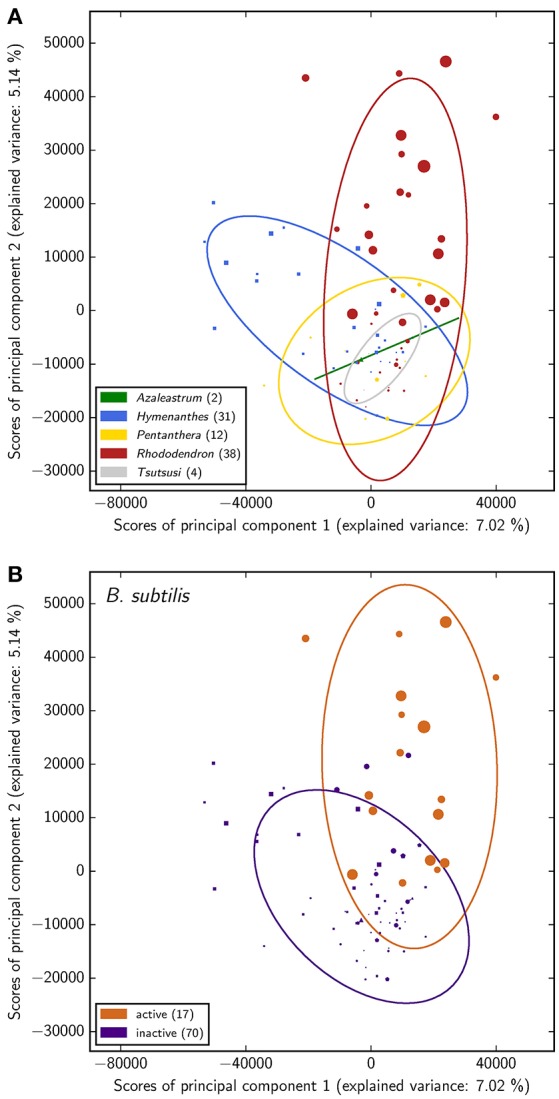
Principal component analysis of the phytochemical data for all 87 Rhododendron species. The scores of the principal components corresponding to the species are colored with respect to the corresponding subgenera (A) and antimicrobial activity classification (B), respectively. In addition, the item shape highlights the subgenus of each species (△:Azaleastrum, ◻:Hymenanthes, formula image:Pentanthera, ◯:Rhododendron, ▽:Tsutsusi) and the item size illustrates the antimicrobial activity of the respective species (the larger the more active).
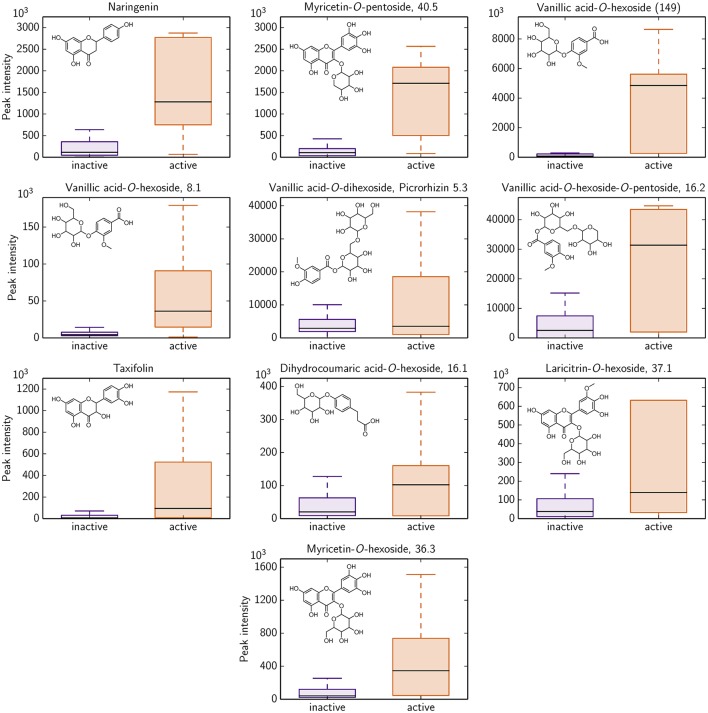
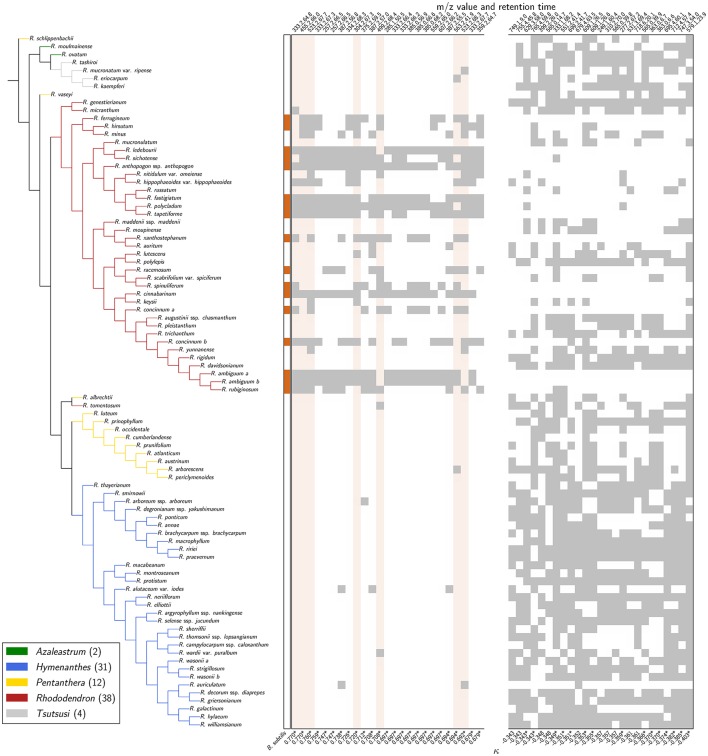
Figure 4
Figure 4
Identified polyphenolics showing significant differences in LC-MS intensity with respect to antimicrobial activity classification of all 87 Rhododendron species (remaining 282 identified compounds are provided in Figure S4). 17 species are denoted as antimicrobial active (orange), i.e., the radius of the agar diffusion assay is ≥0.6 cm, and, thus, 70 species are characterized as antimicrobial inactive (violet).
Figure 5
Figure 5
The 25 most- and least-predictive LC-MS peaks with respect to Cohen's kappa correlation for antimicrobial activity across all 87 Rhododendron species mapped against their phylogeny. A sample is denoted as antimicrobial active (orange) if the radius of the agar diffusion assay is ≥0.6 cm. A compound, defined by an m/z ratio and retention time tuple, is denoted as present in a sample (gray) if its intensity is ≥10,000. The * emphasizes significant correlations with respect to multiple testing correction by Benjamini-Hochberg (α = 0.05). The seven most-predictive peaks regarding antimicrobial activity and non-cytotoxicity at once are highlighted in bright orange.
Figure 6
Figure 6
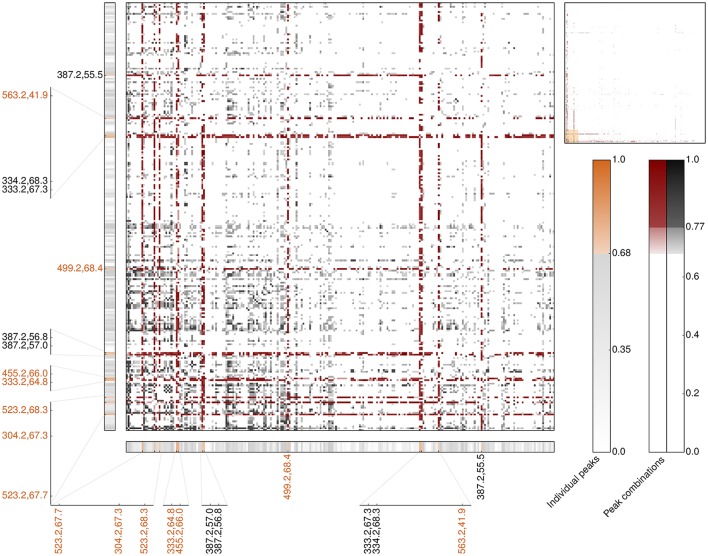
Heatmap of the top 250 LC-MS peaks involved on the most-predictive additive peak combinations regarding Cohen's kappa correlation for antimicrobial activity across all 87 Rhododendron species (main panel). The upper right panel provides the overview of all 643 peaks included in the outperforming additive peak combinations, namely κ ≥ 0.77. The combinations highlighted in red involve at least one of the 23 most-predictive peaks regarding the individual peak analysis, κ ≥ 0.68. The corresponding individual peak correlation coefficients are depicted in the thinner horizontal and vertical panels. Orange labels emphasize the seven most-predictive individual peaks regarding antimicrobial activity and non-cytotoxicity.

References

    1. Angiosperm Phylogeny Group (2016). An update of the Angiosperm Phylogeny Group classification for the orders and families of flowering plants: APG IV. Bot. J. Linn. Soc. 181, 1–20. 10.1111/boj.12385 - DOI
    1. Argent G. (1997). The Rhododendron Handbook 1998: Rhododendron Species in Cultivation. London: Royal Horticultural Society.
    1. Benjamini Y., Hochberg Y. (1995). Controlling the false discovery rate: a practical and powerful approach to multiple testing. J. R. Stat. Soc. Ser. B Stat. Methodol 57, 289–300.
    1. Berenbaum M. C. (1989). What is synergy? Pharmacol. Rev. 41, 93–141. - PubMed
    1. Biasutto L., Zoratti M. (2014). Prodrugs of quercetin and resveratrol: a strategy under development. Curr. Drug Metab. 15, 77–95. 10.2174/1389200214666131211160005 - DOI - PubMed