. 2017 Apr 1;8(4):2983-2993.
doi: 10.1039/c6sc05354h. Epub 2017 Jan 30.

Expanding a fluorescent RNA alphabet: synthesis, photophysics and utility of isothiazole-derived purine nucleoside surrogates

Affiliations

Expanding a fluorescent RNA alphabet: synthesis, photophysics and utility of isothiazole-derived purine nucleoside surrogates

Alexander R Rovira et al. Chem Sci. .

Abstract

A series of emissive ribonucleoside purine mimics, all comprised of an isothiazolo[4,3-d]pyrimidine core, was prepared using a divergent pathway involving a key Thorpe-Ziegler cyclization. In addition to an adenosine and a guanosine mimic, analogues of the noncanonical xanthosine, isoguanosine, and 2-aminoadenosine were also synthesized and found to be emissive. Isothiazolo 2-aminoadenosine, an adenosine surrogate, was found to be particularly emissive and effectively deaminated by adenosine deaminase. Competitive studies with adenosine deaminase with each analogue in combination with native adenosine showed preference for the native substrate while still deaminating the isothiazolo analogues.


Figures
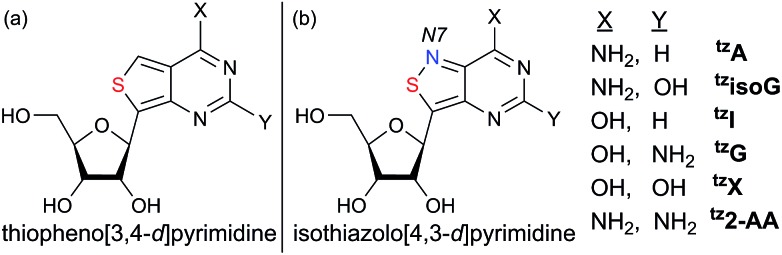
Fig. 1
Fig. 1. Thiopheno vs. isothiazolo family.
Fig. 2
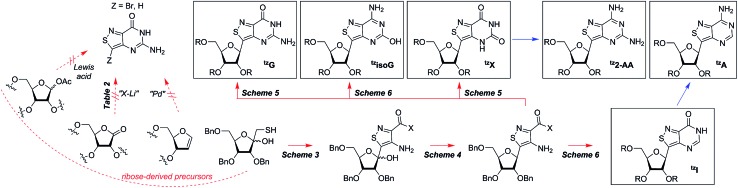
Fig. 2. The synthetic family tree of an isothiazolo alphabet and potential synthetic routes.
Scheme 1
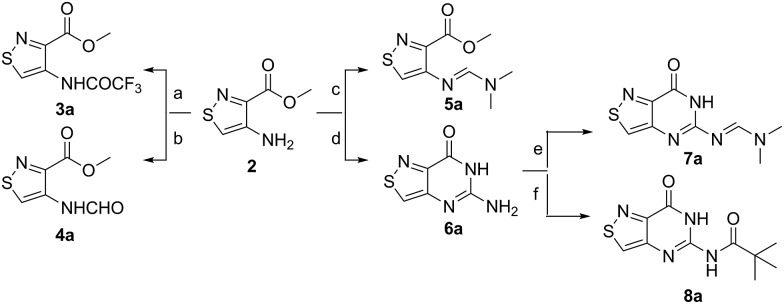
Scheme 1. Isothiazolo functional library. Conditions: (a) trifluoroacetic anhydride, Py, 0 °C to rt, 90 min, 72% yield; (b) KOCN, H2O, acetic acid, rt, 12 h, 70% yield; (c) dimethylformamide dimethyl acetal, DMF, rt, 12 h, 45% yield; (d) chloroformamidine hydrochloride, dimethylsulfone, 125 °C, 1 h, 74% yield; (e) dimethylformamide dimethyl acetal, DMF, rt, 12 h, 68% yield; (f) piv-Cl, Py, rt to 70 °C, 1 h, 61% yield.
Fig. 3
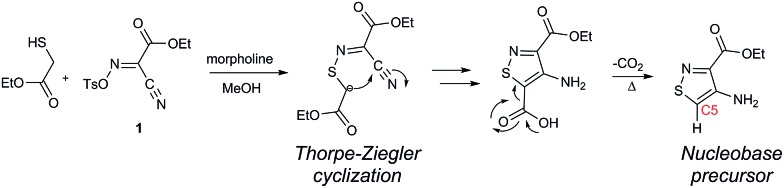
Fig. 3. Thorpe–Ziegler cyclization.
Scheme 2
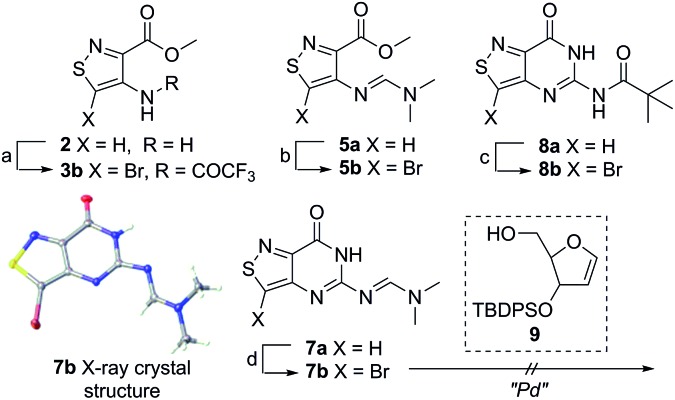
Scheme 2. Bromination of derivatives. Reagents and conditions: (a) Br2, AcOH, 55 °C, 1 h, 73% yield; (b) Br2, AcOH, 50 °C, 2 h, 41% yield; (c) (i) Br2, AcOH, 50 °C, 1 h, (ii) TFAA, Py, 0 °C to rt, 9 h, 60% overall; (d) Br2, AcOH, 50 °C, 2 h, 63% yield.
Scheme 3
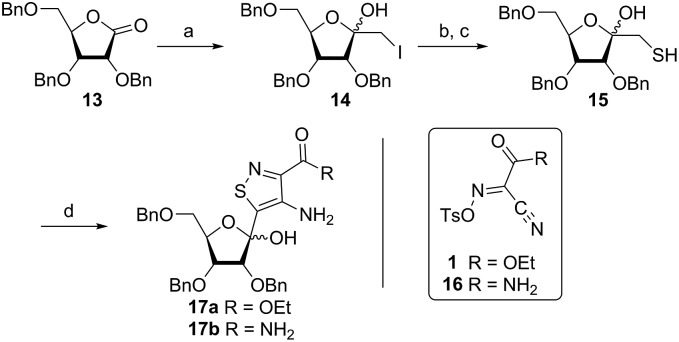
Scheme 3. Thiol construction and cyclization. Conditions: (a) CH2I2, MeLi, toluene, –78 °C, 1 h, 67%; (b) potassium thioacetate, DMF, rt, 6 h, 74%; (c) Et2O, LiAlH4, 0 °C to rt, 1 h, >90%; (d) 16a or 16b, morpholine, MeOH, 0 °C to rt, 12 h, 67% (17a), 79% (17b).
Scheme 4
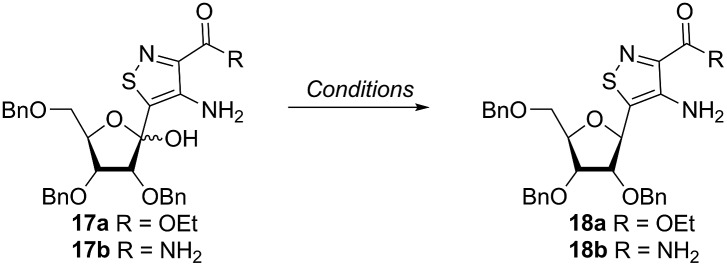
Scheme 4. Reduction of lactol. Conditions: (a) 17a, BF3·OEt2, triethylsilane, DCM, –78 °C to rt, 4 h, 67% yield; (b) 17b, BF3·OEt2, triethylsilane, DCM, –78 °C to rt, 4 h, 79% yield. (c) 17a, (i) NaBH4, MeOH, 0 °C, 4 h, (ii) DIAD, PPh3, DCM, 0 °C to rt, 12 h, 30% over 2 steps; (d) (i) 17a, l-selectride, MeOH, 0 °C, 4 h, (ii) DIAD, PPh3, DCM, 0 °C to rt, 12 h, 40% over 2 steps.
Scheme 5
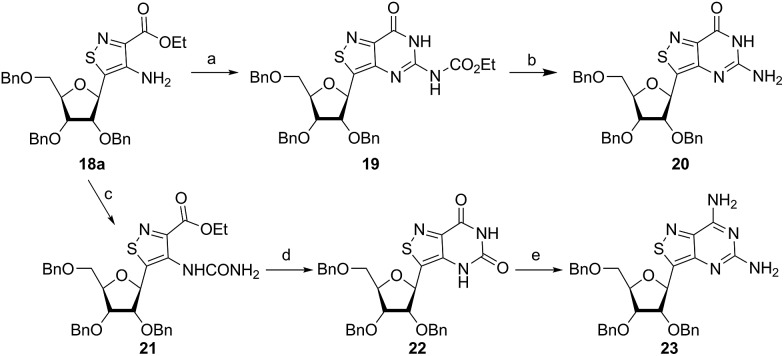
Scheme 5. Protected tzG (20), tzX (22), tz2-AA (23) synthesis. Conditions: (a) (i) ethoxycarbonyl isothiocyanate, MeCN, rt, 6 h; (ii) EDCl, HMDS, rt, 24 h, 63% over 2 steps; (b) 1 M NaOH, MeOH, 80 °C, 1 h; (c) KOCN, H2O, acetic acid, rt, 12 h, 79%; (d) NaOMe, MeOH, rt, 12 h, 89%; (e) (i) POCl3, pyridine, 100 °C, 2 h; (ii) NH3, MeOH, 80 °C, 24 h, 40% over 2 steps.
Scheme 6
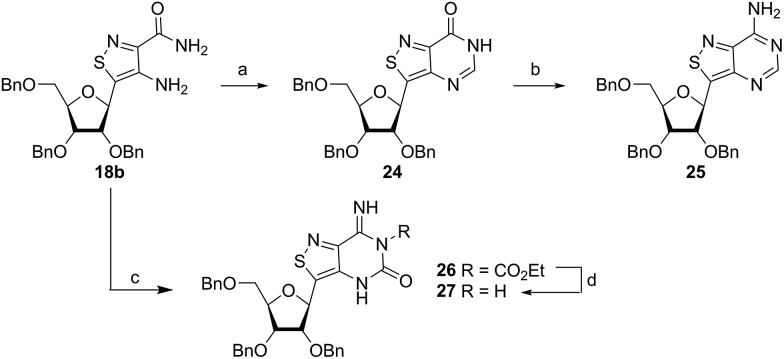
Scheme 6. Synthesis of protected tzA (25) and tzisoG (27). Conditions: (a) triethyl orthoformate, acetic anhydride, 100 °C, 69% yield; (b) (i) P2S5, Py, 120 °C, (ii) NH3, MeOH, 80 °C, 80% crude yield; (c) ethoxycarbonyl isothiocyanate, EDC, HMDS, MeCN, rt, 72 h, 40% yield; (d) 1 M NaOH, MeOH, 80 °C, 1 h, 90% crude yield.
Fig. 4
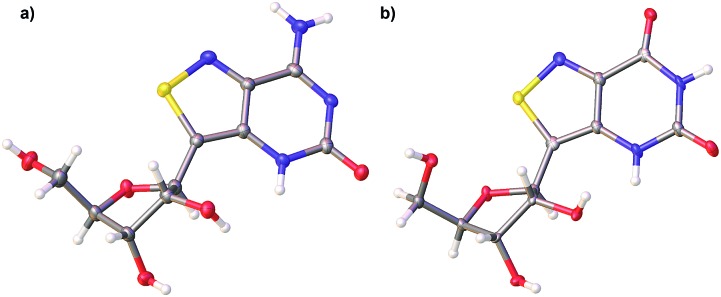
Fig. 4. X-ray crystal structures of isothiazolo[3,4-d]pyrimidine analogs: (a) tzisoG (b) tzX.
Fig. 5
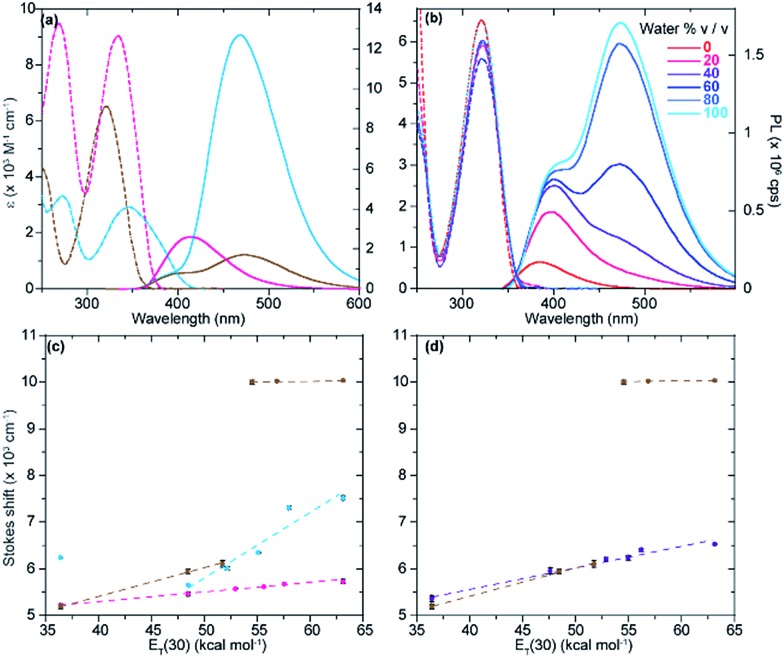
Fig. 5. (a) Absorption (dashed lines) and emission (solid lines) spectra of tzisoG (magenta), tz2-AA (cyan) and tzX (brown) in water. (b) Absorption (dashed lines) and emission (solid lines) traces in water, dioxane and mixture thereof for tzX. (c) Stokes shift correlation versus solvent polarity (E T(30)) of water/dioxane mixtures for tzisoG (magenta), tz2-AA (cyan) and tzX (brown). (d) Stokes shift correlation versus solvent polarity (E T(30)) of water/dioxane mixtures for tzX (brown) in comparison to the structural isomer tzU (purple).
Fig. 6
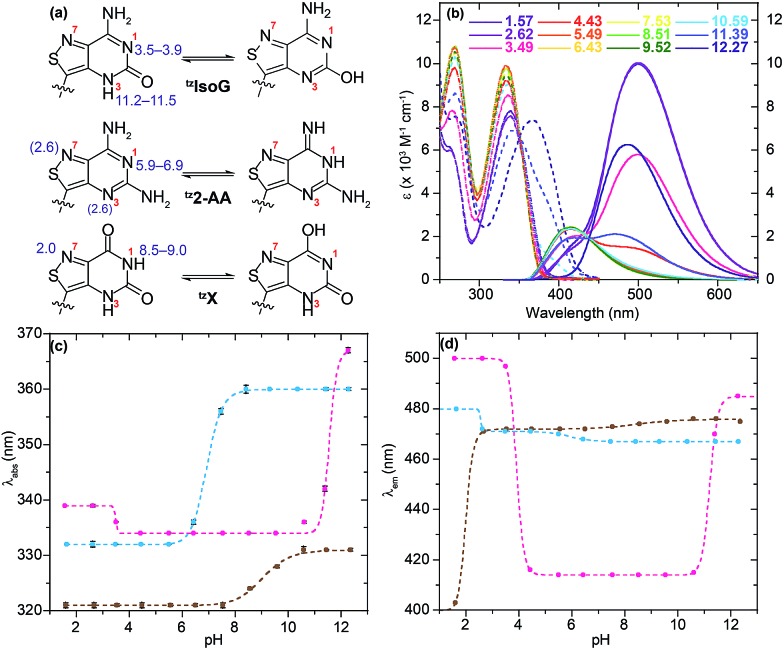
Fig. 6. (a) Schematic representation of possible isothiazolo-pyrimidine nucleoside tautomers with labelled nitrogen atoms (red) and suggested pK a values (blue) corresponding to multiple possible protonation/deprotonation sites (parenthesis). (b) Absorption (dashed lines) and emission (solid lines) spectra of tzX as a function of water solution pH. (c) Absorption maxima and (d) emission maxima variation versus pH for tzisoG (magenta), tz2-AA (cyan) and tzX (brown).
Fig. 7
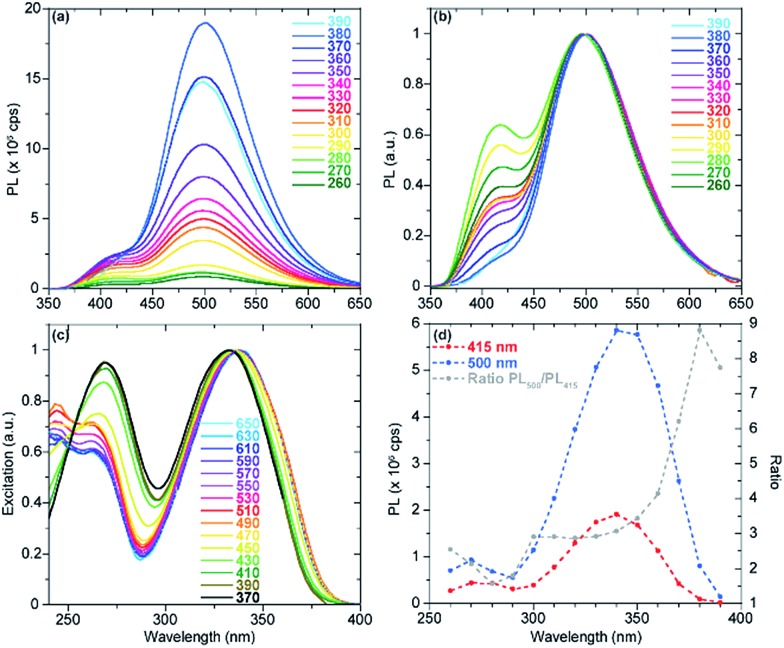
Fig. 7. (a) tzisoG emission spectra at pH 3.49, recorded upon excitation at different wavelengths and normalized for the corresponding absorbance intensity. (b) tzisoG emission spectra at pH 3.49, recorded upon excitation at different wavelengths and normalized to unit in intensity. (c) Excitation spectra normalized to unit recorded at selected emission spectra wavelengths, covering the whole emission band of aqueous solutions of tzisoG at pH 3.49. (d) Reconstructed excitation spectra of tzisoG at pH 3.49, plotting the emission intensities at the relative maxima 415 (red) and 500 (blue) nm upon excitation at different wavelengths. The grey line represents the relative ratio of the emission intensities upon excitation at different wavelengths.
Fig. 8
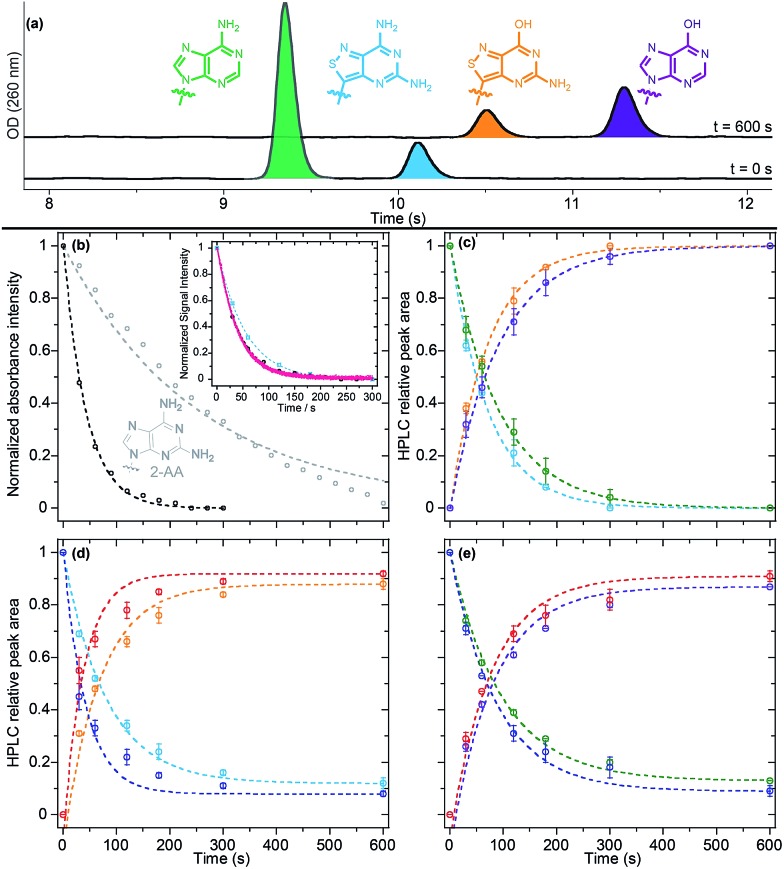
Fig. 8. (a) Enzymatic competitive deamination of tz2-AA and native A to provide tzG and inosine as monitored by HPLC traces at T = 0 s and T = 600 s. (b) Enzymatic deamination of native 2-AA (grey) and tz2-AA (black) monitored by change in absorption spectra intensity at 290 and 368 nm respectively. Inset: ADA-mediated deamination of tz2-AA followed by absorption spectroscopy at 368 nm (black), real-time emission at 475 nm (pink) and HPLC relative peak area variation (cyan) at different time-points for tz2-AA. (c) Enzymatic competitive deamination of tz2-AA (cyan) and native A (green) to provide tzG (orange) and inosine (purple) monitored by HPLC relative peak area variation at different time-points. (d) Enzymatic competitive deamination of tz2-AA (cyan) and tzA (blue) to provide tzG (orange) and tzI (red) monitored by HPLC relative peak area variation at different time-points. (e) Enzymatic competitive deamination of tzA (blue) and native A (green) to provide tzI (red) and inosine (purple) monitored by HPLC relative peak area variation at different time-points.

References

    1. Jordheim L. P., Durantel D., Zoulim F., Dumontet C. Nat. Rev. Drug Discovery. 2013;12:447–464. - PubMed
    1. Callis P. R. Annu. Rev. Phys. Chem. 1983;34:329–357. - PubMed
    1. Favre A., Thomas G. Annu. Rev. Biophys. Bioeng. 1981;10:175–195. - PubMed
    1. Sinkeldam R. W., Greco N. J., Tor Y. Chem. Rev. 2010;110:2579–2619. - PMC - PubMed
    2. Wilhelmsson L. M. Q. Rev. Biophys. 2010;43:159–183. - PubMed
    3. Wierzchowski J., Antosiewicz J. M., Shugar D. Mol. BioSyst. 2014;10:2756–2774. - PubMed
    1. Shaban M. A. E. Adv. Heterocycl. Chem. 1998;70:163–337.
    2. Stambasky J., Hocek M., Kocovsky P. Chem. Rev. 2009;109:6729–6764. - PubMed