. 2017 Apr 24:3:12.
doi: 10.1186/s40780-017-0081-z. eCollection 2017.

Performance evaluation of the compounding robot, APOTECAchemo, for injectable anticancer drugs in a Japanese hospital

Affiliations

Performance evaluation of the compounding robot, APOTECAchemo, for injectable anticancer drugs in a Japanese hospital

Takuya Iwamoto et al. J Pharm Health Care Sci. .

Abstract

Background: The accuracy, safety and feasibility of, the compounding robot APOTECAchemo were evaluated in the clinical practice of Japan.

Methods: Accuracy and precision of robotic preparations by APOTECAchemo was evaluated in 20 preparations of fluorouracil (FU) and cyclophosphamide (CPA) infusions by four pharmacists. Environmental and product contaminations with FU and CPA were evaluated by wipe testing. Robotic performance was compared with manual preparation in a biological safety cabinet. The number of robotic products, total compounding time and total pre-reconstitution time of lyophilized drugs between January 1, 2014 to December 31, 2015 were investigated.

Results: Robotic preparation resulted more accurate and precise (mean absolute dose error and coefficient of variation were 0.83 and 1.04% for FU and 0.52 and 0.59% for CPA) than those of manual preparation (respective values were 1.20 and 1.46% for FU and 1.70 and 2.20% for CPA). Drug residue was not detected from any of the prepared infusion bags with the robotic preparation, whereas FU was detected in two of four analyzed infusion bags with manual preparation. Average total time to make single anticancer drug preparation (compounding plus reconstitution of lyophilized drugs) was 6.11 min in the second half of 2015. During the study period, the highest percentage of production covered by APOTECAchemo was 70.4% of the total inpatient pharmacy activity.

Conclusion: Robotic preparation using APOTECAchemo should give substantial advantages in drug compounding for accuracy and safety and was able to be successfully worked in Mie university hospital.

Keywords: APOTECAchemo; Chemotherapy; Japanese hospital; Pharmacy automation; Robotic preparation; Wipe test.


Figures
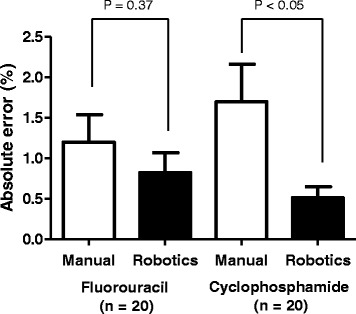
Fig. 1
Fig. 1
Comparison of percent absolute dose error between manual and robotic compounding of FU and CPA. The statistical analyses were performed using Student’s t test or Weltch’s t test. Mean and standard error were shown. FU: Fluorouracil; CPA: Cyclophosphamide
Fig. 2
Fig. 2
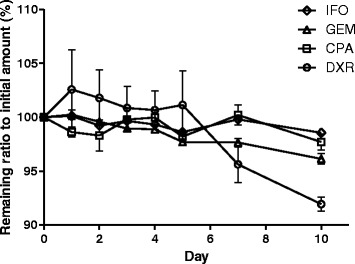
Percent remaining of active ingredient for 4 lyophilized drugs after reconstitution at the recommended concentration for preparation (n = 5). Error bar indicates standard error. IFO: (diamond); GEM: (triangle); CPA: Cyclophosphamide (square); DXR: (circle)
Fig. 3
Fig. 3
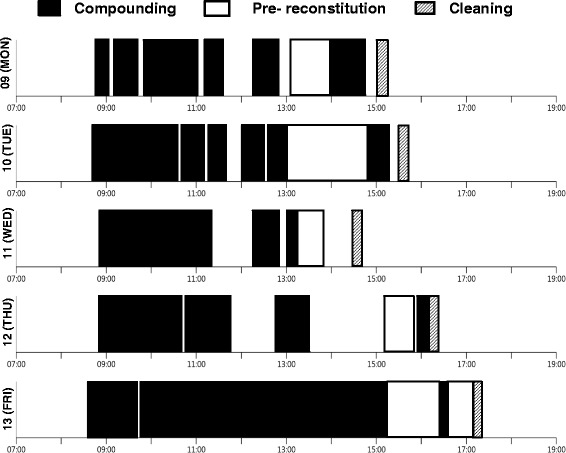
Running status of APOTECAchemo from Nov 9 to Nov 13 2015. Compounding time (black), time of pre- reconstitution time of lyophilized drugs (white) and cleaning time (shaded) were shown
Fig. 4
Fig. 4
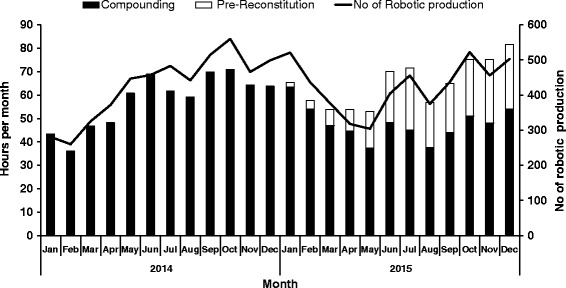
No of robotic production (solid line) and total compounding time (black bar) and total pre- reconstitution time of lyophilized drugs (white bar) per month
Fig. 5
Fig. 5
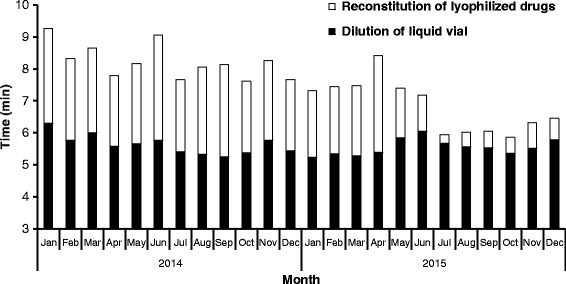
Average of reconstitution time of lyophilized drugs (white bar) and average dilution time with liquid vial in the robot (black bar) per month

References

    1. Schwappach DL, Wernli M. Medication errors in chemotherapy: incidence, types and involvement of patients in prevention. A review of the literature. Eur J Cancer Care (Engl) 2010;19:285–292. doi: 10.1111/j.1365-2354.2009.01127.x. - DOI - PubMed
    1. Dhamija M, Kapoor G, Juneja A. Infusional chemotherapy and medication errors in a tertiary care pediatric cancer unit in a resource-limited setting. J Pediatr Hematol Oncol. 2014;36:e412–e415. doi: 10.1097/MPH.0000000000000044. - DOI - PubMed
    1. Goldspiel B, Hoffman JM, Griffith NL, Goodin S, DeChristoforo R, Montello CM, et al. ASHP guidelines on preventing medication errors with chemotherapy and biotherapy. Am J Health Syst Pharm. 2015;72:e6–e35. doi: 10.2146/sp150001. - DOI - PubMed
    1. Fyhr A, Ternov S, Ek A. From a reactive to a proactive safety approach. Analysis of medication errors in chemotherapy using general failure types. Eur J Cancer Care (Engl). 2017;26(1):e12348. doi:10.1111/ecc.12348. - PMC - PubMed
    1. Connor TH, DeBord DG, Pretty JR, Oliver MS, Roth TS, Lees PS, et al. Evaluation of antineoplastic drug exposure of health care workers at three university-based US cancer centers. J Occup Environ Med. 2010;52:1019–1027. doi: 10.1097/JOM.0b013e3181f72b63. - DOI - PubMed

LinkOut - more resources