


Changes Within Clinical Practice After a Randomized Controlled Trial of Knee Arthroscopy for Osteoarthritis
- PMID: 28451610
- PMCID: PMC5400146
- DOI: 10.1177/2325967117698439
Changes Within Clinical Practice After a Randomized Controlled Trial of Knee Arthroscopy for Osteoarthritis
Abstract
Background: In 2002, Moseley et al published a randomized controlled trial (RCT) that showed no difference between knee arthroscopy and placebo for patients with osteoarthritis (OA). We wanted to assess the impact of the trial on clinical practice in the United States.
Purpose/hypothesis: To evaluate changes in knee arthroscopy practice before and after publication of the article by Moseley et al and to assess the effect of this landmark RCT on the behavior of practicing orthopaedic surgeons. We hypothesized that after publication of the Moseley trial, the overall frequency of knee arthroscopy would decrease, that the mean age of patients undergoing knee arthroscopy would decrease, and that the proportion of arthroscopies for a diagnosis of OA would decrease.
Study design: Descriptive epidemiology study.
Methods: The State Ambulatory Surgery Database was used to analyze cases from 1998 to 2006, which were classified as meniscus tear, OA, or OA with meniscus tear. Changes in age, surgery rates, and case classification were evaluated before and after Moseley's trial using Student t tests and analysis of variance.
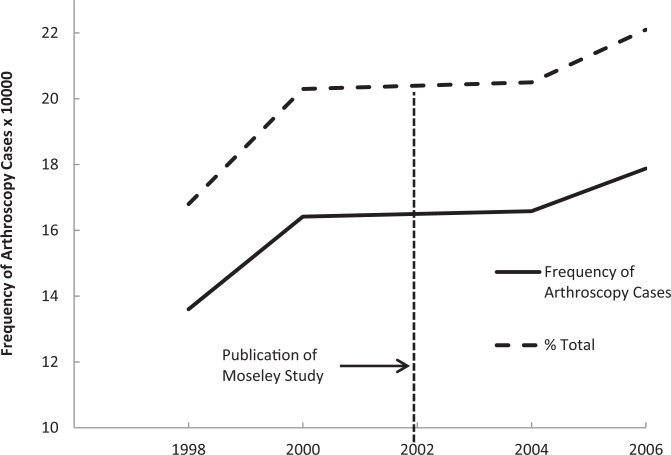
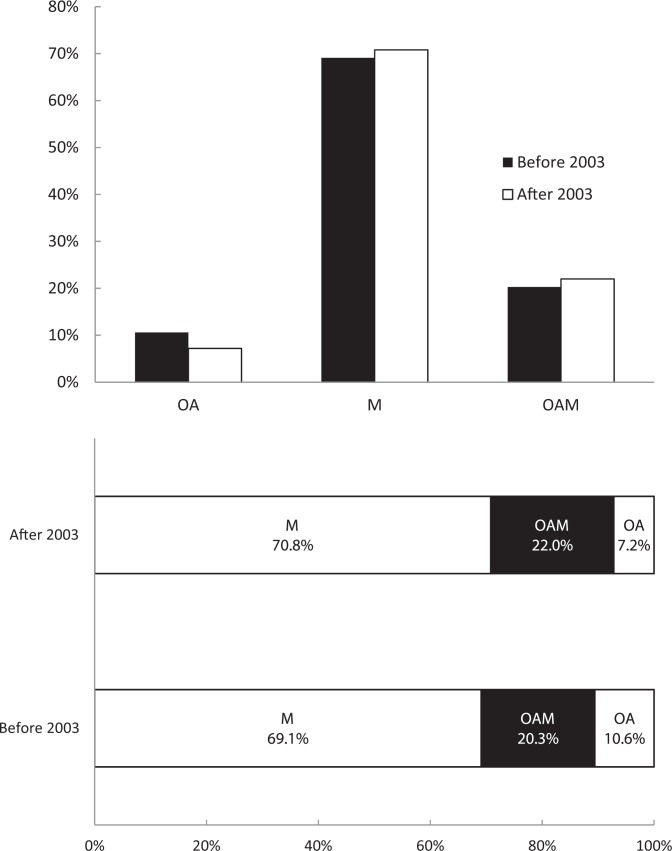
Results: After publication of the trial, the number of knee arthroscopies per year increased from 155,057 in 1998 to 172,317 in 2006 (P ≤ .001). Mean patient age increased from 47.6 to 49.2 years (P < .001). Meniscus tears increased from 69.1% to 70.8%, representing approximately 15,500 additional cases per year. OA decreased from 10.6% to 7.2%, representing approximately 4000 fewer cases per year. OA with meniscus tear increased from 20.3% to 22.0%, representing approximately 6400 additional cases per year.
Conclusion: While overall age and rates of knee arthroscopy increased contrary to our hypothesis, we identified a decrease in rates of knee arthroscopy for OA after publication of the Moseley trial, demonstrating that well-publicized RCTs can influence patterns of clinical practice.
Keywords: knee arthoscopy; meniscus tears; osteoarthritis.
Conflict of interest statement
One or more of the authors has declared the following potential conflict of interest or source of funding: This study was supported by an intramural research grant from the Cleveland Clinic Foundation.
Figures
References
-
- Benedetto KP, Rangger C. Arthroscopic partial meniscectomy: 5-year follow-up. Knee Surg Sports Traumatol Arthrosc. 1993;1:235–238. - PubMed
-
- Bhattacharyya T, Gale D, Dewire P, et al. The clinical importance of meniscal tears demonstrated by magnetic resonance imaging in osteoarthritis of the knee. J Bone Joint Surg Am. 2003;85-A:4–9. - PubMed
-
- Buldu MT, Marsh JL, Arbuthnot J. Mechanical symptoms of osteoarthritis in the knee and arthroscopy. J Knee Surg. 2016;29:396–402. - PubMed
-
- Califf RM, Woodlief LH, Harrell FE, Jr, et al. Selection of thrombolytic therapy for individual patients: development of a clinical model. GUSTO-I Investigators. Am Heart J. 1997;133:630–639. - PubMed
LinkOut - more resources
Full Text Sources
Other Literature Sources
Medical
