. 2017 Apr 17;4(2):ENEURO.0346-16.2017.
doi: 10.1523/ENEURO.0346-16.2017. eCollection 2017 Mar-Apr.

Individual Differences in Human Path Integration Abilities Correlate with Gray Matter Volume in Retrosplenial Cortex, Hippocampus, and Medial Prefrontal Cortex

Affiliations

Individual Differences in Human Path Integration Abilities Correlate with Gray Matter Volume in Retrosplenial Cortex, Hippocampus, and Medial Prefrontal Cortex

Elizabeth R Chrastil et al. eNeuro. .

Abstract

Humans differ in their individual navigational abilities. These individual differences may exist in part because successful navigation relies on several disparate abilities, which rely on different brain structures. One such navigational capability is path integration, the updating of position and orientation, in which navigators track distances, directions, and locations in space during movement. Although structural differences related to landmark-based navigation have been examined, gray matter volume related to path integration ability has not yet been tested. Here, we examined individual differences in two path integration paradigms: (1) a location tracking task and (2) a task tracking translational and rotational self-motion. Using voxel-based morphometry, we related differences in performance in these path integration tasks to variation in brain morphology in 26 healthy young adults. Performance in the location tracking task positively correlated with individual differences in gray matter volume in three areas critical for path integration: the hippocampus, the retrosplenial cortex, and the medial prefrontal cortex. These regions are consistent with the path integration system known from computational and animal models and provide novel evidence that morphological variability in retrosplenial and medial prefrontal cortices underlies individual differences in human path integration ability. The results for tracking rotational self-motion-but not translation or location-demonstrated that cerebellum gray matter volume correlated with individual performance. Our findings also suggest that these three aspects of path integration are largely independent. Together, the results of this study provide a link between individual abilities and the functional correlates, computational models, and animal models of path integration.

Keywords: Cerebellum; VBM; distance; navigation; rotation.


Conflict of interest statement

Authors report no conflict of interest.

Figures
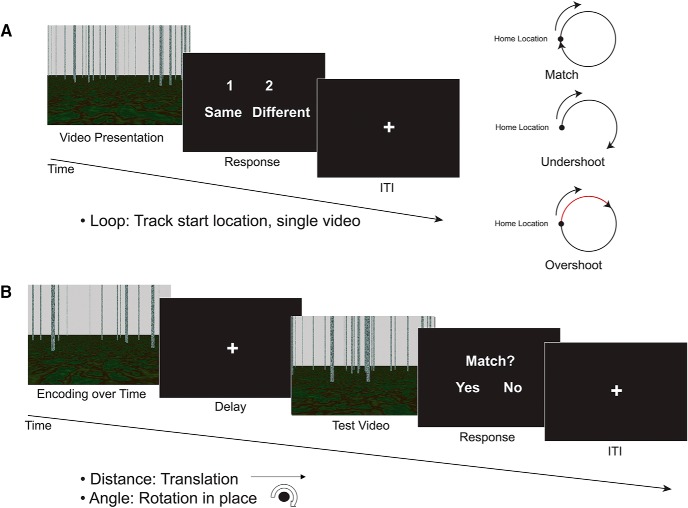
Figure 1.
Figure 1.
Experimental design (from Chrastil et al., 2015). A, Loop paradigm. A single video was shown with movement along a circle. Participants indicated whether the movement ended in the same location in which it started (match) or if it ended in a different location (nonmatch; undershoots and overshoots were both considered nonmatches). B, Translation and rotation paradigms. Two different videos were presented. First, participants viewed a short encoding video of movement, followed by a delay, then a test video of the same type of movement. Participants indicated whether the movement in the two videos was a match or nonmatch: for example, whether the distance traveled in the two videos was the same. Three experimental tasks were presented in blocks of six trials: loop, distance, and angle.
Figure 2.
Figure 2.
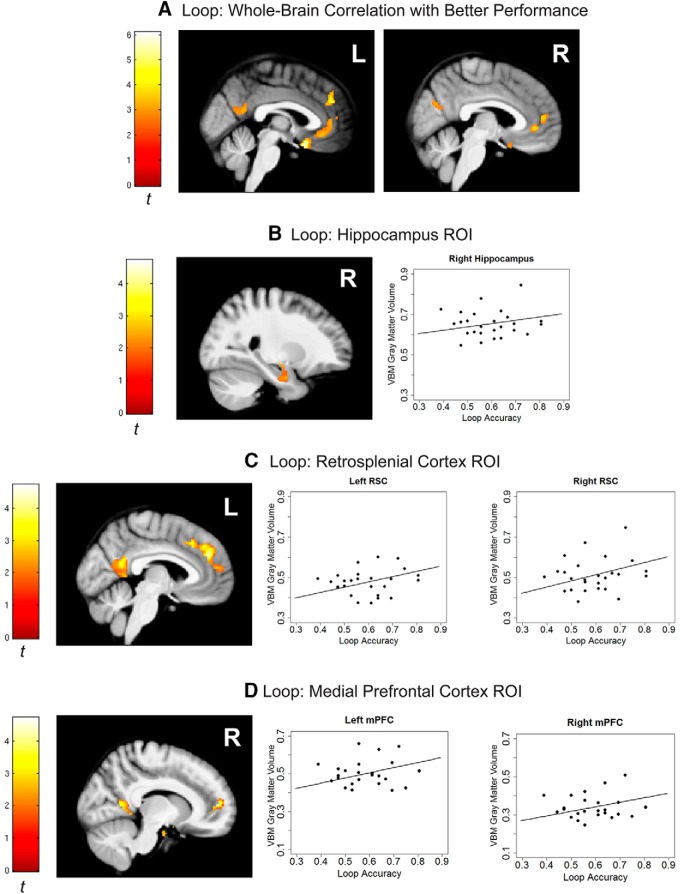
VBM results for the loop task. A, Whole-brain results for positive correlation between gray matter volume and accuracy (proportion correct) in the loop task. Significant correlations were found in retrosplenial cortex, medial prefrontal cortex, anterior cingulate, vmPFC/gyrus rectus, cuneus, putamen (not shown), sylvian fissure (not shown), and lateral occipital gyrus (not shown). Whole-brain results are thresholded at voxel-wise p < 0.01, cluster correction of 333 voxels to family-wise p < 0.05. B, ROI showing the hippocampus (r = 0.165). C, D, ROI showing the RSC (left r = 0.261; right r = 0.303) and mPFC (left r = 0.273; right r = 0.239). For visualization purposes, gray matter volumes were extracted from 5-mm spheres centered on peak coordinates in our ROIs and plotted against proportion correct in the task, with regression lines and r values based on the full model. ROI thresholded at voxel-wise p < 0.05, cluster correction of 336 voxels to family-wise p < 0.05.
Figure 3.
Figure 3.
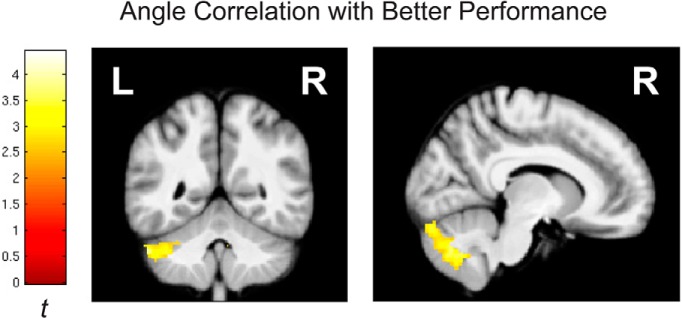
VBM results for the angle task. Positive correlation between gray matter volume and accuracy (proportion correct) at the whole-brain level. Whole-brain results are thresholded at voxel-wise p < 0.01, cluster correction of 333 voxels to family-wise p < 0.05.

References

    1. Aggleton J (2014) Looking beyond the hippocampus: old and new neurological targets for understanding memory disorders. Proc R Soc B 281:1–9. 10.1098/rspb.2014.0565 - DOI - PMC - PubMed
    1. Aguirre GK, D’Esposito M (1999) Topographical disorientation: a synthesis and taxonomy. Brain 122:1613–1628. 10.1093/brain/122.9.1613 - DOI - PubMed
    1. Arnold AEGF, Burles F, Bray S, Levy RM, Iaria G (2014) Differential neural network configuration during human path integration. Front Hum Neurosci 8:263. 10.3389/fnhum.2014.00263 - DOI - PMC - PubMed
    1. Ashburner J (2007) A fast diffeomorphic image registration algorithm. NeuroImage 38(1), 95–113. 10.1016/j.neuroimage.2007.07.007 - DOI - PubMed
    1. Baumann O, Mattingley JB (2010) Medial parietal cortex encodes perceived heading direction in humans. J Neurosci 30:12897–12901. 10.1523/JNEUROSCI.3077-10.2010 - DOI - PMC - PubMed

Publication types