


Accuracy of diagnostic imaging modalities for peripheral post-traumatic osteomyelitis - a systematic review of the recent literature
- PMID: 28451827
- PMCID: PMC5486824
- DOI: 10.1007/s00259-017-3683-7
Accuracy of diagnostic imaging modalities for peripheral post-traumatic osteomyelitis - a systematic review of the recent literature
Abstract
Aims: Post-traumatic osteomyelitis (PTO) is difficult to diagnose and there is no consensus on the best imaging strategy. The aim of this study is to present a systematic review of the recent literature on diagnostic imaging of PTO.
Methods: A literature search of the EMBASE and PubMed databases of the last 16 years (2000-2016) was performed. Studies that evaluated the accuracy of magnetic resonance imaging (MRI), three-phase bone scintigraphy (TPBS), white blood cell (WBC) or antigranulocyte antibody (AGA) scintigraphy, fluorodeoxyglucose positron emission tomography (FDG-PET) and plain computed tomography (CT) in diagnosing PTO were considered for inclusion. The review was conducted using the PRISMA statement and QUADAS-2 criteria.
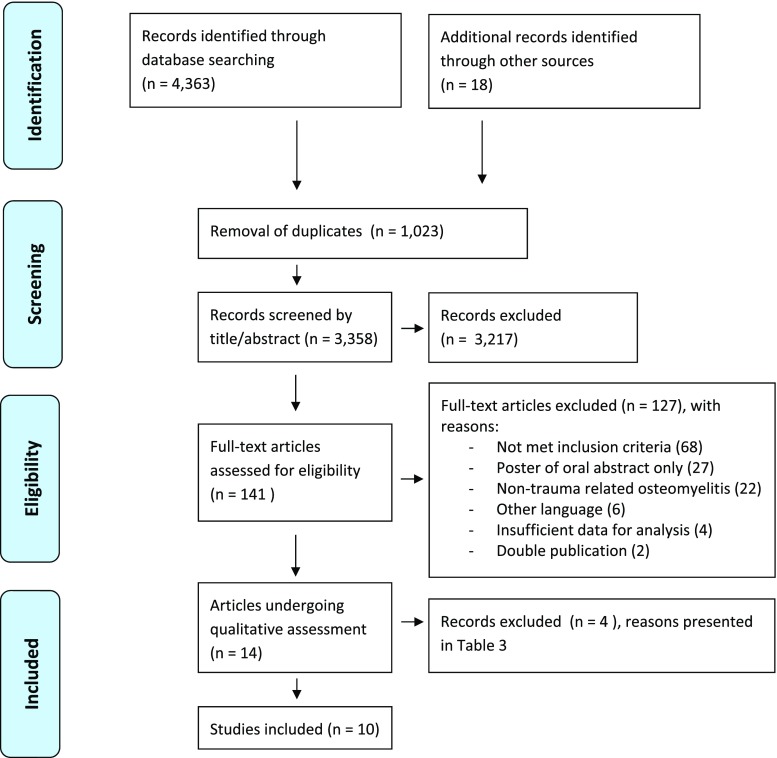
Results: The literature search identified 3358 original records, of which 10 articles could be included in this review. Four of these studies had a comparative design which made it possible to report the results of, in total, 17 patient series. WBC (or AGA) scintigraphy and FDG-PET exhibit good accuracy for diagnosing PTO (sensitivity ranged from 50-100%, specificity ranged from 40-97% versus 83-100% and 51%-100%, respectively). The accuracy of both modalities improved when a hybrid imaging technique (SPECT/CT & FDG-PET/CT) was performed. For FDG-PET/CT, sensitivity ranged between 86 and 94% and specificity between 76 and 100%. For WBC scintigraphy + SPECT/CT, this is 100% and 89-97%, respectively.
Conclusions: Based on the best available evidence of the last 16 years, both WBC (or AGA) scintigraphy combined with SPECT/CT or FDG-PET combined with CT have the best diagnostic accuracy for diagnosing peripheral PTO.
Keywords: Antigranulocyte antibody scintigraphy; CT scan; Diagnostic imaging; FDG-PET; Fracture; Fracture related infection; MRI; Open reduction and internal fixation (ORIF); Osteosynthetic material; Ostheosynthesis; Post-traumatic osteomyelitis; White blood cell scintigraphy.
Conflict of interest statement
Ethical approval
This article does not contain any studies with human participants performed by any of the authors.
Conflict of interest
None
Figures
References
-
- McNally M, Sendi P. Implant associated osteomyelitis of the long bones. In: Zimmerli W, editor. Bone and Joint Infections: from microbiology to diagnostics and treatment.: Wiley-Blackwell; 2015. p. 303–23.
Publication types
MeSH terms
LinkOut - more resources
Full Text Sources
Other Literature Sources
Medical
Miscellaneous
