


doi: 10.1038/nmicrobiol.2017.67.
Convergent evolution of a modified, acetate-driven TCA cycle in bacteria
Affiliations
- PMID: 28452983
- PMCID: PMC5482284
- DOI: 10.1038/nmicrobiol.2017.67
Item in Clipboard
Convergent evolution of a modified, acetate-driven TCA cycle in bacteria
Nat Microbiol.
.
Erratum in
-
Author Correction: Convergent evolution of a modified, acetate-driven TCA cycle in bacteria.Nat Microbiol. 2018 Aug;3(8):960. doi: 10.1038/s41564-018-0195-6. Nat Microbiol. 2018. PMID: 29950695
Abstract
The tricarboxylic acid (TCA) cycle is central to energy production and biosynthetic precursor synthesis in aerobic organisms. There are few known variations of a complete TCA cycle, with the common notion being that the enzymes involved have already evolved towards optimal performance. Here, we present evidence that an alternative TCA cycle, in which acetate:succinate CoA-transferase (ASCT) replaces the enzymatic step typically performed by succinyl-CoA synthetase (SCS), has arisen in diverse bacterial groups, including microbial symbionts of animals such as humans and insects.
Conflict of interest statement
The authors declare no competing interests.
Figures
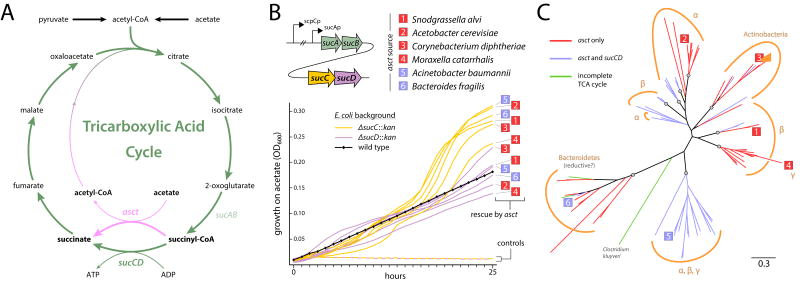
An acetate-driven TCA cycle in diverse bacteria. (A) The TCA cycle (green) and the asct modification (pink). (B) Restoration of TCA cycle function by asct from diverse bacteria (labeled 1–6) in E. coli succinyl-CoA synthetase (SCS) knockouts. Operon structure of sucCD in E. coli is shown at upper left (not to scale); black arrows indicate promoters. Δ, deletion; ::kan, kanamycin resistance gene insertion. Control strains, carrying a plasmid without asct (pBad-EBFP2), are denoted by dashed lines. Colour of lines indicate E. coli background of asct-complemented or control strains; strains are listed in Supplementary Table 1. Growth curves represent average of three replicates; see Supplementary Table 2 for means and standard deviations at each time point. (C) Phylogeny of asct from representative species of phyla Bacteroidetes, Actinobacteria, and Proteobacteria (α, β, γ; classes Alpha-, Beta-, and Gamma-proteobacteria, respectively). Circles indicate nodes with > 95% bootstrap support from maximum-likelihood analysis. Taxa used to build this tree are shown in Supplementary Fig. 2. Numbered labels indicate positions of taxa in (B), with color scheme reflecting presence (blue) or absence (red) of co-occurring sucCD.
References
-
- Meyer FM, Gerwig J, Hammer E, Herzberg C, Commichau FM, Völker U, Stülke J. Physical interactions between tricarboxylic acid cycle enzymes in Bacillus subtilis: evidence for a metabolon. Metab Eng. 2011;13(1):18–27. - PubMed
-
- Wu F, Minteer S. Krebs cycle metabolon: structural evidence of substrate channeling revealed by cross-linking and mass spectrometry. Angew Chem Int Ed Engl. 2015;54(6):1851–1854. - PubMed
-
- Buchanan BB, Arnon DI. A reverse KREBS cycle in photosynthesis: consensus at last. Photosynth Res. 1990;24:47–53. - PubMed
-
- Zhang S, Bryant DA. The tricarboxylic acid cycle in cyanobacteria. Science. 2011;334(6062):1551–1553. - PubMed
MeSH terms
Substances
Grants and funding
LinkOut - more resources
Full Text Sources
Other Literature Sources
Molecular Biology Databases
