


How reliable and valid is the teacher version of the Strengths and Difficulties Questionnaire in primary school children?
- PMID: 28453573
- PMCID: PMC5409073
- DOI: 10.1371/journal.pone.0176605
How reliable and valid is the teacher version of the Strengths and Difficulties Questionnaire in primary school children?
Abstract
Introduction: The Strengths and Difficulties Questionnaire (SDQ) is validated for parents, but not yet for teachers in a broad age range of children. We conducted a cross-sectional study with 4-10 years old school children to investigate if the SDQ-T can be used instead of the validated but lengthy Teacher's Report Form (TRF) to acquire information about emotional and behavioral problems in the school community.
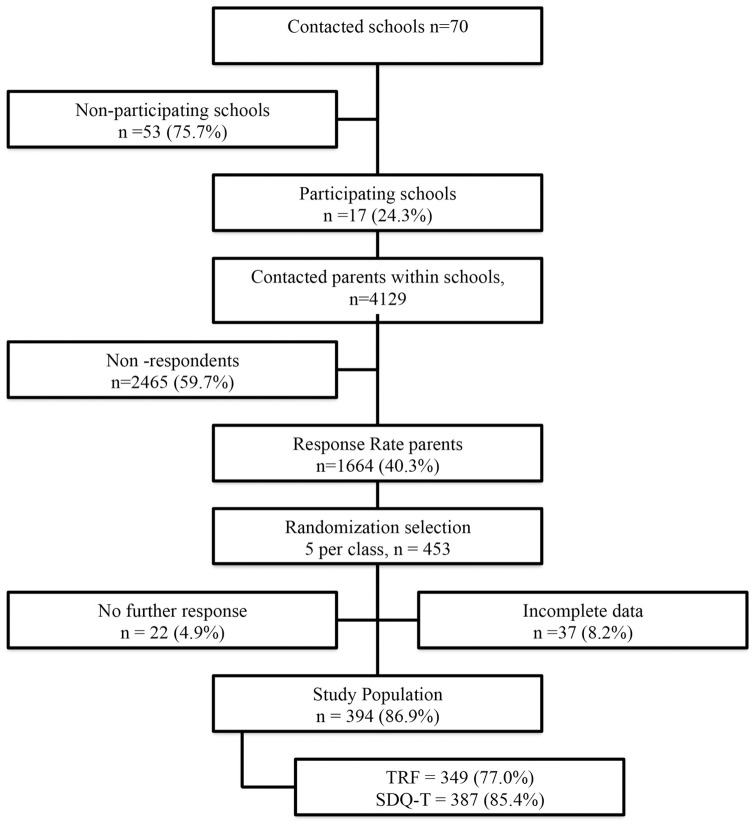
Methods: Teachers of 453 children from primary schools were approached. Teachers of 394 children (response rate 86.9%) with a mean age of 7.1 years filled in the SDQ-T (n = 387), the TRF (n = 349) or both (n = 342). We assessed reliability by calculating internal consistency and concurrent validity (using correlation coefficients, sensitivity, specificity) of the SDQ-T compared with the TRF.
Results: Internal consistency of the SDQ-T Total Difficulties Score (SDQ-T TDS; Cronbach α = 0.80), hyperactivity/ inattention- (α = 0.86) and prosocial behavior (α = 0.81) was very good. Concurrent validity demonstrated a strong correlation of all subscales of the SDQ-T with the corresponding scale on the TRF (range 0.54-0.73), except for peer problems (0.46). Using a SDQ-T TDS cut-off score > 14, the SDQ-T had a good sensitivity (90%) and specificity (94%).
Discussion: The good reliability, validity and brevity of the SDQ-T make it an easily applicable questionnaire for obtaining information about emotional and behavioral problems from teachers in primary school children.
Conflict of interest statement
References
-
- Durlak JA, Wells AM (1998) Evaluation of indicated preventive intervention (secondary prevention) mental health programs for children and adolescents. Am J Community Psychol 26: 775–802. - PubMed
MeSH terms
LinkOut - more resources
Full Text Sources
Other Literature Sources
