


Tea consumption and the risk of biliary tract cancer: a systematic review and dose-response meta-analysis of observational studies
- PMID: 28454105
- PMCID: PMC5503640
- DOI: 10.18632/oncotarget.16963
Tea consumption and the risk of biliary tract cancer: a systematic review and dose-response meta-analysis of observational studies
Abstract
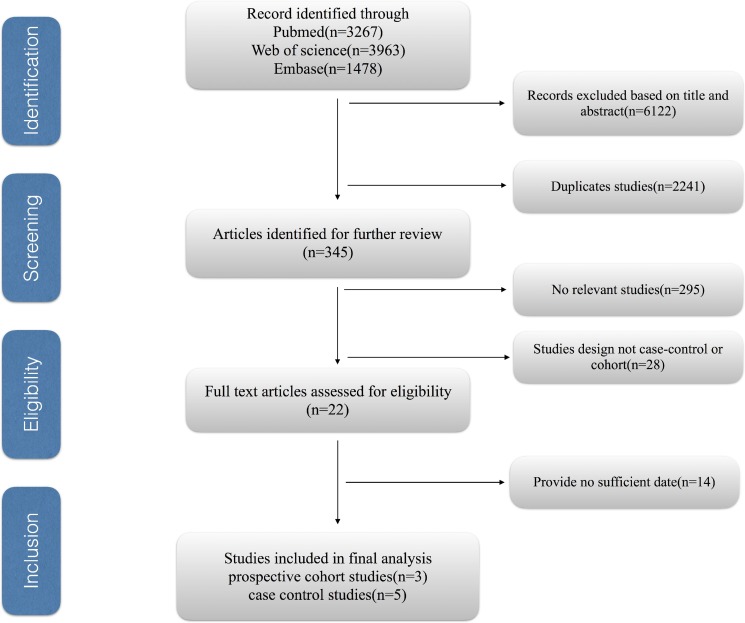
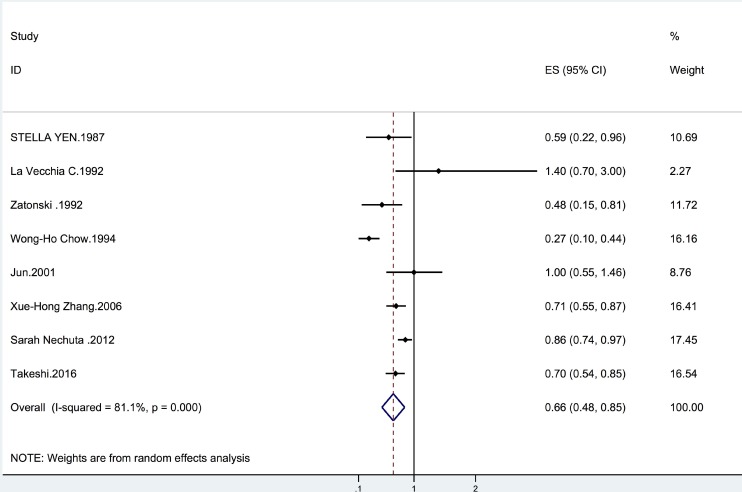
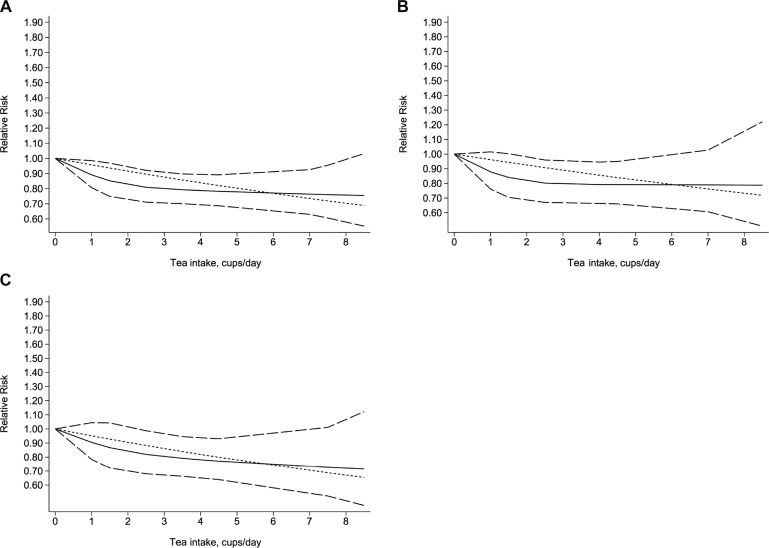
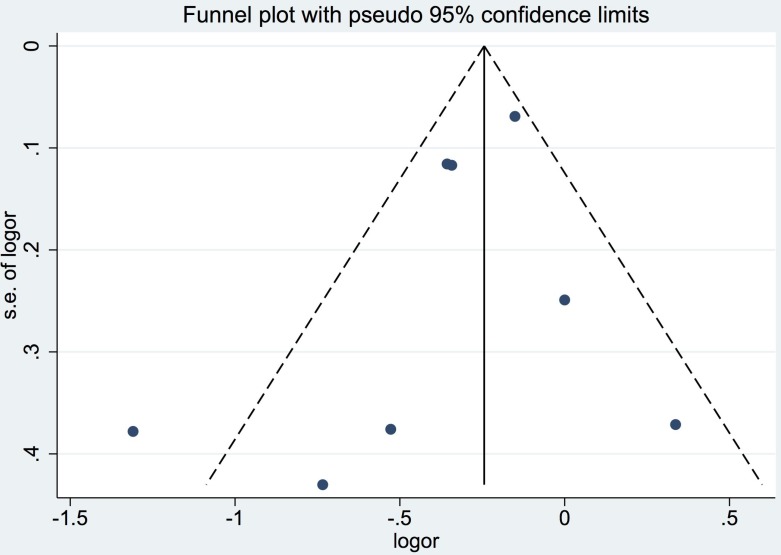
Recent studies have shown that tea consumption is associated with the reduced incidence of some types of cancer, possibly including biliary tract cancer. However, the epidemiological evidences for the association with risk of biliary tract cancer are contradictory. Thus, we performed meta-analysis of published observational studies to assess the association between tea consumption and risk of biliary tract cancer. Relevant studies were identified by searching PubMed, EMBASE, and ISI Web of Science published before October 2016. The Newcastle-Ottawa Scale was used to evaluate the quality of included studies, and publication bias was evaluated using funnel plots, and Begg's and Egger's tests. This meta-analysis includes eight studies comprising 18 independent reports. The incidence of biliary tract cancer reduced about 34% (significantly) for tea intake group in comparison with never intake group (summary odds ratio [OR] = 0.66; 95% confidence interval [CI] = 0.48-0.85). Additionally, an inverse relationship between tea intake and risk of biliary tract cancer was statistically significant in women (OR = 0.65; 95 % CI = 0.47-0.83), but not in men (OR = 0.86; 95% CI = 0.58-1.13). Dose- response analysis indicated that the risk of biliary tract cancer decreased by 4% with each additional cup of tea one day (relative risk [RR] = 0.96, 95% CI = 0.93-0.98, p = 0.001). In summary, tea intake is associated with decreased risk of biliary tract cancer, especially for women.
Keywords: bile duct cancer; biliary tract cancer; cholangiocarcinoma; tea.
Conflict of interest statement
None.
Figures
References
-
- de Groen PC, Gores GJ, LaRusso NF, Gunderson LL, Nagorney DM. Biliary Tract Cancers. New England Journal of Medicine. 1999;341:1368–1378. - PubMed
-
- Lepage C, Cottet V, Chauvenet M, Phelip JM, Bedenne L, Faivre J, Bouvier AM. Trends in the incidence and management of biliary tract cancer: A French population-based study. Journal of Hepatology. 2011;54:306–310. - PubMed
-
- Randi G, Malvezzi M, Levi F, Ferlay J, Negri E, Franceschi S, La Vecchia C. Epidemiology of biliary tract cancers: an update. Annals of Oncology. 2009;20:146–159. - PubMed
-
- Landis SH, Murray T, Bolden S, Wingo PA. Cancer statistics, 1998. CA Cancer J Clin. 1998;48:6–29. - PubMed
-
- Diehl AK. Gallstone size and the risk of gallbladder cancer. Jama. 1983;250:2323–2326. - PubMed
Publication types
MeSH terms
Substances
LinkOut - more resources
Full Text Sources
Other Literature Sources
