Review
. 2017 Apr 28;5(1):48.
doi: 10.1186/s40168-017-0268-4.

A critical assessment of the "sterile womb" and "in utero colonization" hypotheses: implications for research on the pioneer infant microbiome

Affiliations
Review

A critical assessment of the "sterile womb" and "in utero colonization" hypotheses: implications for research on the pioneer infant microbiome

Maria Elisa Perez-Muñoz et al. Microbiome. .

Abstract

After more than a century of active research, the notion that the human fetal environment is sterile and that the neonate's microbiome is acquired during and after birth was an accepted dogma. However, recent studies using molecular techniques suggest bacterial communities in the placenta, amniotic fluid, and meconium from healthy pregnancies. These findings have led many scientists to challenge the "sterile womb paradigm" and propose that microbiome acquisition instead begins in utero, an idea that would fundamentally change our understanding of gut microbiota acquisition and its role in human development. In this review, we provide a critical assessment of the evidence supporting these two opposing hypotheses, specifically as it relates to (i) anatomical, immunological, and physiological characteristics of the placenta and fetus; (ii) the research methods currently used to study microbial populations in the intrauterine environment; (iii) the fecal microbiome during the first days of life; and (iv) the generation of axenic animals and humans. Based on this analysis, we argue that the evidence in support of the "in utero colonization hypothesis" is extremely weak as it is founded almost entirely on studies that (i) used molecular approaches with an insufficient detection limit to study "low-biomass" microbial populations, (ii) lacked appropriate controls for contamination, and (iii) failed to provide evidence of bacterial viability. Most importantly, the ability to reliably derive axenic animals via cesarean sections strongly supports sterility of the fetal environment in mammals. We conclude that current scientific evidence does not support the existence of microbiomes within the healthy fetal milieu, which has implications for the development of clinical practices that prevent microbiome perturbations after birth and the establishment of future research priorities.

Keywords: Axenic animals; Contamination; In utero colonization; Microbiome; Placenta; Sterile womb.


Figures
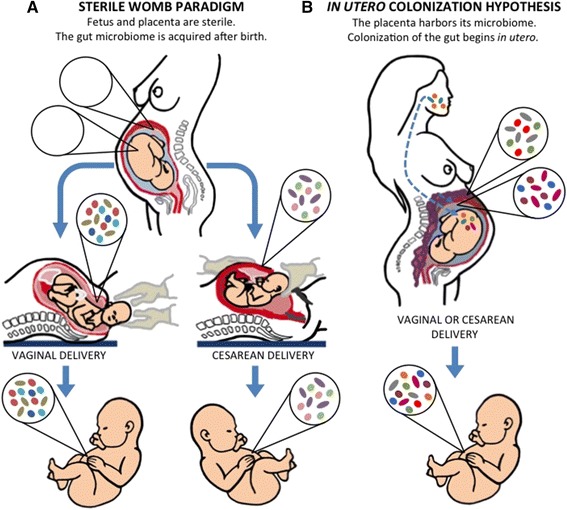
Fig. 1
Fig. 1
Schematic representation of the opposing concepts by which human microbiota is acquired early in life. a In the sterile womb paradigm, the placenta, amniotic fluid, and fetal gut remain sterile during a healthy pregnancy, and the early microbiome is acquired during and after birth. Accordingly, the gut microbiota of infants born vaginally resemble the microbiota of the mother’s vagina, while the microbiota of infants born by cesarean section are similar to the mother’s skin microbiota. b The “in utero colonization hypothesis” proposes that some microbial members of the infants’ gut microbiome are acquired before birth, probably via contact with a placental microbiome, which has been suggested to originate from the mother’s gut or oral microbiome
Fig. 2
Fig. 2
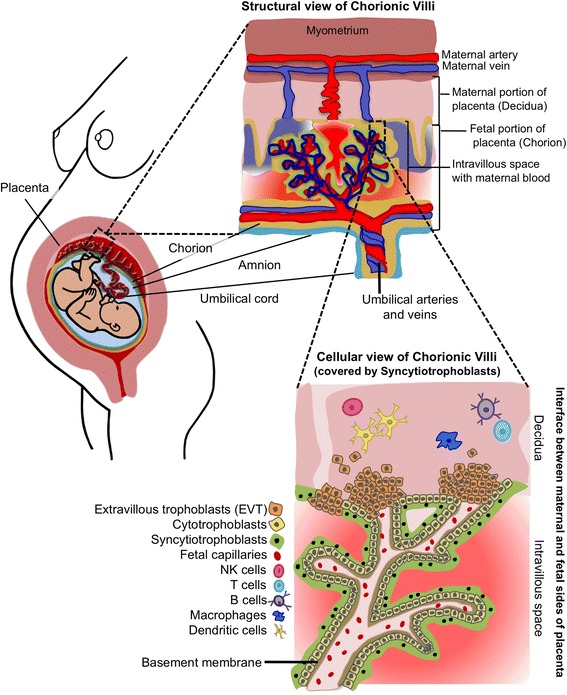
Schematic representation of the anatomical, physiological, and immunological placental barriers designed to limit microbial invasion. Three main types of cells on the fetal side of the placenta prevent access of bacterial invaders to the fetal circulation: the syncytiotrophoblast, the cytotrophoblasts, and the extravillous trophoblasts (EVT). The basement membrane also serves as a physical barrier that averts bacterial invasion. Additionally, maternal immune cells and immunoglobulins (not depicted) are near the EVTs to aid in the defense against microbial insults
Fig. 3
Fig. 3
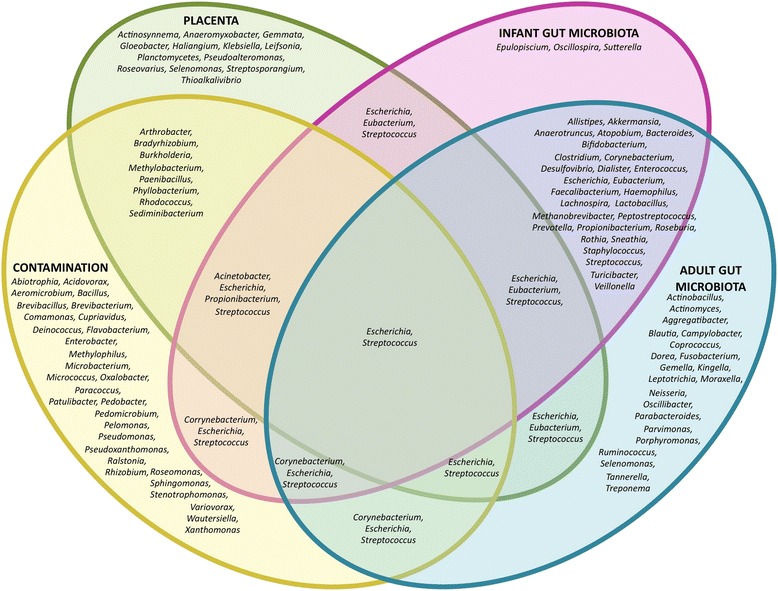
Venn diagram of bacterial genera hypothesized to contribute to the infant gut microbiome. Aagaard and colleagues [9] hypothesized that bacteria translocate from the mother’s oral cavity into the placenta, contributing to in utero colonization of the fetal gut. They further suggest that placentas contain low abundance communities of commensal bacteria. However, 36% of the bacterial genera found by Aagaard and colleagues [9] also appear on the list of contaminants found in reagents by several independent research groups as reported by Salter and colleagues [90]. Not all genera were included for each individual microbiome due to space constraints. Genera found in the infant gut [2, 101, 102, 105, 148] include taxa described in both vaginally and cesarean section-delivered babies [101, 105] and show a substantial overlap with genera found in the adult gut microbiome [–147], but little overlap with taxa found in the placenta [9, 91] or as contaminants [–91]
Fig. 4
Fig. 4
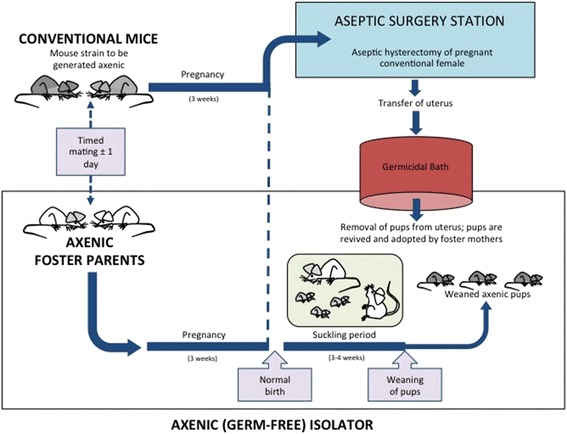
Schematic representation of the generation of axenic rodents by aseptic hysterectomy. In rodents, germ-free offspring are derived by aseptic hysterectomy. Germ-free foster mothers housed in a sterile isolator are time-mated to become pregnant in synchrony with holoxenic (conventional) females. Breeding pairs are mated on such a schedule that the aseptic hysterectomy of the donor mother can be performed a few hours before her scheduled pupping and a few hours after the foster mother gives birth. To perform the hysterectomy, donor females are euthanized, and the uterus is harvested and clamped, aseptically introduced into a germicidal bath, and then transferred into the sterile isolator where the foster mothers reside. The pups are then revived and placed under the care of the foster mother [–125]. If there are no germ-free foster mothers available, then pups are hand-raised using sterile formula. Figure adapted from Hedrich and Hardy [125]

References

    1. Chow J, Lee SM, Shen Y, Khosravi A, Mazmanian SK. Host-bacterial symbiosis in health and disease. Adv Immunol. 2010;107:243–74. doi: 10.1016/B978-0-12-381300-8.00008-3. - DOI - PMC - PubMed
    1. Arrieta M-C, Stiemsma LT, Dimitriu PA, Thorson L, Russell S, Yurist-Doutsch S, Kuzeljevic B, Gold MJ, Britton HM, Lefebvre DL, Subbarao P, Mandhane P, Becker A, McNagny KM, Sears MR, Kollmann T, Mohn WW, Turvey SE, Brett Finlay B. Early infancy microbial and metabolic alterations affect risk of childhood asthma. Sci Transl Med. 2015;7:307ra152. doi: 10.1126/scitranslmed.aab2271. - DOI - PubMed
    1. Koleva PT, Kim J-S, Scott JA, Kozyrskyj AL. Microbial programming of health and disease starts during fetal life. Birth Defects Res C Embryo Today. 2015;105:265–77. doi: 10.1002/bdrc.21117. - DOI - PubMed
    1. Funkhouser LJ, Bordenstein SR. Mom knows best: the universality of maternal microbial transmission. PLoS Biol. 2013;11:e1001631. doi: 10.1371/journal.pbio.1001631. - DOI - PMC - PubMed
    1. Bright M, Bulgheresi S. A complex journey: transmission of microbial symbionts. Nat Rev Microbiol. 2010;8:218–30. doi: 10.1038/nrmicro2262. - DOI - PMC - PubMed

Publication types

LinkOut - more resources