


Rationale and Design of Family-Based Approach in a Minority Community Integrating Systems-Biology for Promotion of Health (FAMILIA)
- PMID: 28454800
- PMCID: PMC6190598
- DOI: 10.1016/j.ahj.2017.02.020
Rationale and Design of Family-Based Approach in a Minority Community Integrating Systems-Biology for Promotion of Health (FAMILIA)
Abstract
Background: The 2020 American Heart Association Impact Goal aims to improve cardiovascular health of all Americans by 20% while reducing deaths from cardiovascular disease and stroke by 20%. A large step toward this goal would be to better understand and take advantage of the significant intersection between behavior and biology across the entire life-span. In the proposed FAMILIA studies, we aim to directly address this major knowledge and clinical health gap by implementing an integrated family-centric health promotion intervention and focusing on the intersection of environment and behavior, while understanding the genetic and biologic basis of cardiovascular disease.
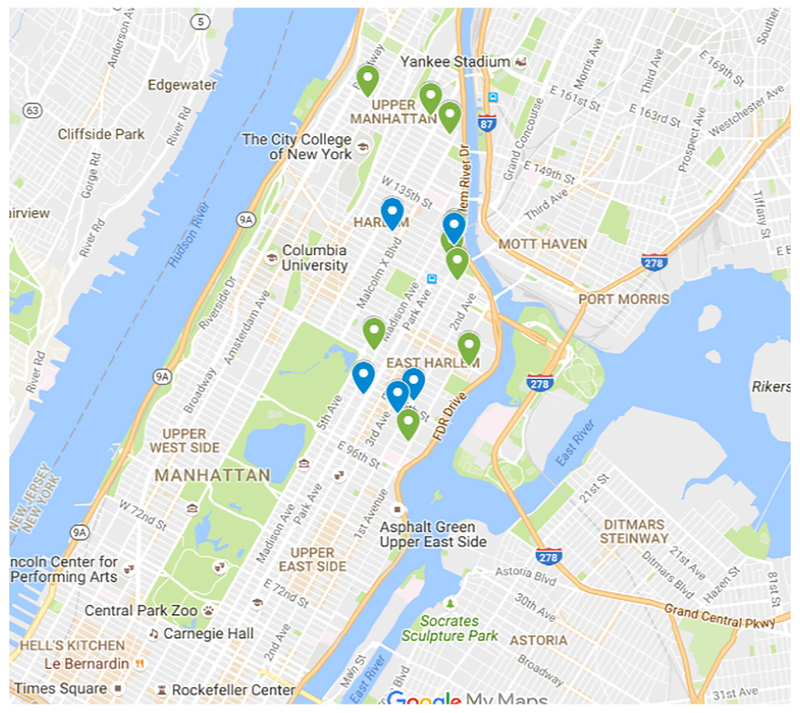
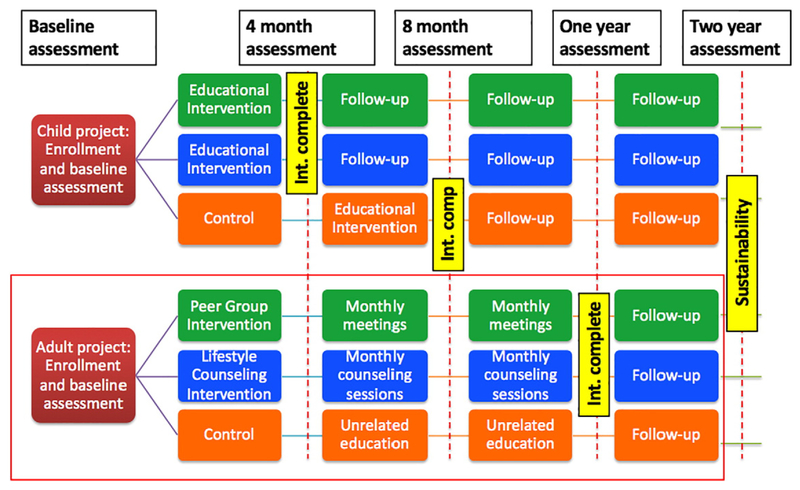
Methods: We plan to recruit 600 preschool children and their 600 parents or caregivers from 12-15 Head Start schools in Harlem, NY, and perform a 2:1 (2 intervention/1 control) cluster randomization of the schools. The preschool children will receive our intensive 37-hour educational program as the intervention for 4 months. For the adults, those in the "intervention" group will be randomly assigned to 1 of 2 intervention programs: an "individual-focused" or "peer-to-peer based." The primary outcome in children will be a composite score of knowledge (K), attitudes (A), habits (H), related to body mass index Z score (B), exercise (E), and alimentation (A) (KAH-BEA), using questionnaires and anthropometric measurements. For adults, the primary outcome will be a composite score for behaviors/outcomes related to blood pressure, exercise, weight, alimentation (diet) and tobacco (smoking; Fuster-BEWAT score). Saliva will be collected from the children for SNP genotyping, and blood will be collected from adults for RNA sequencing to identify network models and predictors of primary prevention outcomes.
Conclusion: The FAMILIA studies seek to demonstrate that targeting a younger age group (3-5 years) and using a family-based approach may be a critical strategy in promoting cardiovascular health across the life-span.
Copyright © 2017 Elsevier Inc. All rights reserved.
Conflict of interest statement
Conflicts of interest
None of the investigators have any financial conflicts of interest related to this work.
Figures

References
-
- Lloyd-Jones DM, Hong Y, Labarthe D, et al. Defining and setting national goals for cardiovascular health promotion and disease reduction: the American Heart Association’s strategic Impact Goal through 2020 and beyond. Circulation 2010;121:586–613. - PubMed
-
- Mensah GA, Mokdad AH, Ford ES, et al. State of disparities in cardiovascular health in the United States. Circulation 2005;111: 1233–41. - PubMed
-
- Bonow RO, Grant AO, Jacobs AK. The cardiovascular state of the union: confronting healthcare disparities. Circulation 2005;111:1205–7. - PubMed
-
- Winkleby MA, Kraemer HC, Ahn DK, et al. Ethnic and socioeconomic differences in cardiovascular disease risk factors: findings for women from the Third National Health and Nutrition Examination Survey, 1988–1994. JAMA 1998;280:356–62. - PubMed
-
- Matte TEJ, Bedell J, Selenic D, et al. Obesity in the South Bronx: a look across generations. NewYork City: Department of Health and Mental Hygiene; 2007.
Publication types
MeSH terms
Grants and funding
LinkOut - more resources
Full Text Sources
Other Literature Sources
Medical
Miscellaneous
