


Chimeric Antigen Receptors: A Cell and Gene Therapy Perspective
- PMID: 28456379
- PMCID: PMC5417838
- DOI: 10.1016/j.ymthe.2017.03.034
Chimeric Antigen Receptors: A Cell and Gene Therapy Perspective
Abstract
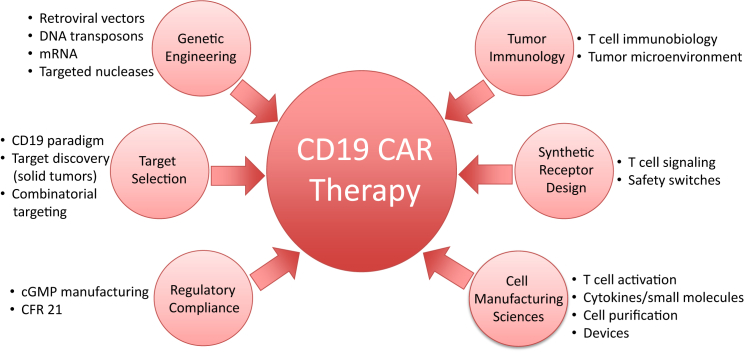
Chimeric antigen receptors (CARs) are synthetic receptors that reprogram T lymphocytes to target chosen antigens. The targeting of CD19, a cell surface molecule expressed in the vast majority of leukemias and lymphomas, has been successfully translated in the clinic, earning CAR therapy a special distinction in the selection of "cancer immunotherapy" by Science as the breakthrough of the year in 2013. CD19 CAR therapy is predicated on advances in genetic engineering, T cell biology, tumor immunology, synthetic biology, target identification, cell manufacturing sciences, and regulatory compliance-the central tenets of CAR therapy. Here, we review two of these foundations: the genetic engineering approaches and cell types to engineer.
Keywords: CAR; T cells; genetic engineering; genome editing; immunotherapy; vectors.
Copyright © 2017 The American Society of Gene and Cell Therapy. Published by Elsevier Inc. All rights reserved.
Figures
References
-
- Eshhar Z., Bach N., Fitzer-Attas C.J., Gross G., Lustgarten J., Waks T., Schindler D.G. The T-body approach: potential for cancer immunotherapy. Springer Semin. Immunopathol. 1996;18:199–209. - PubMed
-
- Sadelain M., Rivière I., Brentjens R. Targeting tumours with genetically enhanced T lymphocytes. Nat. Rev. Cancer. 2003;3:35–45. - PubMed
-
- Irving B.A., Weiss A. The cytoplasmic domain of the T cell receptor zeta chain is sufficient to couple to receptor-associated signal transduction pathways. Cell. 1991;64:891–901. - PubMed
-
- Romeo C., Seed B. Cellular immunity to HIV activated by CD4 fused to T cell or Fc receptor polypeptides. Cell. 1991;64:1037–1046. - PubMed
Publication types
MeSH terms
Substances
Grants and funding
LinkOut - more resources
Full Text Sources
Other Literature Sources
Medical
