


Fibroblast growth factor-23 is independently associated with cardiac mass in African-American adolescent males
- PMID: 28456498
- PMCID: PMC5550349
- DOI: 10.1016/j.jash.2017.04.001
Fibroblast growth factor-23 is independently associated with cardiac mass in African-American adolescent males
Abstract
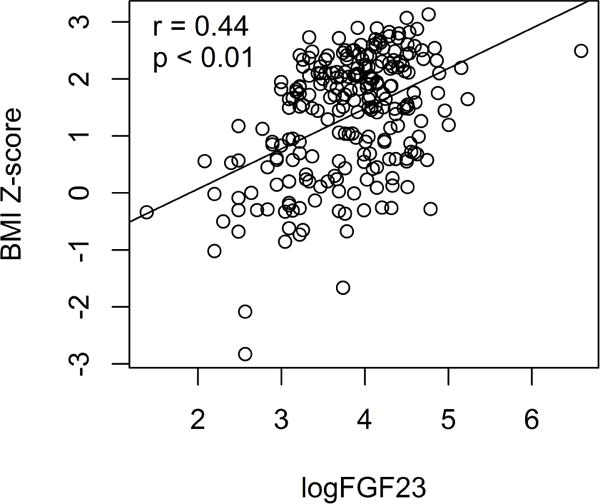
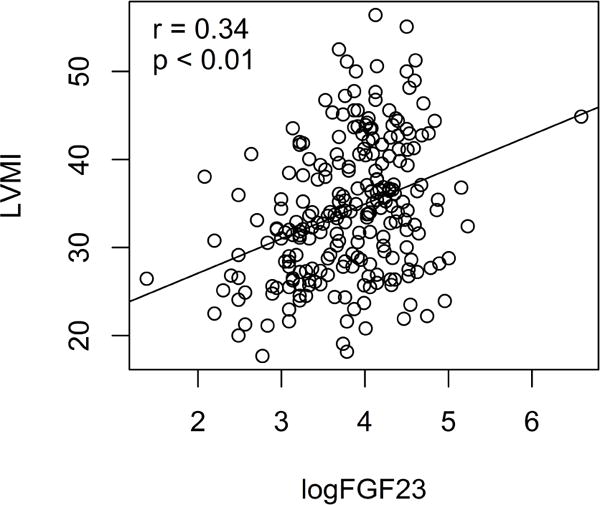
Left ventricular hypertrophy has been documented in hypertensive adolescents and among some with prehypertension. Obesity also appears to be associated with cardiac mass, independent of blood pressure (BP). Fibroblast growth factor 23 (FGF23) is a novel biomarker positively associated with left ventricular hypertrophy in adults with and without kidney disease. The aim of this study was to determine if there was a significant and independent association of FGF23 with cardiac mass in a Black American adolescent cohort including both normotensive and prehypertensive participants with and without obesity. Measurements of BP, body mass index (BMI), plasma c-terminal FGF23, and echocardiographic measures of left ventricular mass index (LVMI) were obtained in 236 adolescents, aged 13-18 years, stratified by BMI as normal, overweight, or obese. LVMI differed significantly between normal, overweight, and obese groups (30.42 ± 6.75 vs. 33.49 ± 8.65 vs. 37.26 ± 6.99 gm/m2.7; P < .01). FGF23 was significantly higher in both overweight (53.03 RU/mL) and obese (54.40 RU/mL) compared to the normal weight (32.83 RU/mL) group (both P < .01). In multiple linear regression analysis, variables significantly related to LVMI in males were BMI (P < .0001) and FGF23 (P = .005), but not BP, high-sensitivity C-reactive protein, or insulin. The only significant variable associated with LVMI in females was BMI (P < .0001). In males, the contribution of FGF23 to predicting LVMI was independent of and in addition to obesity. These results suggest that FGF23 is an integral part of a complex pathway, associated with higher cardiac mass in African-Americans males with excess adiposity.
Keywords: Blood pressure; FGF23; obesity.
Copyright © 2017 American Society of Hypertension. Published by Elsevier Inc. All rights reserved.
Conflict of interest statement
Conflicts of Interest: None
Figures
References
-
- Munter PHJ, Cutler JA, Wildman RP, Welton PK. Trends in blood pressure among children and adolescents. JAMA. 2004;291:2107–2113. - PubMed
-
- Falkner B, Daniels S, Flynn JT, et al. The fourth report on the diagnosis, evaluation, and treatment of high blood pressure in children and adolescents. Pediatrics. 2004;114:555–576. - PubMed
-
- Hanevold C, Waller J, Daniels S, Portman R, Sorof J. The effects of obesity, gender, and ethnic group on left ventricular hypertrophy and geometry in hypertensive children: a collaborative study of the International Pediatric Hypertension Association. Pediatrics. 2004;113:328–333. - PubMed
-
- McNiece KL, Gupta-Malhotra M, Samuels J, Bell C, Garcia K, Poffenbarger T, Sorof JM, Portman RJ. Left ventricular hypertrophy in hypertensive adolescents: analysis of risk by 2004 National High Blood Pressure Education Program Working Group staging criteria. Hypertension. 2007;50:392–395. - PMC - PubMed
Publication types
MeSH terms
Substances
Grants and funding
LinkOut - more resources
Full Text Sources
Other Literature Sources
Medical
Research Materials
