. 2018 Apr 15:300:37-47.
doi: 10.1016/j.jneumeth.2017.04.014. Epub 2017 Apr 26.

Assessing mouse behaviour throughout the light/dark cycle using automated in-cage analysis tools

Affiliations

Assessing mouse behaviour throughout the light/dark cycle using automated in-cage analysis tools

Rasneer S Bains et al. J Neurosci Methods. .

Abstract

An important factor in reducing variability in mouse test outcomes has been to develop assays that can be used for continuous automated home cage assessment. Our experience has shown that this has been most evidenced in long-term assessment of wheel-running activity in mice. Historically, wheel-running in mice and other rodents have been used as a robust assay to determine, with precision, the inherent period of circadian rhythms in mice. Furthermore, this assay has been instrumental in dissecting the molecular genetic basis of mammalian circadian rhythms. In teasing out the elements of this test that have determined its robustness - automated assessment of an unforced behaviour in the home cage over long time intervals - we and others have been investigating whether similar test apparatus could be used to accurately discriminate differences in distinct behavioural parameters in mice. Firstly, using these systems, we explored behaviours in a number of mouse inbred strains to determine whether we could extract biologically meaningful differences. Secondly, we tested a number of relevant mutant lines to determine how discriminative these parameters were. Our findings show that, when compared to conventional out-of-cage phenotyping, a far deeper understanding of mouse mutant phenotype can be established by monitoring behaviour in the home cage over one or more light:dark cycles.

Keywords: Circadian; Home cage; Motor function; Refinement; Welfare; Wheel running.


Figures

Fig. 1
Fig. 1
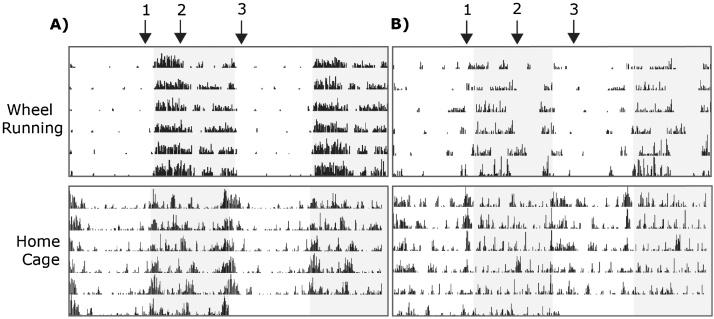
Wheel-running versus home cage activity. Raster plots of total wheel revolutions or total RFID-assessed distance travelled in the home-cage plotted in 6 min time bins over 6 consecutive days in standard 12 h light/dark cycles. The raster plots are double plotted on a 24 h cycle with the shaded area representing the dark phase. Activities of representative animals of two different mouse strains A) C57BL/6J and B) FVB/NcrlBRH. Arrows highlight some of the strain-specific differences in activity that can be distinguished using the two recording systems including 1) differences in anticipatory activity prior to lights-off, 2) abrupt change in activity levels half-way through the dark period and 3) sustained activity following lights-on. Differences between the two systems reflect the fact that wheel-running is an elective behaviour while RFID-based data is collected irrespective of the animal’s voluntary cage activities.
Fig. 2
Fig. 2
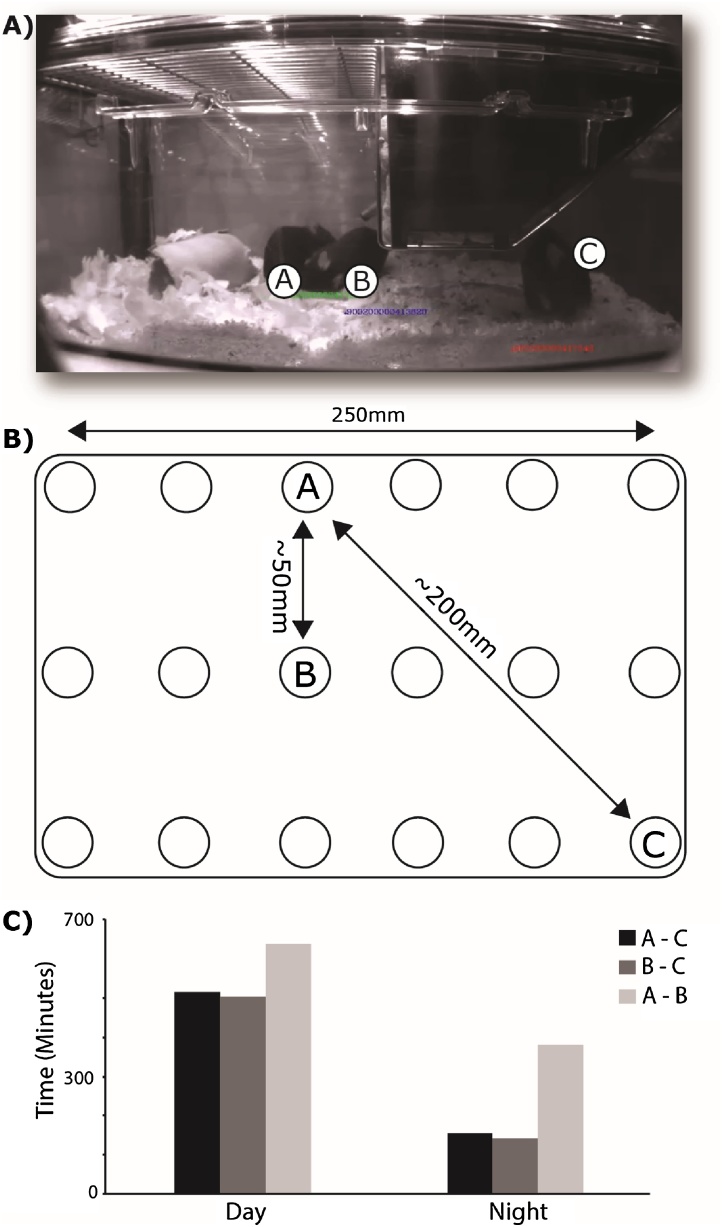
Home-cage social proximity interactions. RFID tracking of mice in multiple occupancy cages enables an estimate of social proximity scores. A) still from a video with overlay of RFIDs for individual animals; B) the base plate array recognises unique RFIDs and records animal locations concurrently; C) cumulative time spent in close proximity (<75 mm) during day and night for each pair of animals in the cage. In this instance, animals A and B spend less time interacting closely with animal C and this is more apparent at night.
Fig. 3
Fig. 3
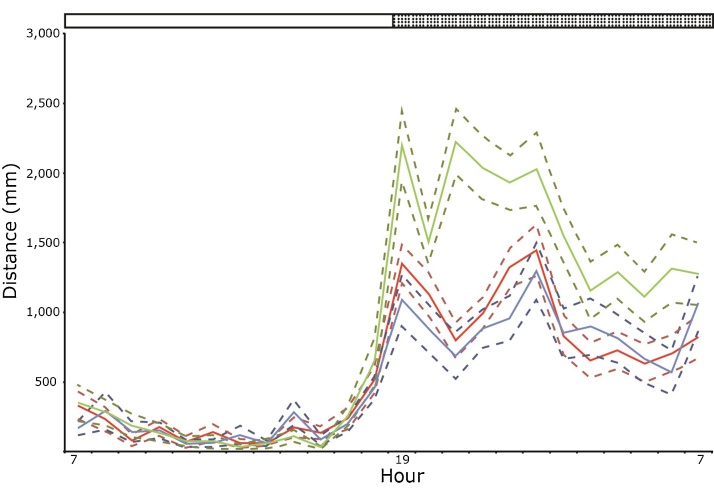
Nocturnal hyperactivity in a neurological mutant. Line plots illustrating the average hourly activity of 3 individual mice over a 24 h period. The solid lines represent the mean of the activity for each hourly period and the dotted lines represent the standard error of the mean activity over 3 consecutive days. The area under the shaded bar represents the dark phase while the area under the clear bar represents the light phase. The activity of all three animals within the cage is similar during the light phase but following lights-off the animal represented by the green line shows hyperactivity, which is sustained throughout the dark phase. (For interpretation of the references to colour in this figure legend, the reader is referred to the web version of this article.)
Fig. 4
Fig. 4
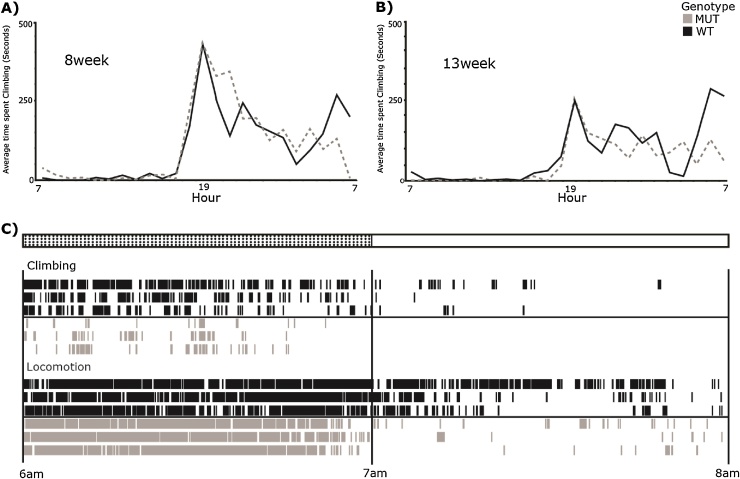
Automated assessment of home cage climbing activity in a mutant line with progressive motor deficits. Line graphs illustrating the average hourly climbing activities of 3 wild type (WT, black solid lines) and 3 mutant (MUT, grey dashed lines) mice. Climbing was assessed automatically using the HCA system. Average time spent climbing is noticeably higher in mice at 8 weeks of age A) than at 13 weeks of age B). Climbing behaviours in mutants appear to be significantly lower towards the end of the dark phase (6–7 a.m.) at both time points. C) Ethogram showing both locomotor activity and climbing activity in 13 week old mice over a two-hour period either side of lights-on (6 a.m.–8 a.m.). Mutant mice with motor deficits show particularly lower bouts of climbing activity at this time of day.

References

    1. Aniszewska A., Szymanski J., Winnicka M.M., Turlejski K. Interleukin 6 deficiency affects spontaneous activity of mice in age- and sex-dependent manner. Acta Neurobiol. Exp. 2014;74:424–432. - PubMed
    1. Asher L., Collins L.M., Ortiz-Pelaez A., Drewe J.A., Nicol C.J., Pfeiffer D.U. Recent advances in the analysis of behavioural organization and interpretation as indicators of animal welfare. J. R. Soc. Interface. 2009;6:1103–1119. - PMC - PubMed
    1. Bains R.S., Cater H.L., Sillito R.R., Chartsias A., Sneddon D., Concas D., Keskivali-Bond P., Lukins T.C., Wells S., Arozena A.A., Nolan P.M., Armstrong J.D. Analysis of individual mouse activity in group housed animals of different inbred strains using a novel automated home cage analysis system. Front. Behav. Neurosci. 2016;10:106. - PMC - PubMed
    1. Baker M. Animal models: inside the minds of mice and men. Nature. 2011;475:123–128. - PubMed
    1. Balzani E., Lassi G., Maggi S., Sethi S., Parsons M.J., Simon M., Nolan P.M., Tucci V. The Zfhx3-mediated axis regulates sleep and interval timing in mice. Cell Rep. 2016;16:615–621. - PMC - PubMed

Publication types

LinkOut - more resources