


A comparative study on endovascular treatment of (sub)acute critical limb ischemia: mechanical thrombectomy vs thrombolysis
- PMID: 28458517
- PMCID: PMC5402877
- DOI: 10.2147/DDDT.S131503
A comparative study on endovascular treatment of (sub)acute critical limb ischemia: mechanical thrombectomy vs thrombolysis
Abstract
Objective: The aim of this study was to compare different interventional methods for treatment of (sub)acute limb ischemia upon thrombotic occlusions of the lower extremity in terms of their safety and efficacy in a tertiary hospital setting.
Design: This is a retrospective, single-center study of non-randomized data.
Methods: A total of 202 patients, including 26 critically ill patients, underwent rotational thrombectomy (Rotarex®), local thrombolysis (recombinant tissue plasminogen activator), or combination of both at the University Hospital Heidelberg (2006-2015). The different interventional procedures were compared in terms of overall and amputation-free survival, as well as patency in a 1-year follow-up (Kaplan-Meier analysis).
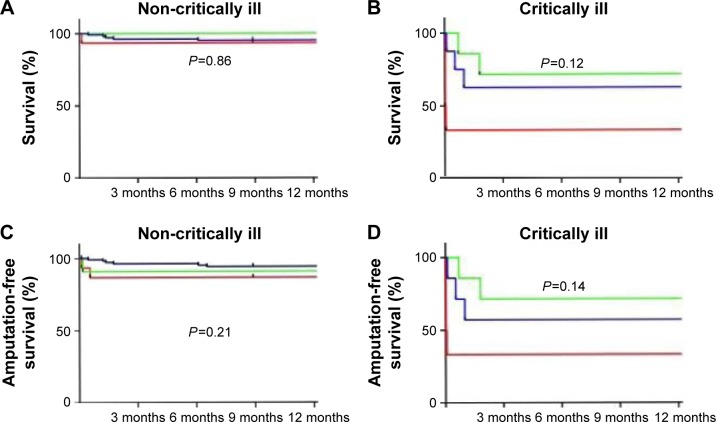
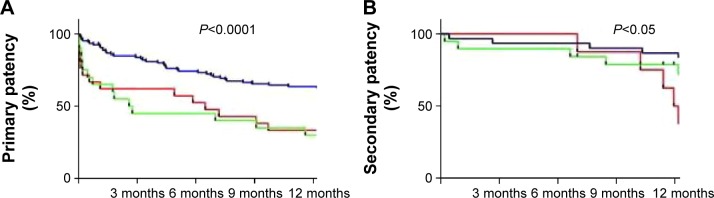
Results: The study demonstrated a primary revascularization success of >98% in all groups. One year after revascularization, primary and secondary patency after mechanical thrombectomy alone were significantly better in comparison to local thrombolysis or a combination of Rotarex® and lysis (63% and 85%, P<0.05). Overall survival 12 months after intervention reached up to 96% in noncritically ill patients, and amputation-free survival was 94.3% in all three groups. Mean hospitalization duration and rate of major bleedings were significantly increased after thrombolysis compared to Rotarex® (P<0.05).
Conclusion: In patients with (sub)acute limb ischemia, Rotarex® mechanical thrombectomy represents a safe and effective alternative to thrombolysis and is associated with a reduced rate of major bleedings, shorter hospitalization durations, and lower costs.
Keywords: Rotarex®; acute artery occlusion; acute limb ischemia; arterial thrombosis and embolism; mechanical thrombectomy; thrombolysis.
Conflict of interest statement
Disclosure The authors report no conflicts of interest in this work.
Figures
References
-
- Norgren L, Hiatt WR, Dormandy JA, Nehler MR, Harris KA, Fowkes FGR, TASC II Working Group Inter-society consensus for the management of peripheral arterial disease (TASC II) Eur J Vasc Endovasc Surg. 2007;33(Suppl 1):S1–S75. - PubMed
-
- Dotter CT, Rösch J, Seaman AJ. Selective clot lysis with low-dose streptokinase. Radiology. 1974;111(1):31–37. - PubMed
Publication types
MeSH terms
Substances
LinkOut - more resources
Full Text Sources
Other Literature Sources
Molecular Biology Databases
