


Inflammatory Responses Regulating Alveolar Ion Transport during Pulmonary Infections
- PMID: 28458673
- PMCID: PMC5394420
- DOI: 10.3389/fimmu.2017.00446
Inflammatory Responses Regulating Alveolar Ion Transport during Pulmonary Infections
Abstract
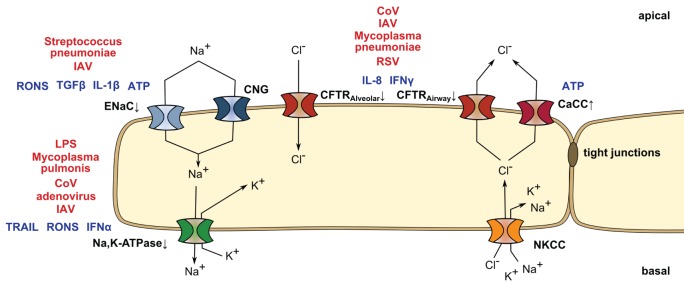
The respiratory epithelium is lined by a tightly balanced fluid layer that allows normal O2 and CO2 exchange and maintains surface tension and host defense. To maintain alveolar fluid homeostasis, both the integrity of the alveolar-capillary barrier and the expression of epithelial ion channels and pumps are necessary to establish a vectorial ion gradient. However, during pulmonary infection, auto- and/or paracrine-acting mediators induce pathophysiological changes of the alveolar-capillary barrier, altered expression of epithelial Na,K-ATPase and of epithelial ion channels including epithelial sodium channel and cystic fibrosis membrane conductance regulator, leading to the accumulation of edema and impaired alveolar fluid clearance. These mediators include classical pro-inflammatory cytokines such as TGF-β, TNF-α, interferons, or IL-1β that are released upon bacterial challenge with Streptococcus pneumoniae, Klebsiella pneumoniae, or Mycoplasma pneumoniae as well as in viral infection with influenza A virus, pathogenic coronaviruses, or respiratory syncytial virus. Moreover, the pro-apoptotic mediator TNF-related apoptosis-inducing ligand, extracellular nucleotides, or reactive oxygen species impair epithelial ion channel expression and function. Interestingly, during bacterial infection, alterations of ion transport function may serve as an additional feedback loop on the respiratory inflammatory profile, further aggravating disease progression. These changes lead to edema formation and impair edema clearance which results in suboptimal gas exchange causing hypoxemia and hypercapnia. Recent preclinical studies suggest that modulation of the alveolar-capillary fluid homeostasis could represent novel therapeutic approaches to improve outcomes in infection-induced lung injury.
Keywords: Na-K-ATPase; cystic fibrosis membrane conductance regulator; cytokines; edema; epithelial sodium channel; ion channel; ion pumps; lung injury.
Figures
References
-
- Bastacky J, Lee CY, Goerke J, Koushafar H, Yager D, Kenaga L, et al. Alveolar lining layer is thin and continuous: low-temperature scanning electron microscopy of rat lung. J Appl Physiol (1995) 79:1615–28. - PubMed
-
- Verkman AS, Matthay MA, Song Y. Aquaporin water channels and lung physiology. Am J Physiol Lung Cell Mol Physiol (2000) 278:L867–79. - PubMed
-
- Bertorello AM, Komarova Y, Smith K, Leibiger IB, Efendiev R, Pedemonte CH, et al. Analysis of Na+,K+-ATPase motion and incorporation into the plasma membrane in response to G protein-coupled receptor signals in living cells. Mol Biol Cell (2003) 14:1149–57. 10.1091/mbc.E02-06-0367 - DOI - PMC - PubMed
-
- Mutlu GM, Adir Y, Jameel M, Akhmedov AT, Welch L, Dumasius V, et al. Interdependency of beta-adrenergic receptors and CFTR in regulation of alveolar active Na+ transport. Circ Res (2005) 96:999–1005. 10.1161/01.RES.0000164554.21993.AC - DOI - PubMed
Publication types
LinkOut - more resources
Full Text Sources
Other Literature Sources
