. 2017 Mar;3(1):9-18.
doi: 10.1007/s40778-017-0070-z. Epub 2017 Feb 1.

Steroid Hormones and the Physiological Regulation of Tissue-Resident Stem Cells: Lessons from the Drosophila Ovary

Affiliations

Steroid Hormones and the Physiological Regulation of Tissue-Resident Stem Cells: Lessons from the Drosophila Ovary

Elizabeth T Ables et al. Curr Stem Cell Rep. 2017 Mar.

Abstract

Purpose of review: Stem cells respond to local paracrine signals; more recently, however, systemic hormones have also emerged as key regulators of stem cells. This review explores the role of steroid hormones in stem cells, using the Drosophila germline stem cell as a centerpiece for discussion.

Recent findings: Stem cells sense and respond directly and indirectly to steroid hormones, which regulate diverse sets of target genes via interactions with nuclear hormone receptors. Hormone-regulated networks likely integrate the actions of multiple systemic signals to adjust the activity of stem cell lineages in response to changes in physiological status.

Summary: Hormones are inextricably linked to animal physiology, and can control stem cells and their local niches. Elucidating the molecular mechanisms of hormone signaling in stem cells is essential for our understanding of the fundamental underpinnings of stem cell biology, and for informing new therapeutic interventions against cancers or for regenerative medicine.

Keywords: cell fate; differentiation; ecdysone; germ cells; germline; nuclear hormone receptor; oocyte; oogenesis; self-renewal.


Figures
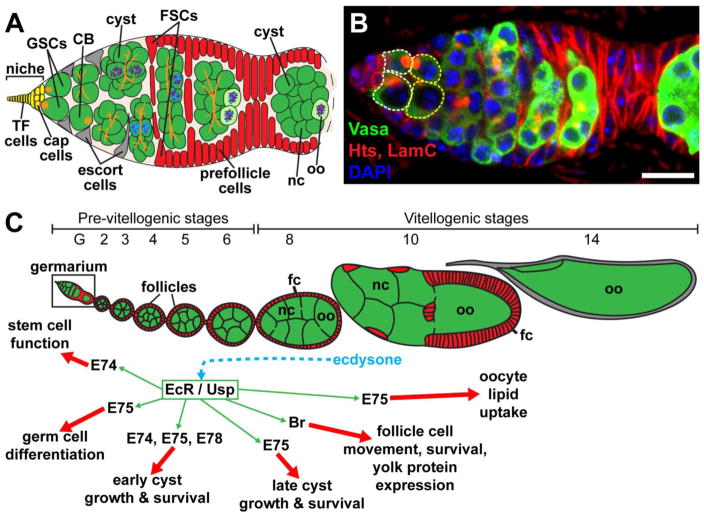
Figure 1
Figure 1. The steroid hormone ecdysone controls multiple steps of Drosophila oogenesis
Female germline stem cells (GSCs) reside in a germarium (A, B) at the anterior tip of each of the 14–16 ovarioles (C) that compose the Drosophila ovary. (A) GSCs are anchored to adjacent cap cells that, along with terminal filament (TF) cells, send signals to maintain GSCs in a self-renewing fate. GSCs divide to form daughter cells (cystoblasts, CB), which divide four additional times to form 16-cell germline cysts composed of nurse cells (nc) and an oocyte (oo). Escort cells (gray) signal to germ cells to promote differentiation. Follicle stem cells (FSCs) divide to form prefollicle cells, which surround the 16-cell germline cyst, giving rise to a follicle that leaves the germarium. Prefollicle cells give rise to a variety of specialized follicle cells (fc; red) that form an epithelial monolayer around each cyst. (B) Confocal micrograph of a germarium immunolabeled with anti-Vasa (green; labels all germ cells), anti-Hts (red; labels early germline-specific organelles called fusomes and follicle cell membranes), anti-Lamin C (red; labels the nuclear envelope of cap cells), and DAPI (blue; labels all nuclei). Dashed lines outline GSCs (white) and cystoblasts (yellow). Scale bar, 10 μm. (C) Summary of ecdysone-regulated processes in the ovary. Ecdysone is produced by older follicles, and stimulates the EcR/Usp complex expressed throughout the ovary. Activation of the complex results in a variety of cellular responses mediated by distinct ecdysone-responsive transcription factors, such as E74, E75, E78, and Br.

References

    1. Lepage R, Albert C. Fifty years of development in the endocrinology laboratory. Clinical biochemistry. 2006;39(5):542–57. doi: 10.1016/j.clinbiochem.2006.03.007. - DOI - PubMed
    1. Wilson JD. The evolution of endocrinology. Clinical endocrinology. 2005;62(4):389–96. doi: 10.1111/j.1365-2265.2005.02209.x. - DOI - PubMed
    1. Ables ET, Laws KM, Drummond-Barbosa D. Control of adult stem cells in vivo by a dynamic physiological environment: diet-dependent systemic factors in Drosophila and beyond. Wiley interdisciplinary reviews Developmental biology. 2012;1(5):657–74. doi: 10.1002/wdev.48. - DOI - PMC - PubMed
    1. Joshi PA, Di Grappa MA, Khokha R. Active allies: hormones, stem cells and the niche in adult mammopoiesis. Trends in endocrinology and metabolism: TEM. 2012;23(6):299–309. doi: 10.1016/j.tem.2012.04.002. - DOI - PubMed
    1. Mihaylova MM, Sabatini DM, Yilmaz OH. Dietary and metabolic control of stem cell function in physiology and cancer. Cell stem cell. 2014;14(3):292–305. doi: 10.1016/j.stem.2014.02.008. - DOI - PMC - PubMed

LinkOut - more resources