


Incidence of Neutropenia in Veterans Receiving Lung Cancer Chemotherapy: A Comparison of Administrative Coding and Electronic Laboratory Data
- PMID: 28459084
- PMCID: PMC5389434
- DOI: 10.13063/2327-9214.1269
Incidence of Neutropenia in Veterans Receiving Lung Cancer Chemotherapy: A Comparison of Administrative Coding and Electronic Laboratory Data
Abstract
Introduction: The frequency of neutropenia associated with lung cancer chemotherapy outside of randomized trials is largely unknown because administrative coding underestimates its prevalence. This study compared International Classification of Diseases (ICD) diagnosis codes and electronic laboratory results, alone and in combination, for identifying neutropenia events.
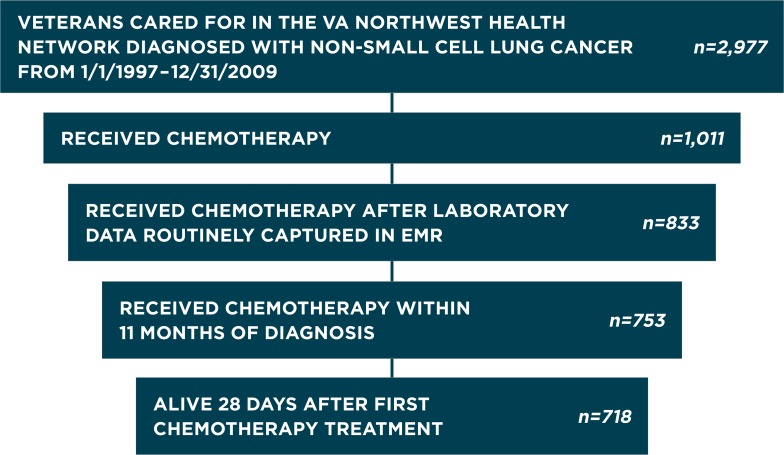
Methods: Retrospective cohort study of 718 veterans receiving their first course of chemotherapy for non-small cell lung cancer. Incidence of neutropenia was assessed using electronic laboratory results and ICD-9 codes captured in the Department of Veterans Affairs (VA) electronic medical records (EMR).
Results: A total of 118 of 718 patients (16.4 percent) were identified with an absolute neutrophil count (ANC) less than 1,000 cells/mm3, while only 49 of 718 patients (6.8 percent) had ICD-9 codes for neutropenia. Using the combination of laboratory results and diagnosis codes, 136 of 718 patients (18.9 percent) experienced a neutropenic event. Compared to laboratory results as a gold standard, diagnosis codes were specific (not present for individuals without a laboratory-documented low ANC), but not sensitive (missing for many individuals with a low ANC documented in their laboratory test results).
Conclusion: Relying on ICD codes to identify neutropenia in administrative data likely results in under-reporting. The emerging availability of electronic laboratory results provides an opportunity to more accurately quantify patterns of neutropenia, identify individual risk factors, and assess clinical management practices-including use of colony-stimulating factor prophylaxis-in large community cohorts.
Keywords: administrative data; electronic health record; laboratory data; neutropenia; non-small cell lung cancer.
Conflict of interest statement
Conflict of interest The authors have no conflicts of interest to disclose. The views expressed in this article are those of the authors and do not necessarily reflect the position or policy of the Department of Veterans Affairs or the United States Government.
Figures
References
-
- Lyman GH. Impact of chemotherapy does intensity on cancer patient outcomes. J Natl Compr Canc Netw. 2009;7(1):99–108. - PubMed
-
- Kuderer NM, Dale DC, Crawford J, Cosler LE, Lyman GH. Morality, morbidity, and costs associated with febrile neutropenia in adult cancer patients. Cancer. 2006;106(10):2258–66. - PubMed
-
- Sullivan SD, Ramsey SD, Blough DK, McDermott CL, Clarke L, McCune JS. Health care use and primary prophylaxis with colony-stimulating factors. Value Health. 2011;14(2):247–252. - PubMed
-
- Lewis JH, Kilgore ML, Goldman DP, Trimble EL, Kaplan R, Montello MJ, Housman MG, Escarce JJ. Participation of patients 65 years of age or older in cancer clinical trials. J Clin Oncol. 2003;21(7):1382–1389. - PubMed
Grants and funding
LinkOut - more resources
Full Text Sources
Other Literature Sources