. 2017 Jul 3;45(W1):W49-W54.
doi: 10.1093/nar/gkx320.

PRISM 3: expanded prediction of natural product chemical structures from microbial genomes

Affiliations

PRISM 3: expanded prediction of natural product chemical structures from microbial genomes

Michael A Skinnider et al. Nucleic Acids Res. .

Abstract

Microbial natural products represent a rich resource of pharmaceutically and industrially important compounds. Genome sequencing has revealed that the majority of natural products remain undiscovered, and computational methods to connect biosynthetic gene clusters to their corresponding natural products therefore have the potential to revitalize natural product discovery. Previously, we described PRediction Informatics for Secondary Metabolomes (PRISM), a combinatorial approach to chemical structure prediction for genetically encoded nonribosomal peptides and type I and II polyketides. Here, we present a ground-up rewrite of the PRISM structure prediction algorithm to derive prediction of natural products arising from non-modular biosynthetic paradigms. Within this new version, PRISM 3, natural product scaffolds are modeled as chemical graphs, permitting structure prediction for aminocoumarins, antimetabolites, bisindoles and phosphonate natural products, and building upon the addition of ribosomally synthesized and post-translationally modified peptides. Further, with the addition of cluster detection for 11 new cluster types, PRISM 3 expands to detect 22 distinct natural product cluster types. Other major modifications to PRISM include improved sequence input and ORF detection, user-friendliness and output. Distribution of PRISM 3 over a 300-core server grid improves the speed and capacity of the web application. PRISM 3 is available at http://magarveylab.ca/prism/.


Figures

Figure 1.
Figure 1.
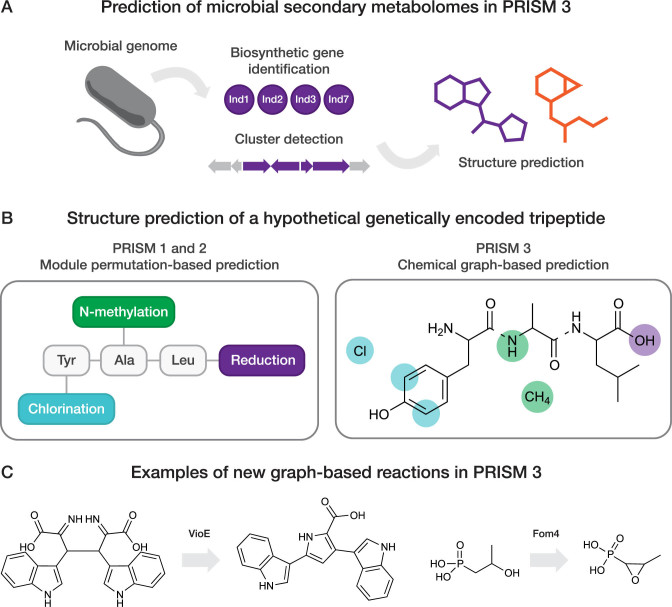
(A) Schematic overview of microbial secondary metabolome prediction in PRISM 3. Following ORF detection in a microbial genome sequence, protein sequences are analyzed and clustered using a library of hidden Markov models for secondary metabolite biosynthesis genes. Identified biosynthetic information is subsequently leveraged for combinatorial prediction of secondary metabolite chemical structures. (B) Overview of chemical graph-based secondary metabolite structure prediction in PRISM 3. Modeling a natural product as a chemical graph, rather than a linear permutation of monomers, facilitates manipulation of the predicted structure at the level of individual atoms or bonds rather than at the level of the monomers. In PRISM 3, individual sets of atoms, rather than individual sets of modules, are tagged as potential sites of tailoring reactions before combinatorialization. Linkages between residues within the same subgraph are indicated as dashed lines. (C) Examples of new virtual reactions facilitated by graph-based structure prediction in PRISM 3.
Figure 2.
Figure 2.
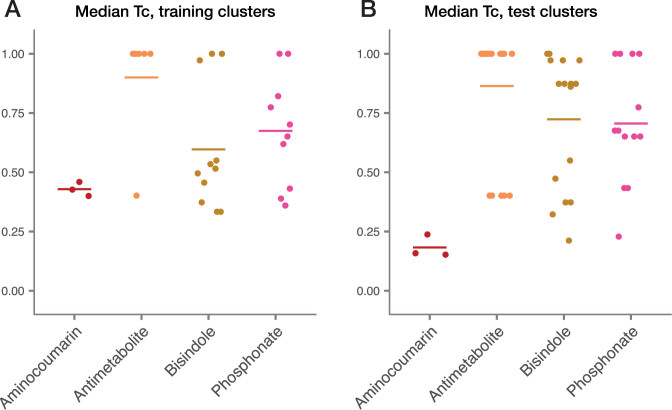
Validating the accuracy of genomic structure predictions for four new classes of natural products in PRISM 3. (A) Median Tanimoto coefficients (Tc) within predicted structure libraries for clusters associated with the biosynthesis of known natural products (training set). (B) Median Tc within predicted structure libraries for clusters excluded from the training set (test set).
Figure 3.
Figure 3.
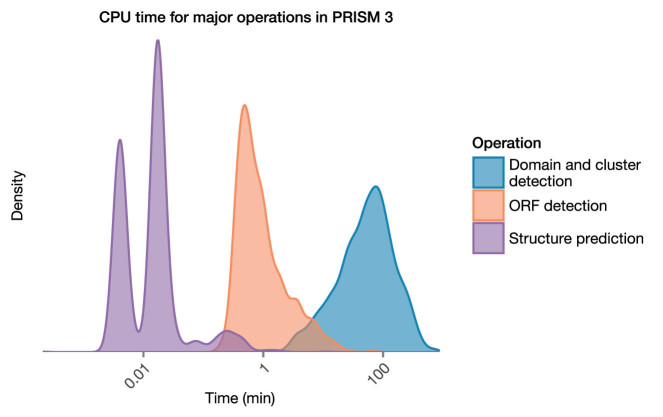
Benchmarking the speed of PRISM 3. Total CPU time required for the three major components of the PRISM algorithm (ORF finding, domain and cluster detection and structure prediction) for analysis of 2314 prokaryotic genomes is shown.

References

    1. Newman D.J., Cragg G.M.. Natural products as sources of new drugs from 1981 to 2014. J. Nat. Prod. 2016; 79:629–661. - PubMed
    1. Nett M., Ikeda H., Moore B.S.. Genomic basis for natural product biosynthetic diversity in the actinomycetes. Nat. Prod. Rep. 2009; 26:1362–1384. - PMC - PubMed
    1. Doroghazi J.R., Albright J.C., Goering A.W., Ju K.S., Haines R.R., Tchalukov K.A., Labeda D.P., Kelleher N.L., Metcalf W.W.. A roadmap for natural product discovery based on large-scale genomics and metabolomics. Nat. Chem. Biol. 2014; 10:963–968. - PMC - PubMed
    1. Starcevic A., Zucko J., Simunkovic J., Long P.F., Cullum J., Hranueli D.. ClustScan: an integrated program package for the semi-automatic annotation of modular biosynthetic gene clusters and in silico prediction of novel chemical structures. Nucleic Acids Res. 2008; 36:6882–6892. - PMC - PubMed
    1. Bachmann B.O., Ravel J.. Chapter 8. Methods for in silico prediction of microbial polyketide and nonribosomal peptide biosynthetic pathways from DNA sequence data. Methods Enzymol. 2009; 458:181–217. - PubMed

Publication types

Substances