. 2017 Jul 1:176:1-6.
doi: 10.1016/j.drugalcdep.2017.02.009. Epub 2017 Apr 13.

Current major depression is associated with greater sensitivity to the motivational effect of both negative mood induction and abstinence on tobacco-seeking behavior

Affiliations

Current major depression is associated with greater sensitivity to the motivational effect of both negative mood induction and abstinence on tobacco-seeking behavior

Lee Hogarth et al. Drug Alcohol Depend. .

Abstract

Background: Although depression and smoking commonly co-occur, the mechanisms underpinning this association are poorly understood. One hypothesis is that depression promotes tobacco dependence, persistence and relapse by increasing sensitivity to acute negative mood and abstinence induced tobacco-seeking behavior.

Methods: Twenty nine daily smokers of >10 cigarettes per day, nine with major depression and 20 without, completed two laboratory sessions one week apart, smoking as normal prior to session 1 (sated session), and 6h abstinent prior to session 2 (abstinent session). In both sessions, tobacco-seeking was measured at baseline by preference to view smoking versus food images. Negative mood was then induced by negative ruminative statements and sad music, before tobacco-seeking was measured again at test.

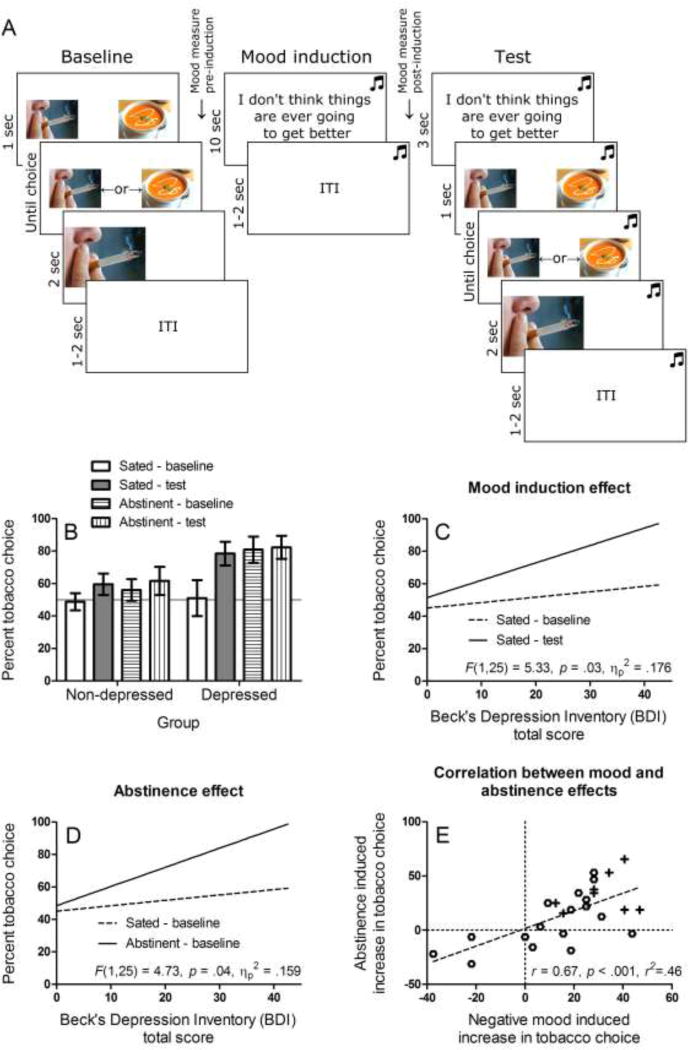
Results: In the sated session, negative mood induction produced a greater increase in tobacco choice from baseline to test in depressed (p<0.001, ηp2=0.782) compared to non-depressed smokers (p=0.045, ηp2=0.216, interaction: p=0.046, ηp2=0.150). Abstinence also produced a greater increase in baseline tobacco choice between the sated and abstinent sessions in depressed (p=0.002, ηp2=0.771) compared to non-depressed smokers (p=0.22, ηp2=0.089, interaction: p=0.023, ηp2=0.189). These mood and abstinence induced increases in tobacco choice were positively associated with depression symptoms across the sample as a whole (ps≤0.04, ηp2≥0.159), and correlated with each other (r=0.67, p<0.001).

Conclusions: Current major depression or depression symptoms may promote tobacco dependence, persistence and relapse by increasing sensitivity to both acute negative mood and abstinence induced tobacco-seeking behavior. Treatments should seek to break the association between adverse states and smoking to cope.

Keywords: Abstinence; Depression; Mood induction; Smoking; Vulnerability.


Conflict of interest statement

Conflict of Interest. Brian Hitsman has served on a scientific advisory board for Pfizer and receives study medication and placebo free of charge from Pfizer for use in ongoing National Institutes of Health funded clinical trials.

Figures

Figure 1
Figure 1
A. Task used to test the effect of mood induction on tobacco choice, completed in both the sated and abstinent sessions. B. Percent choice of tobacco versus food in the baseline and test blocks of the task, completed in the sated and abstinent sessions. Smokers with major depression showed a greater increase in tobacco choice between the sated-baseline and sated-test condition (mood induction effect), and between the sated-baseline and abstinent-baseline condition (abstinence effect), compared to non-depressed smokers. C. Regression slopes relating depression symptoms (BDI-II) across the sample as a whole to percent tobacco choice in the baseline and test blocks completed in the sated session (mood induction effect). The difference between slopes increased with BDI-II scores indicating greater sensitivity to negative mood induced tobacco-seeking. The F statistic reports this interaction. D. Regression slopes relating depression symptoms (BDI-II) across the sample as a whole to percent tobacco choice in the baseline blocks of the sated and abstinent session (abstinence effect). The difference between slopes increased with BDI-II scores indicating greater sensitivity to abstinence induced tobacco-seeking. The F statistic reports this interaction. E. Correlation between the mood induction effect (sated-test minus sated-baseline) and the abstinence effect (abstinent-baseline minus sated-baseline) on tobacco choice across the sample as a whole. Symbols denote depressed (+) and non-depressed (O) smokers.

References

    1. Aguirre C, Madrid J, Leventhal AM. Tobacco withdrawal symptoms mediate motivation to reinstate smoking during abstinence. J Abnorm Psychol. 2015;124:623–634. - PMC - PubMed
    1. Anker JJ, Kushner MG, Thuras P, Menk J, Unruh AS. Drinking to cope with negative emotions moderates alcohol use disorder treatment response in patients with co-occurring anxiety disorder. Drug Alcohol Depend. 2016;159:93–100. - PMC - PubMed
    1. Ashare R, Strasser AA, Wileyto EP, Cuevas J, Audrain-McGovern J. Cognitive deficits specific to depression-prone smokers during abstinence. Exp Clin Psychopharmacol. 2014;22:323–331. - PMC - PubMed
    1. Audrain-McGovern J, Wileyto EP, Ashare R, Cuevas J, Strasser AA. Reward and affective regulation in depression-prone smokers. Biol Psychiatry. 2014;76:689–697. - PMC - PubMed
    1. Back SE, Hartwell K, DeSantis SM, Saladin M, McRae-Clark AL, Price KL, Moran-Santa Maria MM, Baker NL, Spratt E, Kreek MJ, Brady KT. Reactivity to laboratory stress provocation predicts relapse to cocaine. Drug Alcohol Depend. 2010;106:21–27. - PMC - PubMed