. 2017 Jul:143:218-229.
doi: 10.1016/j.antiviral.2017.04.015. Epub 2017 Apr 29.

Characterization of the Zika virus two-component NS2B-NS3 protease and structure-assisted identification of allosteric small-molecule antagonists

Affiliations

Characterization of the Zika virus two-component NS2B-NS3 protease and structure-assisted identification of allosteric small-molecule antagonists

Sergey A Shiryaev et al. Antiviral Res. 2017 Jul.

Abstract

The recent re-emergence of Zika virus (ZIKV)1, a member of the Flaviviridae family, has become a global emergency. Currently, there are no effective methods of preventing or treating ZIKV infection, which causes severe neuroimmunopathology and is particularly harmful to the developing fetuses of infected pregnant women. However, the pathology induced by ZIKV is unique among flaviviruses, and knowledge of the biology of other family members cannot easily be extrapolated to ZIKV. Thus, structure-function studies of ZIKV proteins are urgently needed to facilitate the development of effective preventative and therapeutic agents. Like other flaviviruses, ZIKV expresses an NS2B-NS3 protease, which consists of the NS2B cofactor and the NS3 protease domain and is essential for cleavage of the ZIKV polyprotein precursor and generation of fully functional viral proteins. Here, we report the enzymatic characterization of ZIKV protease, and we identify structural scaffolds for allosteric small-molecule inhibitors of this protease. Molecular modeling of the protease-inhibitor complexes suggests that these compounds bind to the druggable cavity in the NS2B-NS3 protease interface and affect productive interactions of the protease domain with its cofactor. The most potent compound demonstrated efficient inhibition of ZIKV propagation in vitro in human fetal neural progenitor cells and in vivo in SJL mice. The inhibitory scaffolds could be further developed into valuable research reagents and, ultimately, provide a roadmap for the selection of efficient inhibitors of ZIKV infection.

Keywords: Flavivirus; Inhibitors; NS2B; NS3; Protease; Zika virus.


Conflict of interest statement

Conflict of interest

No author has an actual or perceived conflict of interest with the contents of this article.

Figures

Fig. 1
Fig. 1. Constructs and purification of soluble ZIKV NS2B-NS3pro
(A) ZIKV polyprotein processing by NS2B-NS3pro and host cell proteases. NS2B-NS3pro cleavage sites are shown by white arrows. Host cell proteases and furin cleavage sites are shown by black arrows. (B) Coomassie staining of purified ZIKV wild-type (WT) and S135A NS2B-NS3pro. M, molecular weight markers. (C) Sequence alignment of the flaviviral NS3 protease domain. Dark blue, regular blue, and light blue highlight the residues identical in 5, 4, and 3 flaviviruses, respectively. An arrow indicates the S135A mutant residue (this mutant residue is numbered according to the ZIKV protease sequence rather than the consensus numbering). (For interpretation of the references to colour in this figure legend, the reader is referred to the web version of this article.)
Fig. 2
Fig. 2. Enzymatic characteristics of ZIKV NS2B-NS3pro
(A) Cleavage of Pyr-RTKR-MCA by purified ZIKV WT and S135A NS2B-NS3pro. WNV NS2B-NS3pro cleavage is shown for reference. Data are the mean ± S.D of n = 5. (BE) Effect of ions on ZIKV and WNV NS2B-NS3pro activity: (B) Ca2+, (C) Mg2+, (D) Na+, and (E) K+. Data are the mean ± S.D of n = 3. Stars above the bars represent statistical significance determined by Student t-test: *p < 0.05, **p < 0.01, *** – p < 0.001 and ns – not statistically significant.
Fig. 3
Fig. 3. Cleavage of protein targets by ZIKV NS2B-NS3pro
(A) Myelin basic protein (MBP, 18.5 kDa) is not susceptible to ZIKV NS2B-NS3pro (left panel), but could be readily cleaved by WNV NS2B-NS3pro (enzyme:substrate ratio of 1:10–10,000) (right panel). Please, note that only the pre-existing degraded MBP species rather than newly accumulated cleavage products are present in the left panel. Coomassie Blue staining is shown. (B) Human Sox2 could be partially cleaved by an excess of ZIKV NS2B-NS3pro in vitro. The degradation products the enhanced levels which discriminate the WT samples from the inactive S135A samples are marked by a star symbol. Multiple pre-existing degraded Sox2 species are also visible because of the limited stability of recombinant Sox2. Stars indicate Sox2 cleavage products. Western blot using the Sox2 antibody is shown (C) Sox2 is not cleaved in ZIKV-infected human fetal neural progenitors. Western blot using the Sox2 antibody is shown.
Fig. 4
Fig. 4. Inhibitors of ZIKV NS2B-NS3pro
(A) NSC157058, NSC716897, NSC86314, and aprotinin inhibit the catalytic activity of ZIKV NS2B-NS3pro. Representative dose-response curves are shown. Data are the mean ± S.D of n = 3. (B) Modeling of aprotinin in ZIKV NS2B-NS3pro (PDB 5lc0; right). The X-ray structure of aprotinin in its complex with WNV NS2B-NS3pro (PDB 2ijo) is shown on the left. NS3pro is shown as a cartoon (light brown); the catalytic triad is in red; and NS2B and aprotinin are shown in dark and light blue, respectively. (For interpretation of the references to colour in this figure legend, the reader is referred to the web version of this article.)
Fig. 5
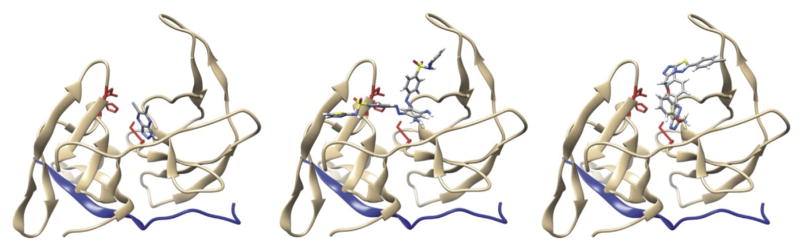
Fig. 5. Predicted binding mode of NSC157058 (left), NSC86314 (middle), and NSC716903 (right) to ZIKV NS2B-NS3pro
NS2B-NS3pro is shown as a cartoon (light brown), NS2B is in blue, and the catalytic triad is in red. The ligand structures are multicolored per their atomic composition. (For interpretation of the references to colour in this figure legend, the reader is referred to the web version of this article.)
Fig. 6
Fig. 6. Assay of ZIKV infection (Asian strain FSS13025) of primary human fetal neural progenitors
(A) Micrograph of infected cells (44 h post-infection). Active caspase-3, red; nuclei, blue; ZIKV Envelope protein, green; EdU, white. (B) Infection time course. (C) Number of nuclei in infected cells. (D) Percentage of EdU-positive proliferating cells in the subset of ZIKV-positive cells. At MOI = 0, the percentage of EdU-positive cells is shown relative to the total cell number. Error bars are ± SD. (For interpretation of the references to colour in this figure legend, the reader is referred to the web version of this article.)
Fig. 7
Fig. 7. NSC157058 inhibits ZIKV infection in human fetal neural progenitors and in SJL mice
(A) Cells were infected with ZIKV at a MOI of 0.1 and co-incubated with NSC157058, NSC86314, or NSC716903 (0–100 μM) for an additional 4 days. Data are the mean ± S.D of n = 3. Stars above the bars represent statistical significance determined by Student t-test: *p < 0.05. (B) NSC157058 (10 mg/kg) was injected intraperitoneally. NSC157058 concentrations were measured by LC-MS/MS mass spectrometry in plasma samples prepared at 15 min, 30 min, 1 h, and 2 h post-injection. The estimated half-life of NSC157058 was ~20 min (C) SJL mice were infected with ZIKV (2 × 10³ PFU; Panama strain, PA 259459). Mice were then provided with water containing NSC157058 (30 mg/kg) for 5 days. On day 6, blood samples were taken and ZIKV RNA was quantified by RT-PCR. Horizontal bars show the mean values, n = 3 mice, p < 0.01 Student t-test. Cytotoxicity of the tested compounds, including NSC157058, NSC86314, or NSC716903, is summarized in Table 2.

References

    1. Aleshin AE, Shiryaev SA, Strongin AY, Liddington RC. Structural evidence for regulation and specificity of flaviviral proteases and evolution of the Flaviviridae fold. Protein Sci. 2007;16:795–806. - PMC - PubMed
    1. Amador-Arjona A, Cimadamore F, Huang CT, Wright R, Lewis S, Gage FH, Terskikh AV. SOX2 primes the epigenetic landscape in neural precursors enabling proper gene activation during hippocampal neurogenesis. Proc Natl Acad Sci U S A. 2015;112:E1936–E1945. - PMC - PubMed
    1. Azevedo RS, Araujo MT, Martins Filho AJ, Oliveira CS, Nunes BT, Cruz AC, Nascimento AG, Medeiros RC, Caldas CA, Araujo FC, Quaresma JA, Vasconcelos BC, Queiroz MG, da Rosa ES, Henriques DF, Silva EV, Chiang JO, Martins LC, Medeiros DB, Lima JA, Nunes MR, Cardoso JF, Silva SP, Shi PY, Tesh RB, Rodrigues SG, Vasconcelos PF. Zika virus epidemic in Brazil. I Fatal disease in adults: clinical and laboratorial aspects. J Clin Virol. 2016;85:56–64. - PMC - PubMed
    1. Barrows NJ, Campos RK, Powell ST, Prasanth KR, Schott-Lerner G, Soto-Acosta R, Galarza-Munoz G, McGrath EL, Urrabaz-Garza R, Gao J, Wu P, Menon R, Saade G, Fernandez-Salas I, Rossi SL, Vasilakis N, Routh A, Bradrick SS, Garcia-Blanco MA. A screen of FDA-approved drugs for inhibitors of Zika virus infection. Cell Host Microbe. 2016;20:259–270. - PMC - PubMed
    1. Campos GS, Bandeira AC, Sardi SI. Zika virus outbreak, Bahia, Brazil. Emerg Infect Dis. 2015;21:1885–1886. - PMC - PubMed

Publication types

MeSH terms