Review
. 2017 Jun;17(6):376-390.
doi: 10.1038/nri.2017.25. Epub 2017 May 2.

Multi-receptor detection of individual bacterial products by the innate immune system

Affiliations
Review

Multi-receptor detection of individual bacterial products by the innate immune system

Karen J Kieser et al. Nat Rev Immunol. 2017 Jun.

Abstract

The receptors of the innate immune system detect specific microbial ligands to promote effective inflammatory and adaptive immune responses. Although this idea is well appreciated, studies in recent years have highlighted the complexity of innate immune detection, with multiple host receptors recognizing the same microbial ligand. Understanding the collective actions of diverse receptors that recognize common microbial signatures represents a new frontier in the study of innate immunity, and is the focus of this Review. Here, we discuss examples of individual bacterial cell wall components that are recognized by at least two and as many as four different receptors of the innate immune system. These receptors survey the extracellular or cytosolic spaces for their cognate ligands and operate in a complementary manner to induce distinct cellular responses. We further highlight that, despite this genetic diversity in receptors and pathways, common features exist to explain the operation of these receptors. These common features may help to provide unifying organizing principles associated with host defence.


Conflict of interest statement

Competing interests statement

The authors declare no competing interests.

Figures
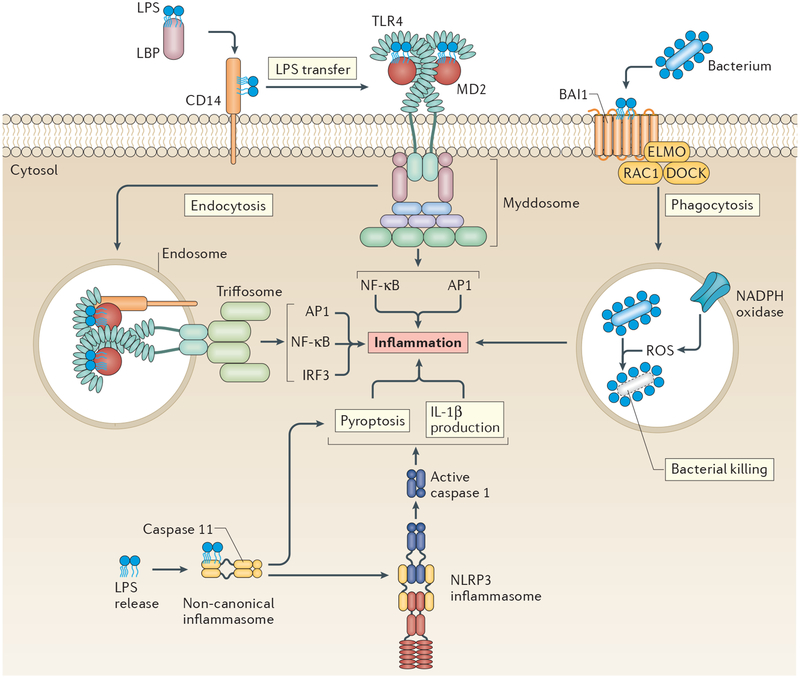
Figure 1 |
Figure 1 |. Four receptors induce five lipopolysaccharide response pathways to promote inflammation.
Lipopolysaccharide (LPS) is sensed at the plasma membrane initially by LPS-binding protein (LBP), which helps CD14 to extract this pathogen-associated molecular pattern (PAMP) from bacterial cell walls. CD14 then delivers LPS to Toll-like receptor 4 (TLR4)–MD2, prompting the dimerization and activation of TLR4, a process that leads to myddosome assembly. CD14 then delivers dimerized TLR4 to endosomes to promote TIR domain-containing adaptor protein inducing IFNβ (TRIF) signalling through the putative triffosome. Both pathways result in inflammation. Brain-specific angiogenesis inhibitor 1 (BAI1) also detects LPS at the plasma membrane and uses the engulfment and cell motility protein–dedicator of cytokinesis protein–RAC1 (ELMO–DOCK–RAC1) complex to promote phagocytosis, leading to reactive oxygen species (ROS) production and induction of inflammation. LPS that has reached the cytosol is bound by caspase 11, initiating formation of the non-canonical inflammasome and, in turn, pyroptosis. Caspase 11 activity also stimulates the formation of the canonical NLR family pyrin domain-containing protein 3 (NLRP3) inflammasome (solid arrow), which elicits interleukin-1β (IL-1β) processing and release. AP1, activator protein 1; IRF3, interferon regulatory factor 3; NF-κB, nuclear factor-κB.
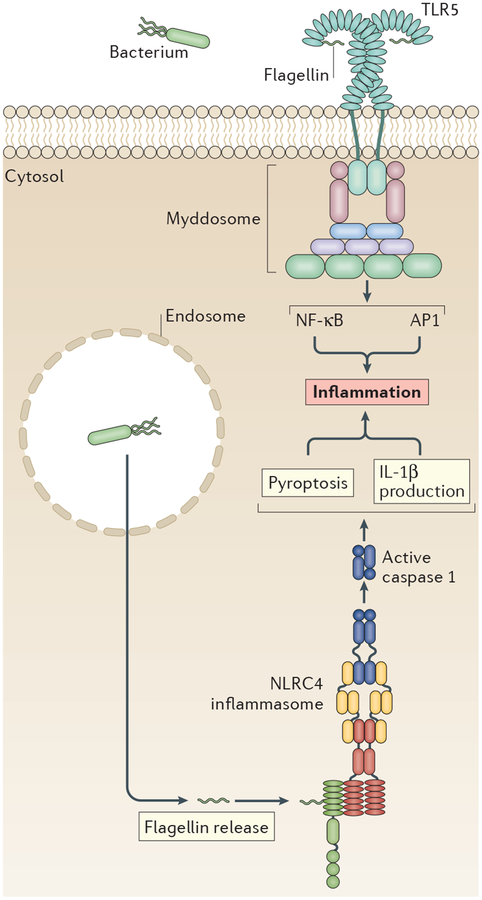
Figure 2 |
Figure 2 |. Three receptors stimulate two pathways to induce inflammatory responses to flagellin.
Flagellin, a subunit of the bacterial flagellum, is bound by Toll-like receptor 5 (TLR5) at the cell surface. Activated TLR5 is likely to stimulate cytokine production through the formation of a myddosome. TLR5 might be internalized after binding flagellin to elicit interferons (IFNs) through TIR domain-containing adaptor protein inducing IFNβ (TRIF), but further analysis is needed to determine whether this occurs and, if so, whether it is functionally important. Intracellular flagellin is bound by the pattern-recognition receptors (PRRs) neuronal apoptosis inhibitory protein 5 (NAIP5) and NAIP6, which induce assembly of the NLR family CARD-containing protein 4 (NLRC4)-dependent inflammasome. The secondary ASC adaptor is sometimes used by the NLRC4 inflammasome, although it may not always be required. AP1, activator protein 1; IL-1β, interleukin-1β; NF-κB, nuclear factor-κB.
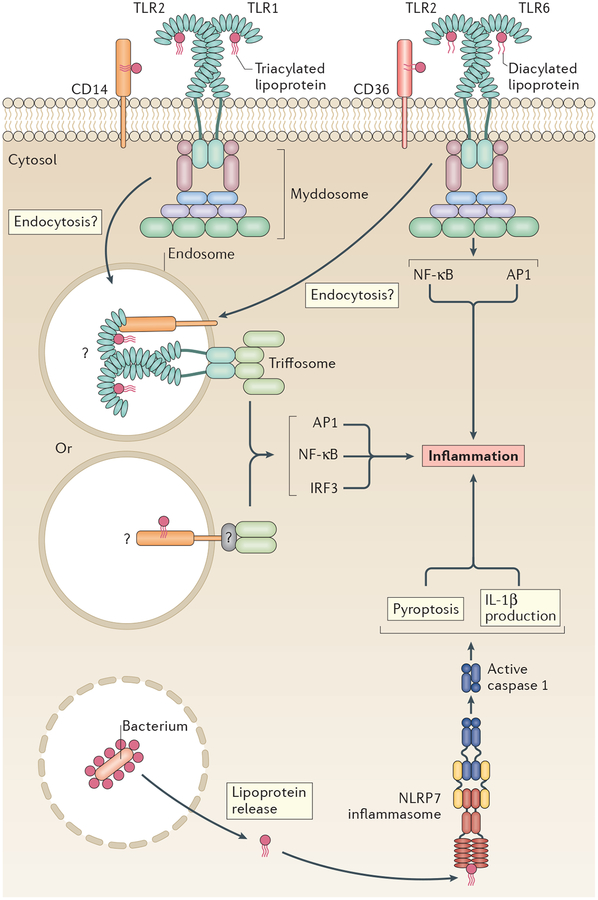
Figure 3 |
Figure 3 |. Three receptors and pathways induce inflammatory responses to lipoproteins.
Lipoproteins are detected at the plasma membrane by Toll-like receptor 2 (TLR2), TLR1 and TLR6, which form heterodimers. Their recognition of lipoproteins is assisted by the co-receptors CD14 and CD36. TLR2 heterodimers induce pro-inflammatory cytokines through a myddosome. Whether a robust interferon (IFN) response occurs downstream of TLR2 activation remains controversial (indicated by question marks), but it might occur through internalization of ligand bound to the CD14 or CD36 co-receptor, which would require an unidentified adaptor to interact with TIR domain-containing adaptor protein inducing IFNβ (TRIF) (indicated by a question mark). Alternatively, the TLR bound to ligand might be internalized, which could stimulate IFNs through the triffosome. Further experimentation is required to determine whether a robust IFN response occurs downstream of TLR2 (see main text). Intracellular lipoproteins stimulate the formation of an NLR family pyrin domain-containing protein 7 (NLRP7) inflammasome in human, but not murine, cells, leading to interleukin-1β (IL-1β) release and inflammation. AP1, activator protein 1; IRF3, interferon regulatory factor 3; NF-κB, nuclear factor-κB.
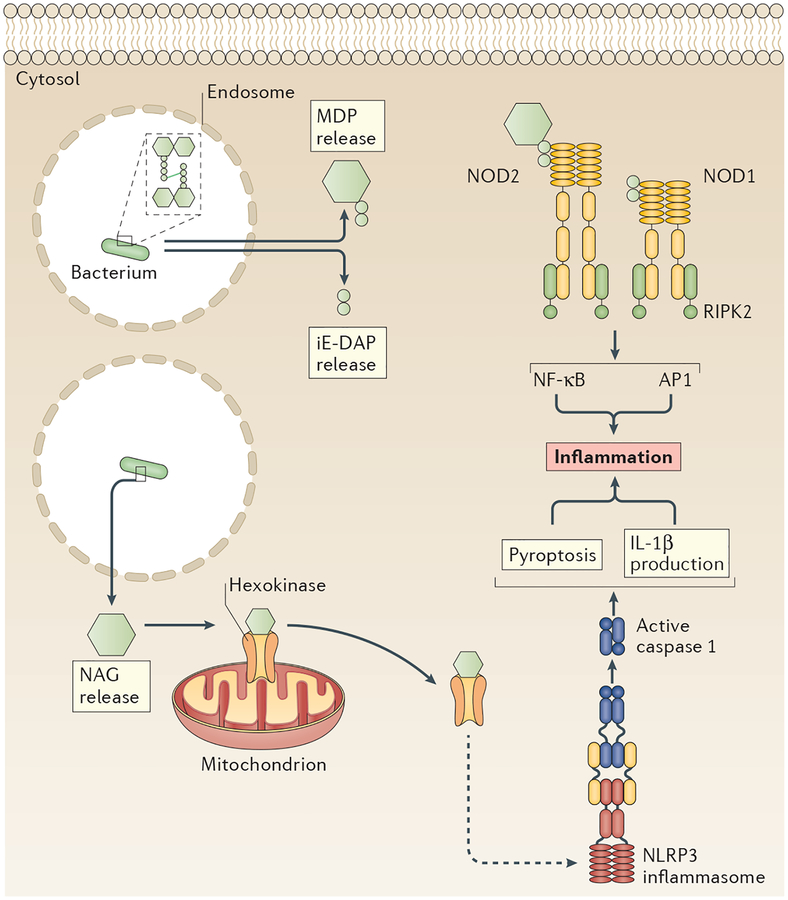
Figure 4 |
Figure 4 |. Three receptors and pathways induce inflammatory responses to peptidoglycan.
Intracellular peptidoglycan is detected by several pattern-recognition receptors (PRRs), including nucleotide-binding oligomerization domain-containing protein 1 (NOD1) and NOD2, which use a receptor-interacting serine/threonine-protein kinase 2 (RIPK2)-based putative supramolecular organizing centre (SMOC) to promote inflammation. NOD1 detects the iE-DAP dipeptide, whereas NOD2 detects muramyl dipeptide (MDP), both of which are peptidoglycan degradation products. Another peptidoglycan degradation product, N-acetyl glucosamine (NAG), indirectly induces assembly of the NLR family pyrin domain-containing protein 3 (NLRP3) inflammasome. NAG binds to the metabolic enzyme hexokinase and induces its dissociation from the mitochondrial membrane. This dissociation stimulates formation of an NLRP3 inflammasome through an unknown mechanism (dashed arrow). AP1, activator protein 1; IL-1β, interleukin-1β; NF-κB, nuclear factor-κB.

References

    1. Rakoff-Nahoum S, Paglino J, Eslami-Varzaneh F, Edberg S & Medzhitov R Recognition of commensal microflora by Toll-like receptors is required for intestinal homeostasis. Cell 118, 229–241 (2004). - PubMed
    1. Slack E et al. Innate and adaptive immunity cooperate flexibly to maintain host-microbiota mutualism. Science 325, 617–620 (2009). - PMC - PubMed
    1. Janeway CA Pillars article: approaching the asymptote? Evolution and revolution in immunology. Cold Spring Harb. Symp. Quant. Biol 54, 1–13 (1989). - PubMed
    1. Medzhitov R Approaching the asymptote: 20 years later. Immunity 30, 766–775 (2009). - PubMed
    1. Lemaitre B, Nicolas E, Michaut L, Reichhart JM & Hoffmann JA The dorsoventral regulatory gene cassette spätzle/Toll/cactus controls the potent antifungal response in Drosophila adults. Cell 86, 973–983 (1996). - PubMed

Substances