Review
. 2017 Apr;23(2):249-268.
doi: 10.1007/s12298-017-0422-2. Epub 2017 Mar 10.

Glutathione in plants: biosynthesis and physiological role in environmental stress tolerance

Affiliations
Review

Glutathione in plants: biosynthesis and physiological role in environmental stress tolerance

Mirza Hasanuzzaman et al. Physiol Mol Biol Plants. 2017 Apr.

Abstract

Glutathione (GSH; γ-glutamyl-cysteinyl-glycine) is a small intracellular thiol molecule which is considered as a strong non-enzymatic antioxidant. Glutathione regulates multiple metabolic functions; for example, it protects membranes by maintaining the reduced state of both α-tocopherol and zeaxanthin, it prevents the oxidative denaturation of proteins under stress conditions by protecting their thiol groups, and it serves as a substrate for both glutathione peroxidase and glutathione S-transferase. By acting as a precursor of phytochelatins, GSH helps in the chelating of toxic metals/metalloids which are then transported and sequestered in the vacuole. The glyoxalase pathway (consisting of glyoxalase I and glyoxalase II enzymes) for detoxification of methylglyoxal, a cytotoxic molecule, also requires GSH in the first reaction step. For these reasons, much attention has recently been directed to elucidation of the role of this molecule in conferring tolerance to abiotic stress. Recently, this molecule has drawn much attention because of its interaction with other signaling molecules and phytohormones. In this review, we have discussed the recent progress in GSH biosynthesis, metabolism and its role in abiotic stress tolerance.

Keywords: Antioxidant; Glyoxalase system; Oxidative stress; Phytochelatin; Reactive oxygen species; Thiol.


Conflict of interest statement

The authors declare no conflicts of interest.

Figures
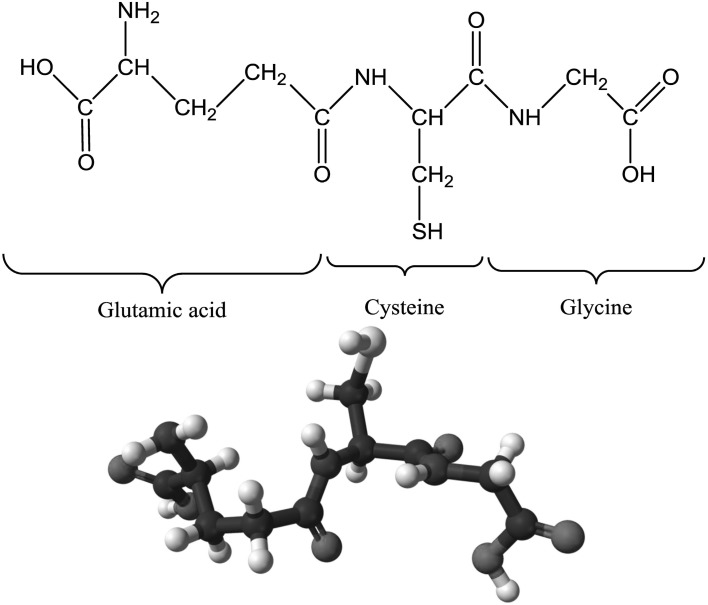
Fig. 1
Fig. 1
Chemical structure (above) and ball-and-stick model of the glutathione molecule, C10H17N3O6S
Fig. 2
Fig. 2
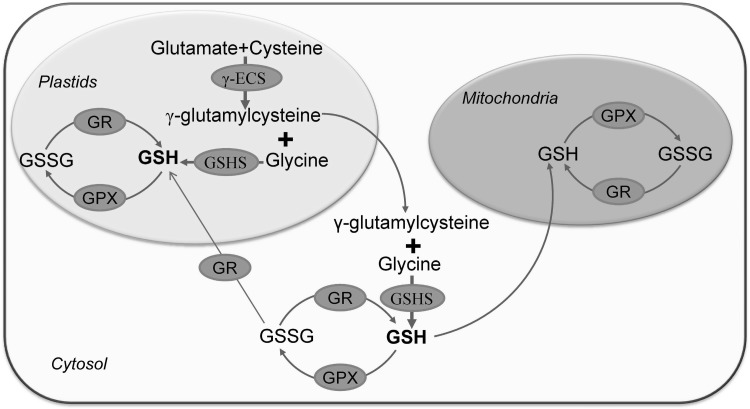
Biosynthesis and metabolism of glutathione. γ-glutamylcysteine synthetase (γ-ECS). First step (in plastid): Glutamate and cysteine together form γ-glutamylcysteine through a reaction catalyzed by the enzyme γ-ECS (γ-glutamylcysteine synthetase). Second step (in cytosol or in plastid): γ-glutamylcysteine and glycine bond together to form GSH via a reaction catalyzed by GSHS: glutathione synthase. The synthesized GSH can be utilized by cellular organelles like the plastids or mitochondria or in the cytosol. GSH participates in ROS scavenging and is converted into GSSG by the enzyme GPX. GSSG can be reconverted/recycled again into GSH by the activity of GR. Nahar et al. (2016b), with Permission from Wiley
Fig. 3
Fig. 3
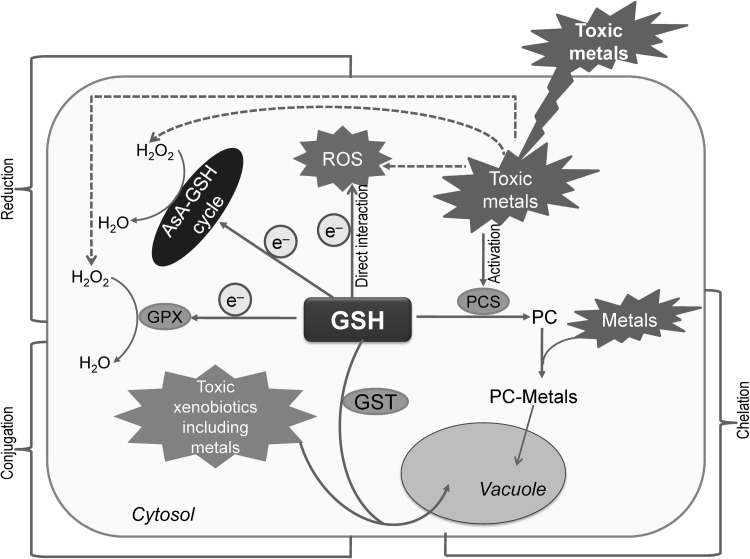
GSH mediated toxic metal and xenobiotic detoxification in a plant cell; PC: phytochelatin, PCS: phytochelatin synthase. Dotted arrows indicate the induction of ROS production. Protection of plant cells from metal/metalloid toxicity by GSH occurs in three possible ways: (1) reduction: direct quenching of ROS which is occurred by AsA-GSH cycle together with other components of antioxidant system, (2) conjugation: toxic metals/xenobiotics conjugation by the activity of glutathione S-transferase (GST) and transportation of conjugates into vacuole, (3) chelation: GSH acts as a precursor for the synthesis of phytochelatins (PC). Metals are bound to the thiol (–SH) group of GSH and forms PC by the activity of enzyme phytochelatin synthase (PCS, γ-Glu-Cys transpeptidase); the PC-Metal complex is also transported into the vacuole. Nahar et al. (2016b), with Permission from Wiley
Fig. 4
Fig. 4
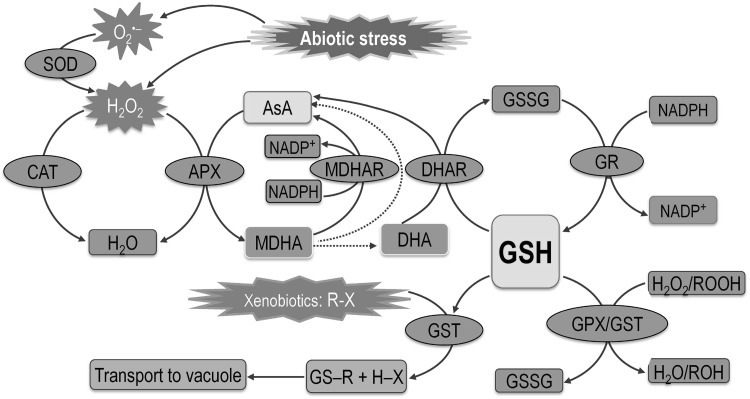
Mechanisms of ROS detoxification by different antioxidant enzymes. AsA-GSH cycle consist of AsA (ascorbate) and GSH (glutathione), and antioxidant enzymes APX (ascorbate peroxidase), MDHAR (monodehydroascorbate reductase), DHAR (dehydroascorbate reductase), GR (glutathione reductase). MDHA-monodehydroascorbate, DHA-dehydroascorbate. Dotted lines denote non-enzymatic conversions. R may be an aliphatic, aromatic, or heterocyclic group; X may be a sulfate, nitrite, or halide group. Abiotic stresses generate reactive oxygen species/ROS. The SOD (superoxide dismutase) is considered the first line of defense in the ROS detoxification process and converts O2·− to H2O2. This H2O2 can be converted to H2O by CAT (catalase) activity or H2O2 enters the AsA-GSH cycle, where APX, using AsA, converts H2O2 to H2O. While participating in the ROS detoxification process, AsA is oxidized to DHA (dehydroascorbate reductase). AsA is regenerated through the AsA-GSH cycle enzymes MDHAR and DHAR in a step-by-step reaction. In the AsA-GSH cycle, GSH takes part in detoxification of ROS (by the activity of enzyme GPX/glutathione peroxidase or GST/glutathione-S-transferase) or xenobiotics (by the activity of GST). The GSH is converted into GSSG (glutathione disulfide) during ROS detoxification and this GSSG is recycled again to GSH by the activity of GR. Adapted from Hasanuzzaman et al. (2012a)
Fig. 5
Fig. 5
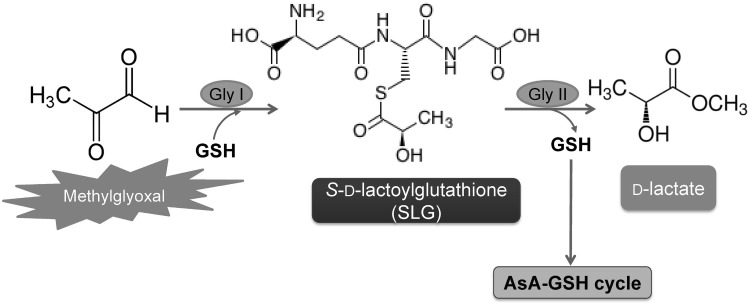
Roles of glutathione in methylglyoxal (MG) detoxification. First step: The enzyme GlyI (glyoxalase-I) utilizes GSH to convert MG to S-d-lactoylglutathione (SLG). Second step: S-d-lactoylglutathione (SLG) is converted to d-lactate by the activity of GlyII (glyoxalase-II) and GSH is regenerated in this step
Fig. 6
Fig. 6
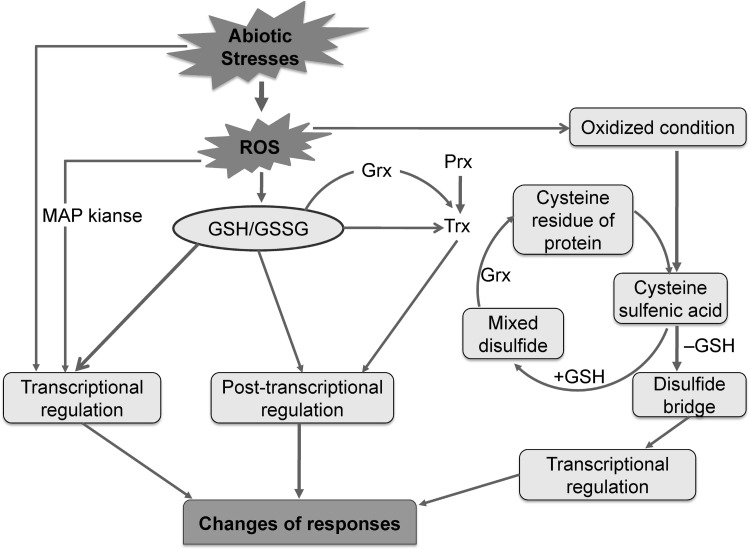
Schematic representation of GSH induced signal transmission under abiotic stress condition. Several pathways are proposed for signal transmission by GSH. Stress induced ROS and the subsequent stress signal may be transmitted through a mitogen activated protein (MAP) kinase cascade to modulate transcriptional regulation. The GSH/GSSG redox system can control redox signaling and can directly participate in transcriptional regulation. Oxidative stressand GSH/GSSG-modulated glutathionylation has been confirmed for a number of proteins including Grx (glutaredoxin) and several GSTs. Redox changes in Trxs (thioredoxin) are important because they target the intercellular disulfide bonds of proteins. Trxs are inactivated by glutathionylation. The reduction of Trxs may be regulated by GPXs (glutathione peroxidases) and Prxs (peroxiredoxins). Trxs can also be activated by deglutathionylation, which is activated by Grxs (glutaredoxins, members of the Trx superfamily). Trx and the GSH/Grx redox systems have important roles in signaling. Interactions between GSH, GSH/GSSG, Trx, Grx, and Prx in stress signaling pathways still require intensive study. Glutathione directly or indirectly regulates the transcriptional or post-translational processes by interacting with other redox systems. Abiotic stress generates ROS/oxidative conditions in the cell. The oxidative environment helps to convert cysteine residues of proteins into cysteine sulfenic acid, which is regulated by GSH and Grx (glutaredoxin). Oxidation of protein then occurs by conversion of cysteine sulfenic acid into cysteine sulfinic acid and cysteine sulfonic acid. Deglutathionization of the cysteine sulfenic acid then occurs to form the disulfide bridge, which transmits the oxidative stress signal to regulate transcriptional factors. Nahar et al. (2016a), with Permission from Wiley

References

    1. Akter N, Sobahan MA, Uraji M, Ye W, Hossain MA, Mori IC, Nakamura Y, Murata Y. Effects of depletion of glutathione on abscisic acid- and methyl jasmonate-induced stomatal closure in Arabidopsis thaliana. Biosci Biotechnol Biochem. 2012;76:2032–2037. doi: 10.1271/bbb.120384. - DOI - PubMed
    1. Alam MM, Hasanuzzaman M, Nahar K, Fujita M. Exogenous salicylic acid ameliorates short-term drought stress in mustard (Brassica juncea L.) seedlings by up-regulating the antioxidant defense and glyoxalase system. Aust J Crop Sci. 2013;7:1053–1063.
    1. Aravind P, Prasad MNV. Modulation of cadmium-induced oxidative stress in Ceratophyllum demersum by zinc involves ascorbate–glutathione cycle and glutathione metabolism. Plant Physiol Biochem. 2005;43:107–116. doi: 10.1016/j.plaphy.2005.01.002. - DOI - PubMed
    1. Asada K. Production and action of active oxygen species in photosynthetic tissues. In: Foyer CH, Mullineaux PM, editors. Causes of photooxidative stress and amelioration of defense systems in plants. Boca Raton: CRC Press; 1994. pp. 77–104.
    1. Barroso JB, Corpa FJ, Carreras A, Rodriguez-Serrano M, Esteban FJ, Fernandez-Ocana A, Chaki M, Romero-Puertas MC, Valderrama R, Sandalio LM, del Rio LA. Localization of S-nitrosoglutathione and expression of S-nitrosoglutathione reductase in pea plants under cadmium stress. J Exp Bot. 2006;57:1785–1793. doi: 10.1093/jxb/erj175. - DOI - PubMed