Review
. 2017 Mar 13;1(10):368-374.
doi: 10.1302/2058-5241.1.000051. eCollection 2016 Oct.

Gait analysis of patients with knee osteoarthritis highlights a pathological mechanical pathway and provides a basis for therapeutic interventions

Affiliations
Review

Gait analysis of patients with knee osteoarthritis highlights a pathological mechanical pathway and provides a basis for therapeutic interventions

Julien Favre et al. EFORT Open Rev. .

Abstract

Knee osteoarthritis (OA) is a painful and incapacitating disease affecting a large portion of the elderly population, for which no cure exists. There is a critical need to enhance our understanding of OA pathogenesis, as a means to improve therapeutic options.Knee OA is a complex disease influenced by many factors, including the loading environment. Analysing knee biomechanics during walking - the primary cyclic load-bearing activity - is therefore particularly relevant.There is evidence of meaningful differences in the knee adduction moment, flexion moment and flexion angle during walking between non-OA individuals and patients with medial knee OA. Furthermore, these kinetic and kinematic gait variables have been associated with OA progression.Gait analysis provides the critical information needed to understand the role of ambulatory biomechanics in OA development, and to design therapeutic interventions. Multidisciplinary research is necessary to relate the biomechanical alterations to the structural and biological components of OA. Cite this article: Favre J, Jolles BM. Analysis of gait, knee biomechanics and the physiopathology of knee osteoarthritis in the development of therapeutic interventions. EFORT Open Rev 2016;1:368-374. DOI: 10.1302/2058-5241.1.000051.

Keywords: adduction moment; ambulatory mechanics; flexion angle; flexion moment; gait analysis; knee; osteoarthritis.


Conflict of interest statement

Conflict of Interest: No interests declared.

Figures
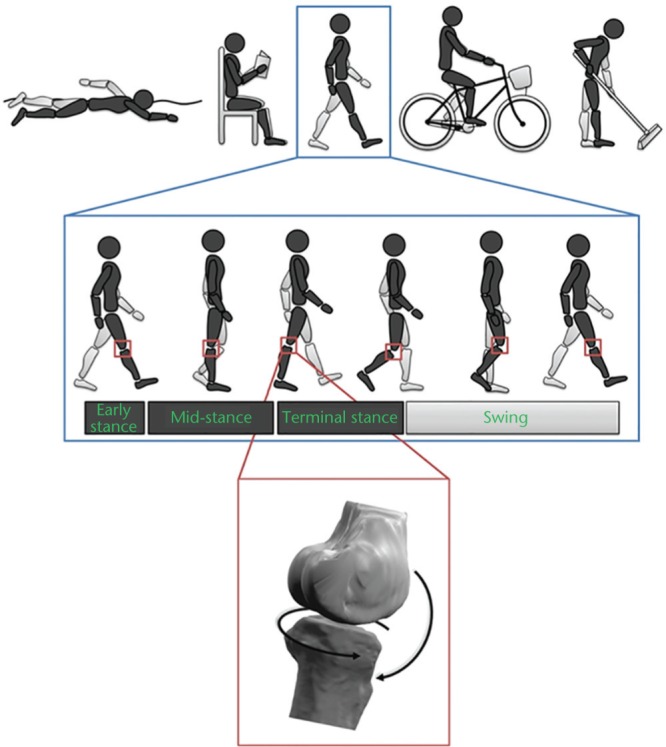
Fig. 1
Fig. 1
Quantifying three-dimensional ambulatory biomechanics is critical to understand knee osteoarthritis. Combining the results of prior research indentifying some occupations and sport activities as risk factors for knee osteoarthritis (OA) with the results suggesting that the intensity of physical activity is not associated with the risks of OA development in the general population, indicates the need for gait analysis in order to better understand the mechanical pathway leading to knee OA. While an overall description of the ambulatory function using spatio-temporal parameters is enough to study numerous pathologies, such parameters are not specific enough to detect the subtle biomechanical differences involved in knee OA. Consequently, gait analyses in the framework of knee OA were mostly based on three-dimensional kinetic and kinematic patterns.
Fig. 2
Fig. 2
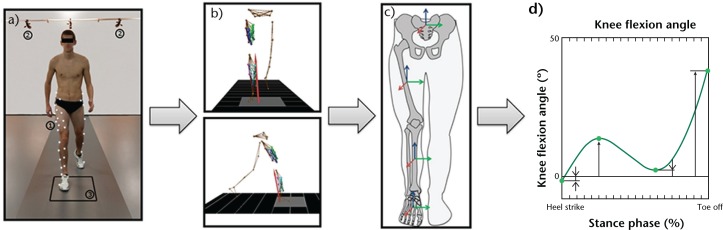
Illustration of a standard gait analysis procedure. a) A subject with reflective markers(1) walks in a gait laboratory instrumented with a network of cameras(2) and floor-mounted forceplates(3). b) The camera and forceplate signals are processed to determine the three-dimensional trajectories of the markers and the forces exchanged between the foot of the subject and the ground. c) Biomechanical modelling is performed to determine the dynamics of the pelvis, thigh, shank, and foot segments based on marker trajectories and force data. d) Descriptive modelling is carried out to quantify three-dimensional joint kinetics and kinematics according to clinically relevant variables, such as the knee flexion/extension angle. Finally, the continuous data over the entire walking trial are limited to a period of interest, for example a stance phase in the middle of the walkway, and the amplitude of characteristic peaks are measured.
Fig. 3
Fig. 3
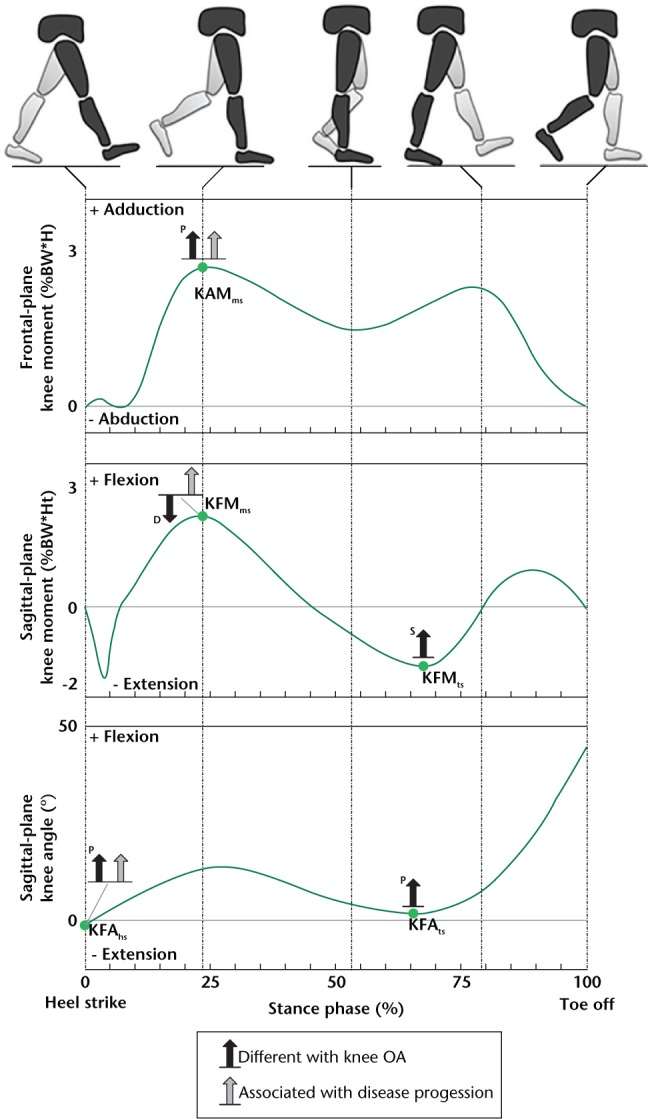
Overview of gait alterations consistently reported with medial knee OA. The black arrows indicate differences between groups of individuals at diverse stages of the disease, and the gray arrows indicate gait parameters which have been associated with OA progression in longitudinal studies. Please note that the gait alterations reported in this figure are the result of a conservative literature analysis and it is possible that additional alterations are important in OA but divergences among publications did not allow their identification. P, progressive differences from non-OA subjects to moderate and severe OA patients; D, differences between non-OA and OA individuals; S, differences between patients with severe knee OA and both non-OA individuals and moderate OA patients; KAM, knee adduction moment; KFM, knee flexion moment; KFA, knee flexion angle; hs, heel-strike; ms, mid-stance; ts, terminal stance.

References

    1. Yelin E, Murphy L, Cisternas MG, et al. Medical care expenditures and earnings losses among persons with arthritis and other rheumatic conditions in 2003, and comparisons with 1997. Arthritis Rheum 2007;56:1397-1407. - PMC - PubMed
    1. Helmick CG, Felson DT, Lawrence RC, et al. ; National Arthritis Data Workgroup. Estimates of the prevalence of arthritis and other rheumatic conditions in the United States. Part I. Arthritis Rheum 2008;58:15-25. - PubMed
    1. Lawrence RC, Felson DT, Helmick CG, et al. ; National Arthritis Data Workgroup. Estimates of the prevalence of arthritis and other rheumatic conditions in the United States. Part II. Arthritis Rheum 2008;58:26-35. - PMC - PubMed
    1. Andriacchi TP, Favre J, Erhart-Hledik JC, Chu CR. A systems analysis of knee osteoarthritis reveals new insights into the pathogenesis of the disease. Ann Biomed Eng 2015;43:376-387. - PMC - PubMed
    1. Andriacchi TP, Favre J. The nature of in vivo mechanical signals that influence cartilage health and progression to knee osteoarthritis. Curr Rheumatol Rep 2014;16:463. - PubMed

LinkOut - more resources