


Helicobacter pylori and cardiovascular complications: a mechanism based review on role of Helicobacter pylori in cardiovascular diseases
- PMID: 28462125
- PMCID: PMC5390428
- DOI: 10.1016/j.imr.2016.05.005
Helicobacter pylori and cardiovascular complications: a mechanism based review on role of Helicobacter pylori in cardiovascular diseases
Abstract
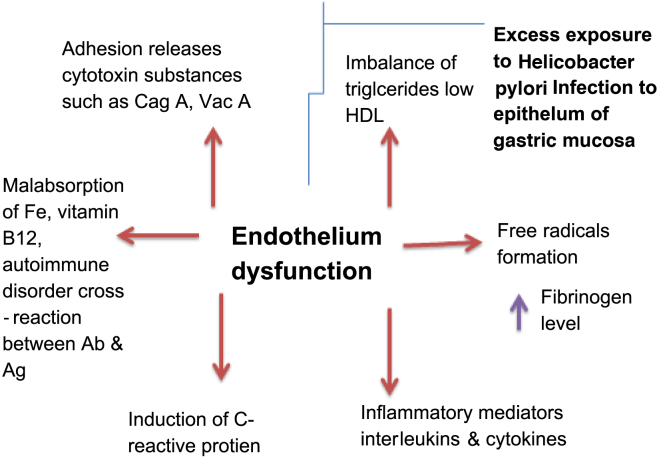
Heart disease comprises a wide class of cardiovascular abnormalities, including ischemic heart disease, myocardial infarction, atherosclerosis, and coronary artery disease. It is the leading cause of death all over the world. Several traditional and novel risk factors, such as infectious and noninfectious agents, have been associated with heart disease. Out of these, Helicobacter pylori has been recently introduced as an important etiological factor for heart disease. Numerous seroepidemiological findings observed H. pylori antibodies in the blood of a patient with cardiovascular complications. The bacteria survive in the epithelial cells of gastric organs and cause digestive complications. Excess inflammatory pathogenesis and prognosis stimulate an immune response that further causes significant disturbances in various factors like cytokines, fibrinogen, triglycerides, high density lipoprotein, C-reactive protein, heat shock protein, and white blood cell count, and provoke a number of problems such as atherosclerosis and prothrombic state, and cross-reactivity which eventually leads to heart diseases. H. pylori releases toxigenic nutrients, chiefly vacuolating cytotoxin gen A (Vac A) and cytotoxin associated gene A (Cag A), of which Cag A is more virulent and involved in the formation of cholesterol patches in arteries, induction of autoimmune disorder, and release of immune mediated response. Although numerous mechanisms have been correlated with H. pylori and heart disease, the exact role of bacteria is still ambiguous.
Keywords: Helicobacter pylori; atherosclerosis; cardiovascular diseases; heat shock protein; tumor necrosis factor.
Figures
References
-
- Strachan D.P., Mendall M.A., Carrington D., Path F.R.C., Butland B.K., Yarnell J.W.G. Relation of Helicobacter pylori infection to 13-year mortality and incident ischemic heart disease in the caerphilly prospective heart disease study. Circulation. 1998;98:1286–1290. - PubMed
-
- Eskandarian R., Moosavi S., Babai M., Toussy J., Ghorbani R., Malek M. Impact of Helicobacter pylori on prognosis of patients with acute coronary syndrome. Arya J. 2006;1:164–169.
-
- AL-Obeidy E.S., Saeed B.N. Helicobacter pylori in Iraq patient with ischemic heart disease. Fac Med Baghdad. 2011;53:29–31.
-
- Braunwald E., Zipes D.P., Libby P. 6th ed. W.B. Saunders Company; Philadelphiya: 2001. Heart Disease: A Textbook of Cardiovascular Medicine; p. 031.
-
- Torresa A.M., Gaensly M.M. Helicobacter pylori: A new cardiovascular risk factor. Rev Esp Cardiol. 2002;55:652–656. - PubMed
Publication types
LinkOut - more resources
Full Text Sources
Other Literature Sources
Research Materials
