


Reducing the CP content in broiler feeds: impact on animal performance, meat quality and nitrogen utilization
- PMID: 28462773
- PMCID: PMC5645801
- DOI: 10.1017/S1751731117000660
Reducing the CP content in broiler feeds: impact on animal performance, meat quality and nitrogen utilization
Abstract
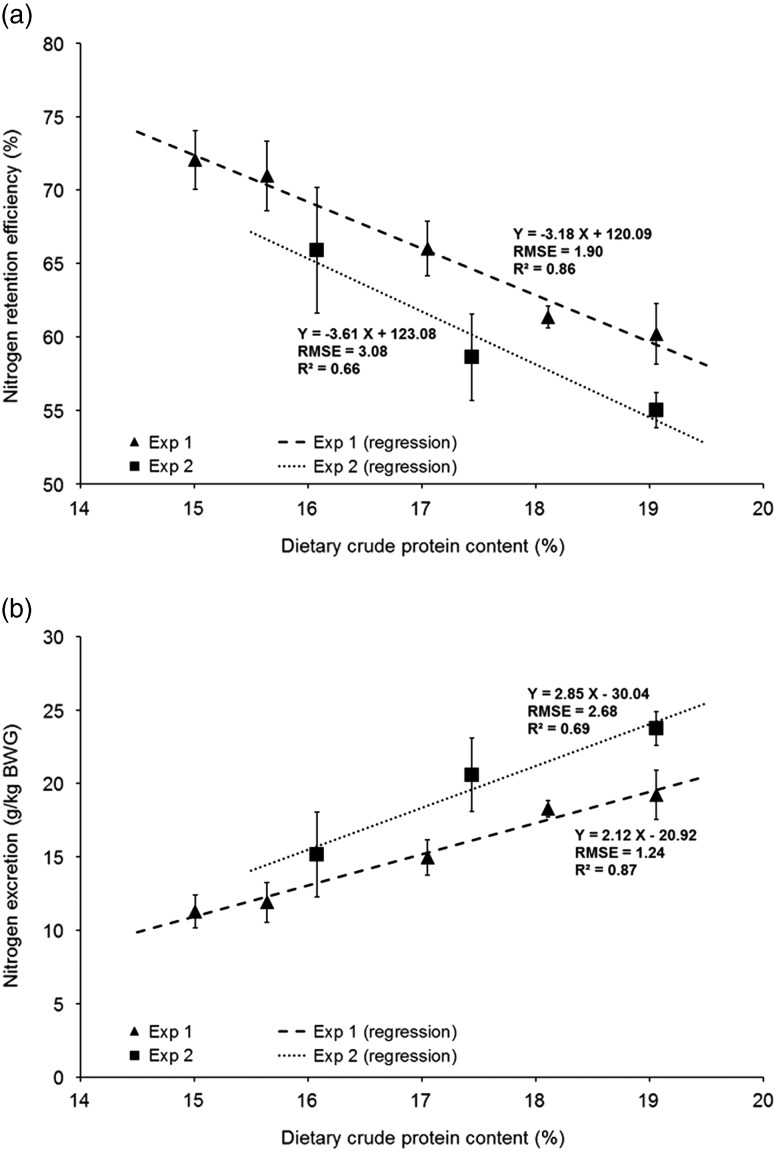
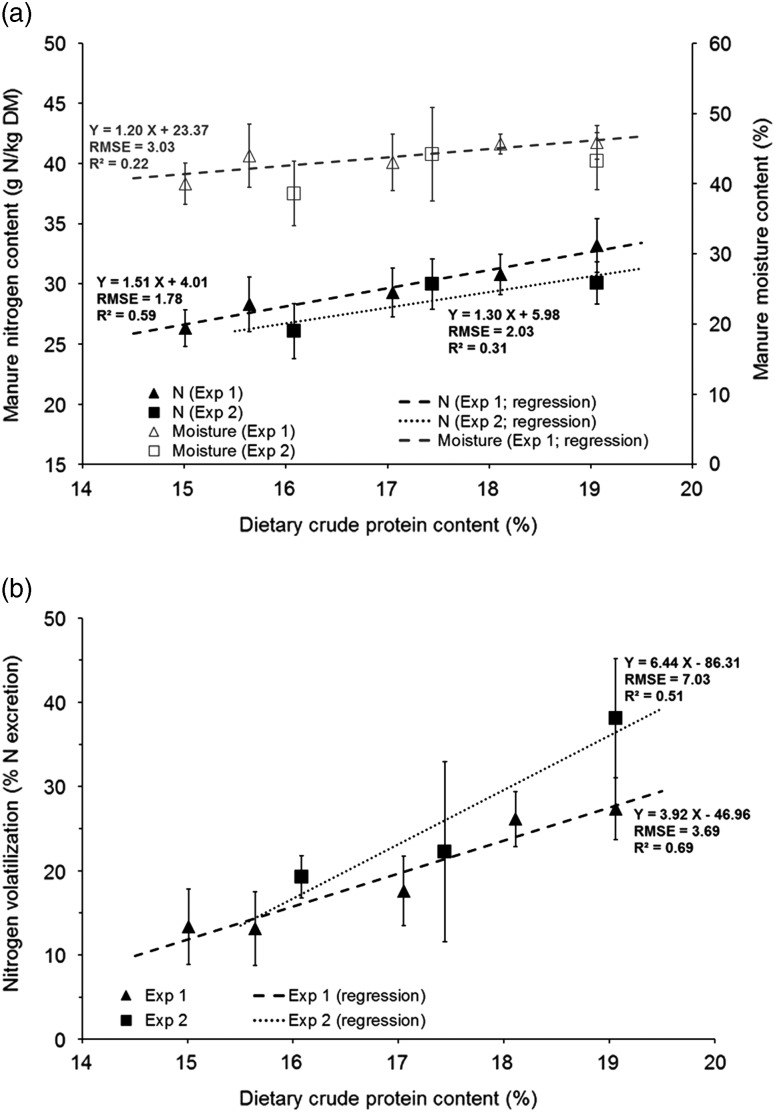
Reducing the dietary CP content is an efficient way to limit nitrogen excretion in broilers but, as reported in the literature, it often reduces performance, probably because of an inadequate provision in amino acids (AA). The aim of this study was to investigate the effect of decreasing the CP content in the diet on animal performance, meat quality and nitrogen utilization in growing-finishing broilers using an optimized dietary AA profile based on the ideal protein concept. Two experiments (1 and 2) were performed using 1-day-old PM3 Ross male broilers (1520 and 912 for experiments 1 and 2, respectively) using the minimum AA:Lys ratios proposed by Mack et al. with modifications for Thr and Arg. The digestible Thr (dThr): dLys ratio was increased from 63% to 68% and the dArg:dLys ratio was decreased from 112% to 108%. In experiment 1, the reduction of dietary CP from 19% to 15% (five treatments) did not alter feed intake or BW, but the feed conversion ratio was increased for the 16% and 15% CP diets (+2.4% and +3.6%, respectively), while in experiment 2 (three treatments: 19%, 17.5% and 16% CP) there was no effect of dietary CP on performance. In both experiments, dietary CP content did not affect breast meat yield. However, abdominal fat content (expressed as a percentage of BW) was increased by the decrease in CP content (up to +0.5 and +0.2 percentage point, in experiments 1 and 2, respectively). In experiment 2, meat quality traits responded to dietary CP content with a higher ultimate pH and lower lightness and drip loss values for the low CP diets. Nitrogen retention efficiency increased when reducing CP content in both experiments (+3.5 points/CP percentage point). The main consequence of this higher efficiency was a decrease in nitrogen excretion (-2.5 g N/kg BW gain) and volatilization (expressed as a percentage of excretion: -5 points/CP percentage point). In conclusion, this study demonstrates that with an adapted AA profile, it is possible to reduce dietary CP content to at least 17% in growing-finishing male broilers, without altering animal performance and meat quality. Such a feeding strategy could therefore help improving the sustainability of broiler production as it is an efficient way to reduce environmental burden associated with nitrogen excretion.
Keywords: broiler; environment; low-protein diet; meat quality; performance.
Figures
References
-
- Aletor VA, Hamid II, Nieß E and Pfeffer E 2000. Low-protein amino acid-supplemented diets in broiler chickens: effects on performance, carcass characteristics, whole-body composition and efficiencies of nutrient utilisation. Journal of the Science of Food and Agriculture 80, 547–554.
-
- Alleman F and Leclercq B 1997. Effect of dietary protein and environmental temperature on growth performance and water consumption of male broiler chickens. British Poultry Science 38, 607–610. - PubMed
-
- Alnahhas N, Berri C, Boulay M, Baéza E, Jégo Y, Baumard Y, Chabault M and Le Bihan-Duval E 2014. Selecting broiler chickens for ultimate pH of breast muscle: analysis of divergent selection experiment and phenotypic consequences on meat quality, growth, and body composition traits. Journal of Animal Science 92, 3816–3824. - PubMed
-
- Berres J, Vieira SL, Dozier WA, Cortês MEM, de Barros R, Nogueira ET and Kutschenko M 2010. Broiler responses to reduced-protein diets supplemented with valine, isoleucine, glycine, and glutamic acid. Journal of Applied Poultry Research 19, 68–79.
-
- Berri C, Besnard J and Relandeau C 2008. Increasing dietary lysine increases final pH and decreases drip loss of broiler breast meat. Poultry Science 87, 480–844. - PubMed
MeSH terms
Substances
LinkOut - more resources
Full Text Sources
Other Literature Sources
Medical
Miscellaneous
