


Directly converting CO2 into a gasoline fuel
- PMID: 28462925
- PMCID: PMC5418575
- DOI: 10.1038/ncomms15174
Directly converting CO2 into a gasoline fuel
Erratum in
-
Erratum: Directly converting CO2 into a gasoline fuel.Nat Commun. 2017 Oct 12;8:16170. doi: 10.1038/ncomms16170. Nat Commun. 2017. PMID: 29022568 Free PMC article.
Abstract
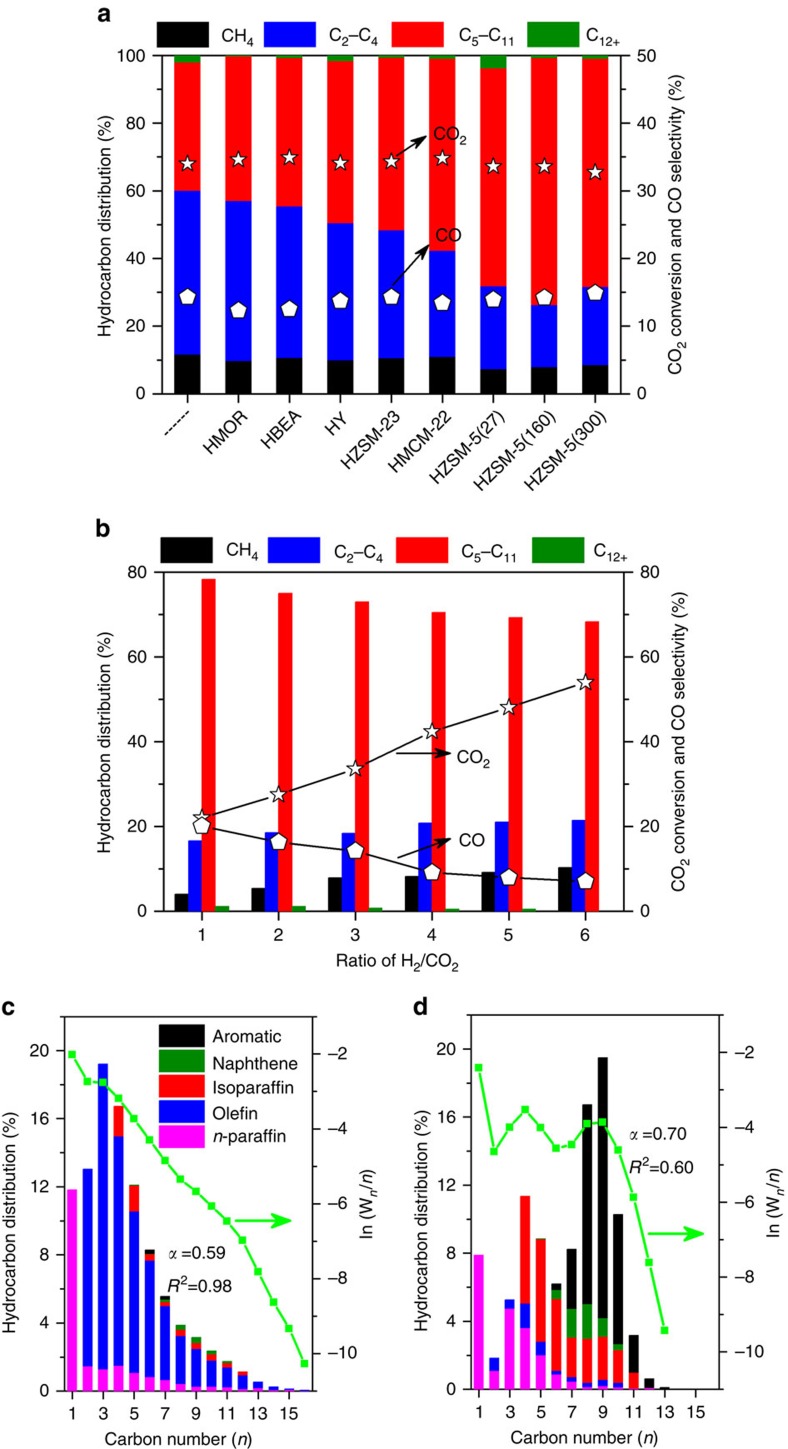
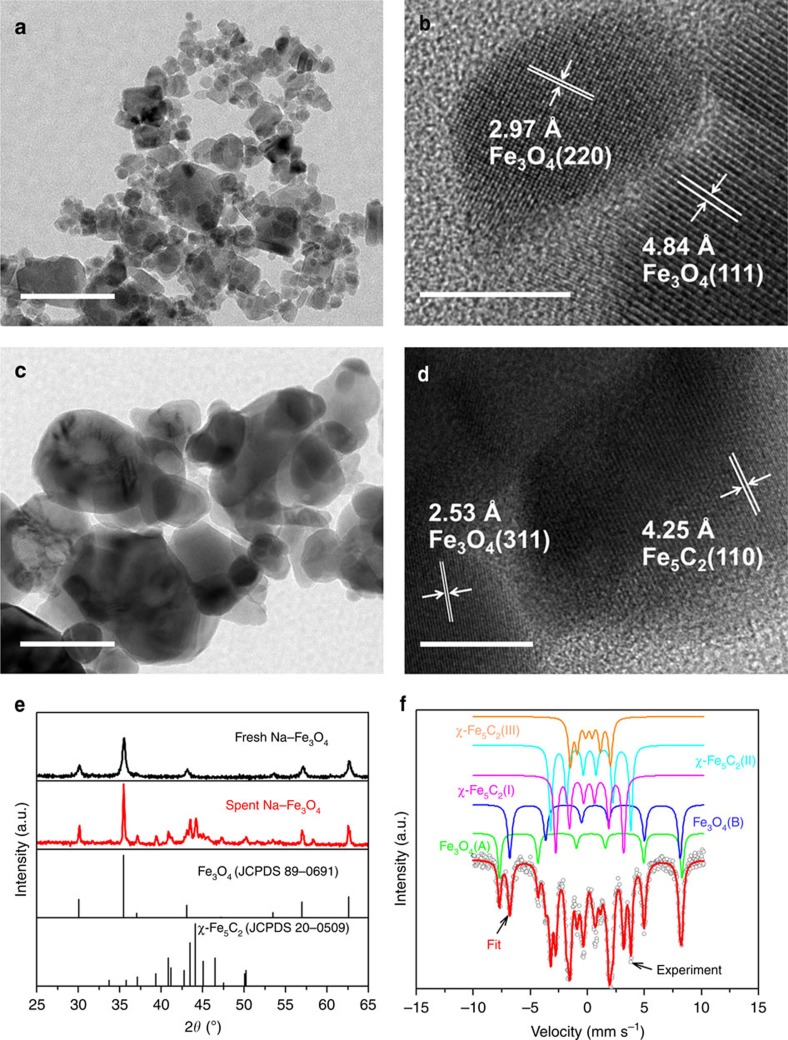
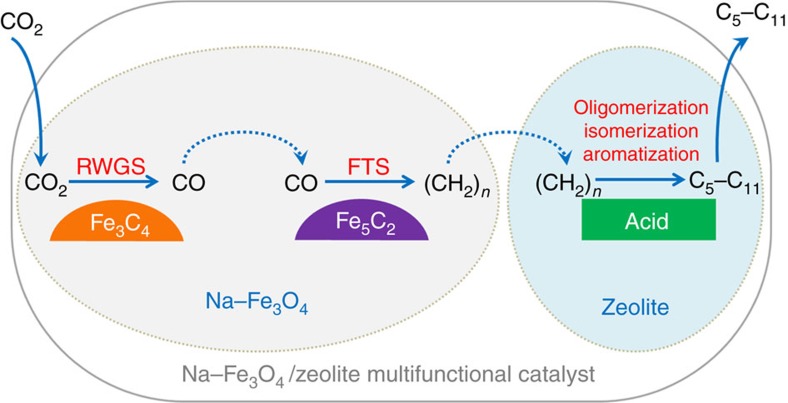
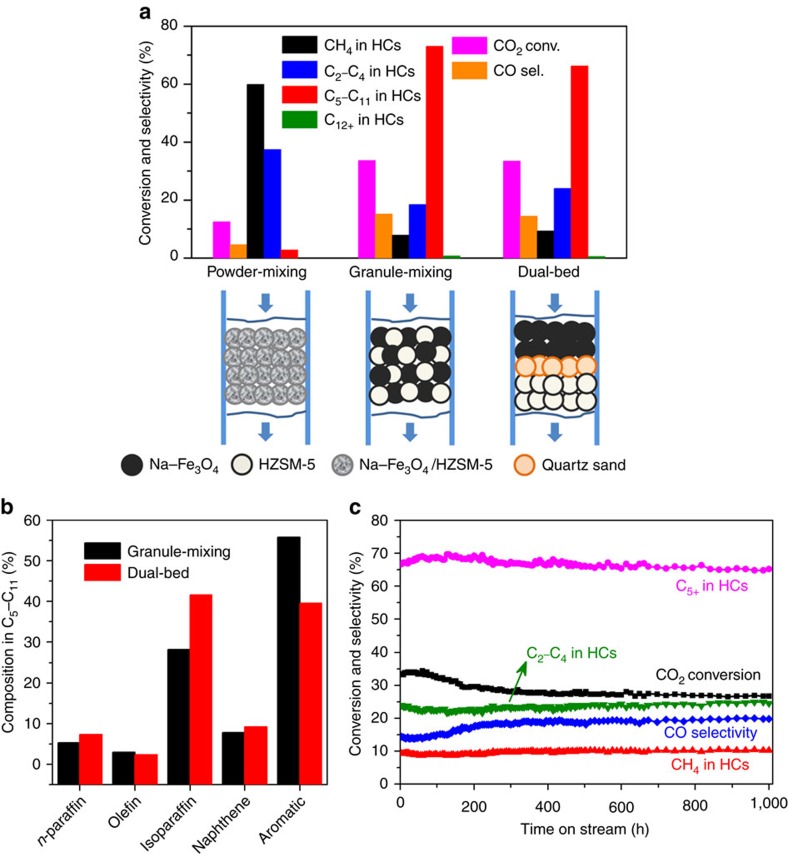
The direct production of liquid fuels from CO2 hydrogenation has attracted enormous interest for its significant roles in mitigating CO2 emissions and reducing dependence on petrochemicals. Here we report a highly efficient, stable and multifunctional Na-Fe3O4/HZSM-5 catalyst, which can directly convert CO2 to gasoline-range (C5-C11) hydrocarbons with selectivity up to 78% of all hydrocarbons while only 4% methane at a CO2 conversion of 22% under industrial relevant conditions. It is achieved by a multifunctional catalyst providing three types of active sites (Fe3O4, Fe5C2 and acid sites), which cooperatively catalyse a tandem reaction. More significantly, the appropriate proximity of three types of active sites plays a crucial role in the successive and synergetic catalytic conversion of CO2 to gasoline. The multifunctional catalyst, exhibiting a remarkable stability for 1,000 h on stream, definitely has the potential to be a promising industrial catalyst for CO2 utilization to liquid fuels.
Conflict of interest statement
The authors declare no competing financial interests.
Figures
References
-
- Olah G. A., Goeppert A. & Prakash G. S. Chemical recycling of carbon dioxide to methanol and dimethyl ether: from greenhouse gas to renewable, environmentally carbon neutral fuels and synthetic hydrocarbons. J. Org. Chem. 74, 487–498 (2008). - PubMed
-
- Dorner R. W., Hardy D. R., Williams F. W. & Willauer H. D. Heterogeneous catalytic CO2 conversion to value-added hydrocarbons. Energy Environ. Sci. 3, 884–890 (2010).
-
- Centi G., Quadrelli E. A. & Perathoner S. Catalysis for CO2 conversion: a key technology for rapid introduction of renewable energy in the value chain of chemical industries. Energy Environ. Sci. 6, 1711–1731 (2013).
-
- Porosoff M. D., Yan B. & Chen J. G. Catalytic reduction of CO2 by H2 for synthesis of CO, methanol and hydrocarbons: challenges and opportunities. Energy Environ. Sci. 9, 62–73 (2016).
-
- Lu Q. et al. A selective and efficient electrocatalyst for carbon dioxide reduction. Nat. Commun. 5, 3242 (2014). - PubMed
Publication types
LinkOut - more resources
Full Text Sources
Other Literature Sources
