


Meniscal Tissue Engineering Using Aligned Collagen Fibrous Scaffolds: Comparison of Different Human Cell Sources
- PMID: 28463545
- PMCID: PMC5770095
- DOI: 10.1089/ten.TEA.2016.0205
Meniscal Tissue Engineering Using Aligned Collagen Fibrous Scaffolds: Comparison of Different Human Cell Sources
Abstract
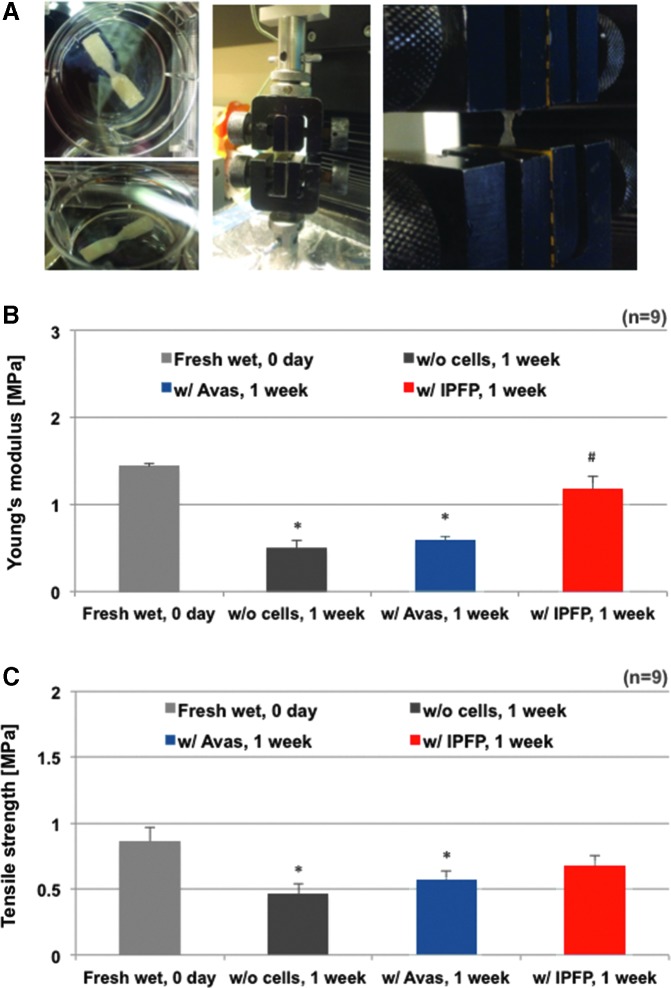
Hydrogel and electrospun scaffold materials support cell attachment and neotissue development and can be tuned to structurally and mechanically resemble native extracellular matrix by altering either electrospun fiber or hydrogel properties. In this study, we examined meniscus tissue generation from different human cell sources including meniscus cells derived from vascular and avascular regions, human bone marrow-derived mesenchymal stem cells, synovial cells, and cells from the infrapatellar fat pad (IPFP). All cells were seeded onto aligned electrospun collagen type I scaffolds and were optionally encapsulated in a tricomponent hydrogel. Single or multilayered constructs were generated and cultivated in defined medium with selected growth factors for 2 weeks. Cell viability, cell morphology, and gene-expression profiles were monitored using confocal microscopy, scanning electron microscopy, and quantitative polymerase chain reaction (qPCR), respectively. Multilayered constructs were examined with histology, immunohistochemistry, qPCR, and for tensile mechanical properties. For all cell types, TGFβ1 and TGFβ3 treatment increased COL1A1, COMP, Tenascin C (TNC), and Scleraxis (SCX) gene expression and deposition of collagen type I protein. IPFP cells generated meniscus-like tissues with higher meniscogenic gene expression, mechanical properties, and better cell distribution compared to other cell types studied. We show proof of concept that electrospun collagen scaffolds support neotissue formation and IPFP cells have potential for use in cell-based meniscus regeneration strategies.
Keywords: adult stem cells; biomimetic materials; meniscus.
Conflict of interest statement
No competing financial interests exist.
Figures


References
-
- Sweigart M.A., and Athanasiou K.A. Toward tissue engineering of the knee meniscus. Tissue Eng 7, 111, 2001 - PubMed
-
- Baker P., Coggon D., Reading I., Barrett D., McLaren M., and Cooper C. Sports injury, occupational physical activity, joint laxity, and meniscal damage. J Rheumatol 3, 557, 2002 - PubMed
-
- Boyd K.T., and Myers P.T. Meniscus preservation; rationale, repair techniques and results. Knee 10, 1, 2003 - PubMed
-
- Poulsen M.R., and Johnson D.L. Meniscal injuries in the young, athletically active patient. Phys Sportsmed 39, 123, 2011 - PubMed
-
- Setton L.A., Guilak F., Hsu E.W., and Vail T.P. Biomechanical factors in tissue engineered meniscal repair. Clin Orthop Relat Res 367(Suppl), S254, 1999 - PubMed
Publication types
MeSH terms
Substances
Grants and funding
LinkOut - more resources
Full Text Sources
Other Literature Sources
Miscellaneous
